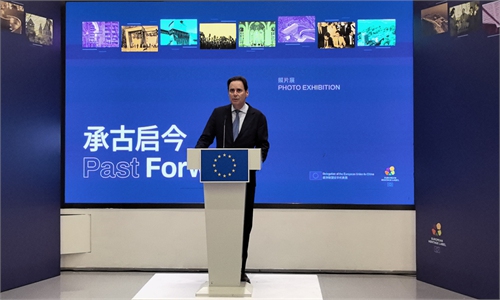
‘Navigating beyond the inflection point’ forum held: EU-China conference calls for dialogue amid global shifts
‘Navigating beyond the inflection point’ forum held
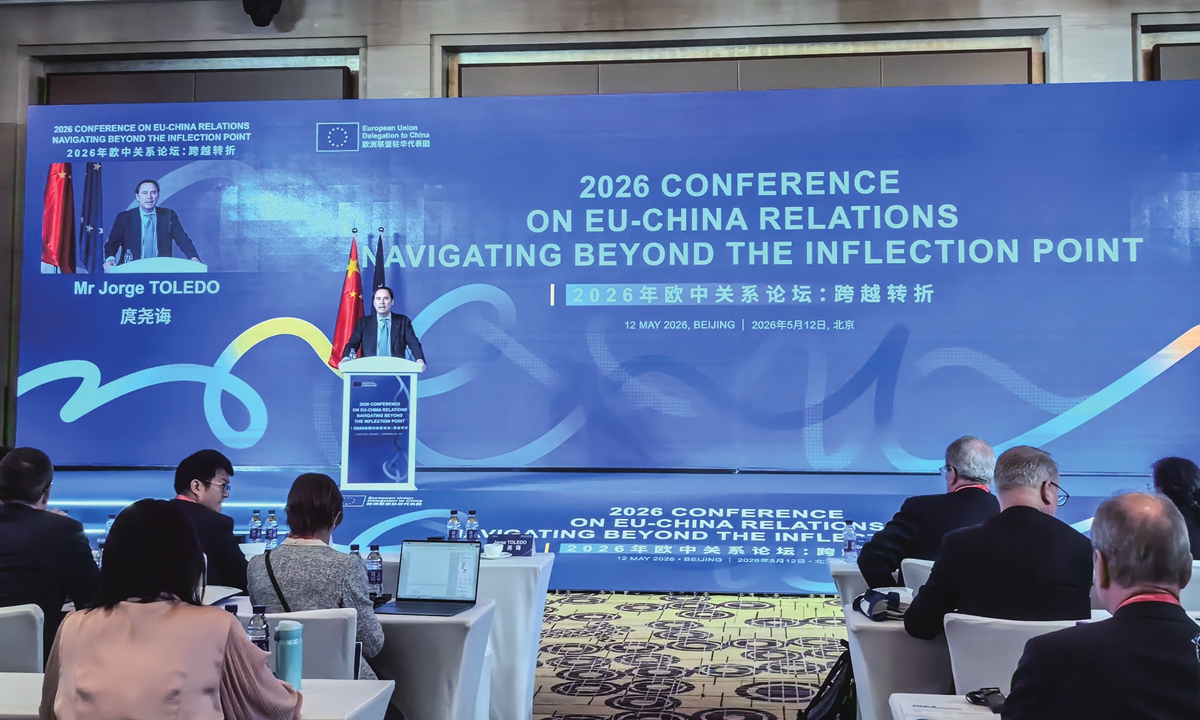
EU Ambassador to China Jorge Toledo delivers a speech at the second EU-China Conference in Beijing on May 12, 2026. Photo: Dong Feng/GT
The Delegation of the European Union in China hosted the second EU-China Conference in Beijing on Tuesday. Under the theme "navigating beyond the inflection point," the forum hosted more than 500 delegates from various sectors, advocating for dialogue as the only viable path to advance bilateral ties, push for greater reciprocity, fairness and rebalancing in EU-China relations.With its inauguration edition held in May 2025 to mark the 50th anniversary of establishment of EU-China diplomatic relations, this second edition aims to offer a platform and host constructive, open dialogue between EU and Chinese stakeholders to narrow differences in perspectives and expectations.
EU Ambassador to China Jorge Toledo said in his keynote speech "Let this conference help us to look beyond the inflection point to understand the choices before us and to contribute modestly, but seriously to a more stable, balanced and cooperative forward-looking EU-China relations." He affirmed that the EU and China agreed on a joint statement of climate change.
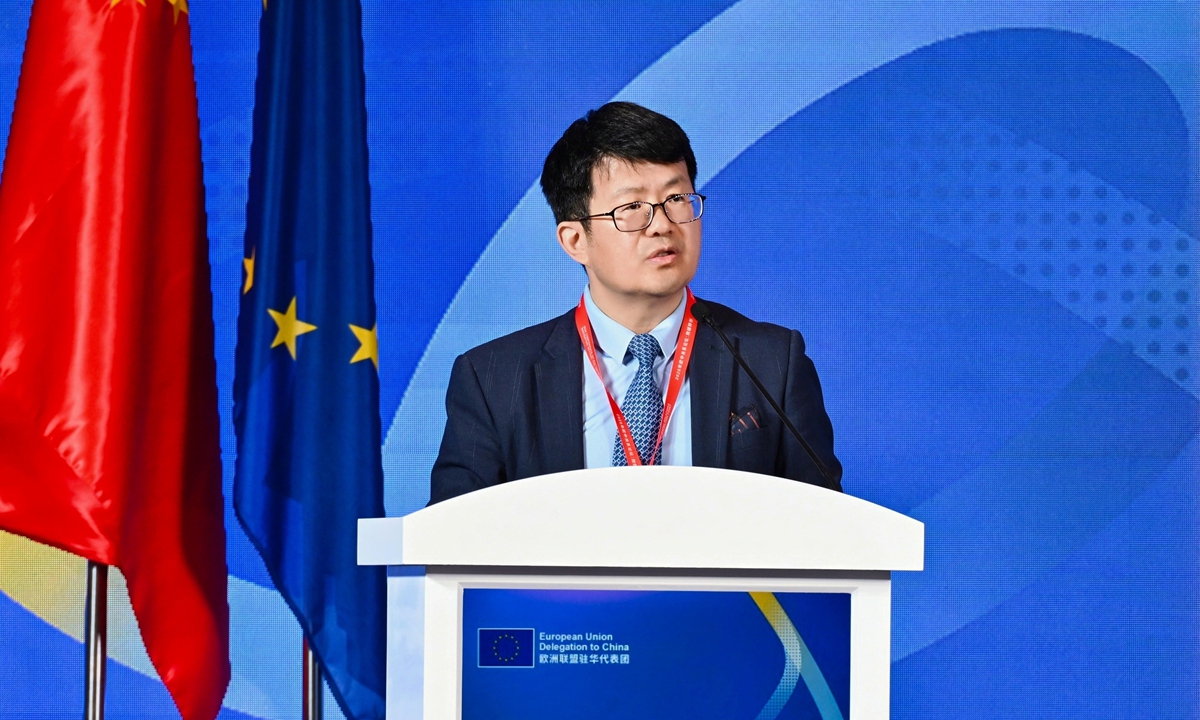
Director-General of the Department of European Affairs of the Foreign Ministry Li Jian gives a keynote speech at the 2026 Conference on EU-China relations: Navigating beyond the Inflection Point in Beijing on May 12, 2026. Photo: Courtesy of the Delegation of the European Union in China
Director-General of the Department of European Affairs of the Foreign Ministry Li Jian said in his keynote speech that "China-EU's industrial and supply chains are deeply intertwined, and they both have a rich history and culture. We have 100 reasons to improve China-EU relations, and not a single reason to fail," Li stressed.China-EU relations are not only crucial to the prosperity of Eurasia but also to the stability of the global order, he said.
The more turbulent the international situation and the more prominent the global challenges, the more significant the global implications of China-EU relations become, Li added.
Erik Kurzweil, Managing Director of the Asia-Pacific Department of the European External Action Service, echoed Li's view while sharing his thoughts on the prospects for the relations.
"The challenges we face - geopolitical tensions and uncertainty, economic instability, climate disruption - demand that we find a way to work together," said Kurzweil.
He elaborated that the question is "not whether we can afford to cooperate, but whether we can afford not to."
He underscored that, "the EU does not seek confrontation with China, nor do we advocate for decoupling. What we seek is a mature, balanced, and predictable relationship - one that recognizes our interdependence but also our distinct interests and values."
In the following panel discussions, delegates had in-depth exchanges over topics on EU-China trade relations, global security landscape, tech landscape, multilateralism for development and global green governance.
Jin Ling, director of the Department for Global Governance and International Organization Studies, China Institute of International Studies (CIIS), who is one of the panelists at the opening panel on EU-China relations, told the Global Times on site that China and the EU have different views on the causes of the trade and economic issues.
Both sides need to look beyond the surface disagreements to understand the underlying structural reasons, she said.
The EU has attributed China's advantages to policy subsidies, while China's advantages arise from market factors such as market size, innovation capabilities, and production costs, said Jin.
To consolidate the resilience of China-EU economic and trade relations, Jin believes that China and the EU need to maintain frequent high-level interaction, build consensus on global hotspot issues such as Middle East and green transformation, and achieve mutual benefit and win-win results by leveraging the comparative advantages of both sides.
At a panel focusing on tech landscape in the EU and China toward 2030, panelists explored the respective approaches of the EU and China to emerging technologies, including the EU's International Digital Strategy and China's 15th Five-Year Plan (2026-30).
When discussing the question on how the EU and China can support global green governance in these challenging times, panelists said the EU and China have managed waterways well, and such efforts can also be expanded to tackle the climate change and to put engineering talents together to help other countries around the world.
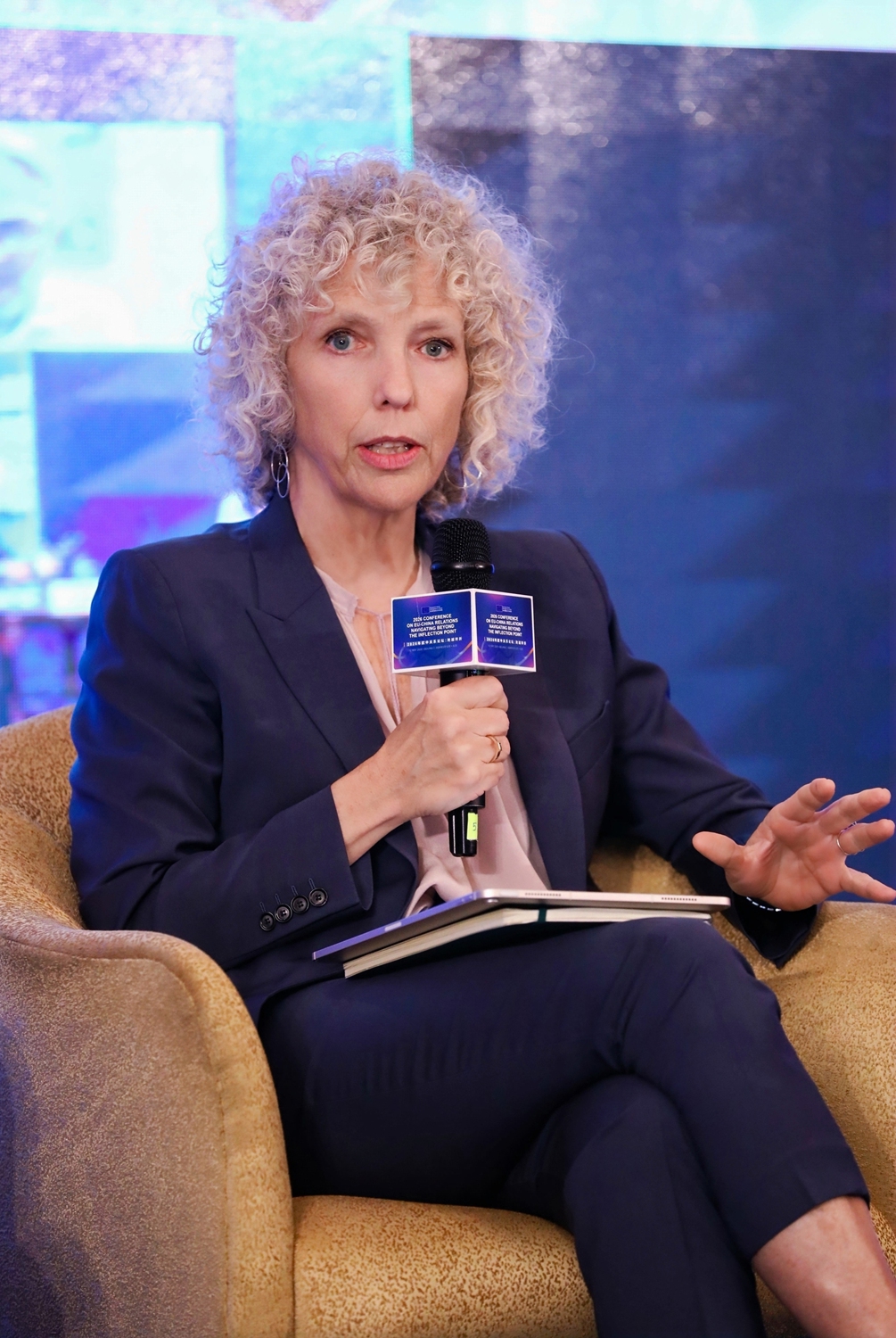
Jennifer Morgan, senior fellow at Fletcher School of Law and Diplomacy of Tufts University at a panel discussion during the second EU-China Conference in Beijing on May 12, 2026. Photo: Courtesy of the Delegation of the European Union in China
Jennifer Morgan, senior fellow at Fletcher School of Law and Diplomacy of Tufts University, told the Global Times that both China and the EU are very committed to multilateralism in the Paris Agreement, adopted by 195 parties a decade ago to combat climate change.Morgan added that there is huge opportunity for China and Europe to work together in driving forward cleaner electrification as well as in developing countries.
In industrial standards and circular economy, both sides could drive green development further, Morgan said.
RELATED ARTICLES