ARTS / CULTURE & LEISURE
Ancient tooth fossils offer new clues about H. erectus evolution
Suggest potential connection with modern humans
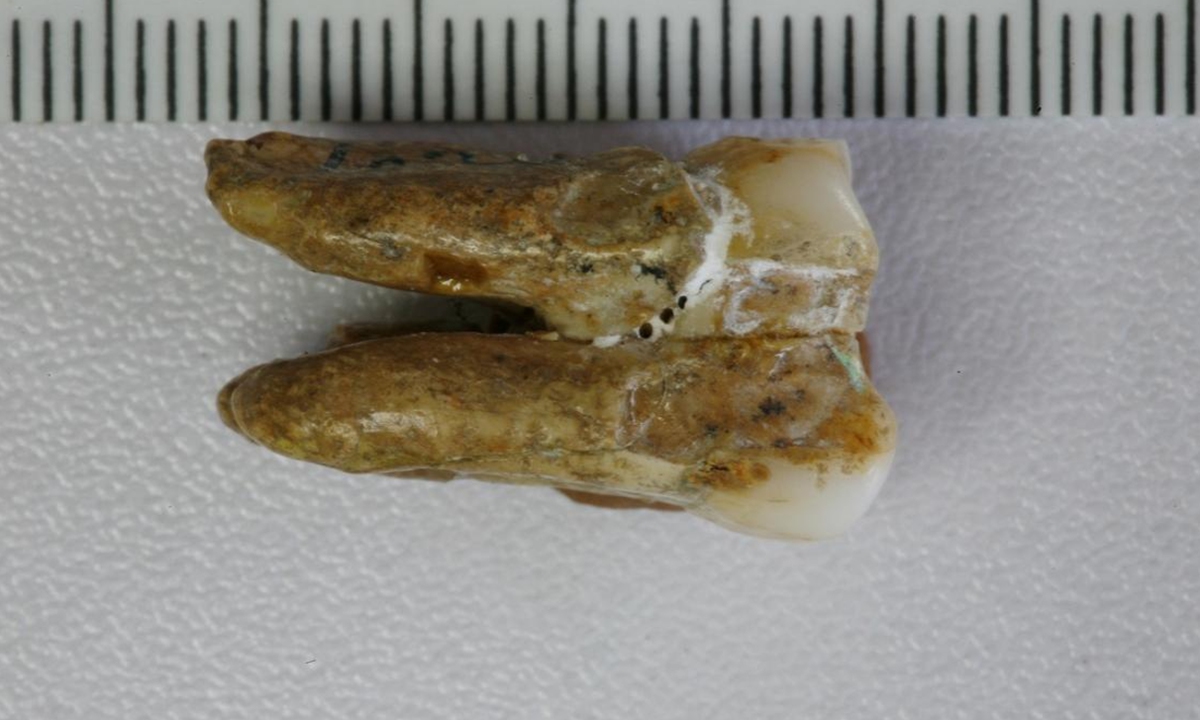
The tooth from the Zhoukoudian site Photo: Courtesy of Fu Qiaomei from the Institute of Vertebrate Paleontology and Paleoanthropology, Chinese Academy of Sciences
Scientists in China have uncovered new information from six Homo erectus tooth fossils dating back around 400,000 years, suggesting a potential connection between Homo erectus and modern humans, while also developing new, less invasive paleoproteomics methods of fossil research.The study, conducted by researchers from the Institute of Vertebrate Paleontology (IVPP) and Paleoanthropology of the Chinese Academy of Sciences, in collaboration with multiple institutions, analyzed fossil teeth unearthed from three major archaeological sites spanning northern and southern China: Zhoukoudian, known for the discovery of Peking Man; the Hexian site; and the Sunjiadong site.
The findings were published Wednesday in the journal Nature in a paper titled "Enamel proteins from six Homo erectus specimens across China."
Homo erectus, or H. erectus, was the first species within the genus Homo to leave Africa, leading to it occupying a key position in human evolutionary history. However, due to the lack of molecular evidence from H. erectus, their genetic characteristics, population diversity, and especially their potential connections to modern humans remain unresolved. As a result, the role of H. erectus represents a major mystery and a focal point of debate in human evolution, according to the IVPP.
Molecular research on H. erectus remains has been limited because ancient human fossils are irreplaceable and precious cultural heritage. For this reason, traditional destructive sampling methods are considered unacceptable and have long constrained the progress of relevant molecular research.
Now, the research team, led by Fu Qiaomei from IVPP, has broken this bottleneck by employing a micro-destructive sampling approach based on acid etching to recover molecular information from six Homo erectus teeth without damaging their morphology.
They successfully extracted and analyzed ancient enamel proteins from five male and one female Middle Pleistocene H. erectus specimens dating back approximately 400,000 years ago from the Zhoukoudian, Hexian and Sunjiadong sites.
By first examining protein preservation in animal fossils from the three sites, the research team gained initial insights into the feasibility of carrying out an analysis without damaging the ancient human fossils. The specimens from all three sites share two amino acid variants.
The researchers discovered two significant genetic variants preserved in the ancient proteins.
The first variant was identified as a potential molecular marker associated with H. erectus populations. The variant was previously unknown and has not been identified in other human lineages, including H. erectus from Dmanisi (Georgia), Homo antecessor from Atapuerca (Spain), Denisovans, Neanderthals and modern humans. It provides the first evidence that H. erectus specimens from these three sites belonged to the same evolutionary population.
The second variant was previously thought to be specific to Denisovans. However, this study reveals that this variant was not unique to Denisovans but was shared by these H. erectus populations.
The new evidence indicates the variant may have been introduced through populations related to these Middle Pleistocene H. erectus. The regions in the Denisovan genome attributed to super-archaic introgression, some of which later passed to modern humans, are likely to have originated from H. erectus. Late Middle Pleistocene H. erectus may have coexisted with Denisovans in parts of East Asia, where these interactions are presumed to have occurred, according to the paper.
According to Fu, the second variant may have entered the Denisovan lineage through admixture and was subsequently passed to some modern human populations (in Southeast Asia and Oceania) via Denisovan introgression.
"This provides the first insights into a possible connection between East Asian H. erectus (such as those from Zhoukoudian) and Denisovans, as well as the potential deep genetic links to some present-day modern humans," Fu told the Global Times.
Recent research has demonstrated the potential of ancient protein analysis in uncovering human evolutionary history. However, genetic data about H. erectus, a key hominin and the first to travel to and inhabit geographically diverse regions, are scarce. The enamel proteins obtained from six Middle Pleistocene H. erectus fossils from three well-known sites in China permit a rare insight into the genetic makeup of H. erectus, added Fu.
Additionally, the study establishes a suite of new experimental and computational methodologies, including a sex determination method for ancient hominins based on the male-specific enamel protein AMELY, a cross-validation approach using tandem mass spectrometry and multiple data analysis pipelines, and DNA analysis methods linked to specific amino acid variants. "Together, these tools provide a new framework for systematic paleoproteomics research," noted Fu.
RELATED ARTICLES