ARTS / CULTURE & LEISURE
Bringing Li Bai to life: Performer finds life lessons in ancient verses
Performer at tourist site finds life lessons in ancient verses
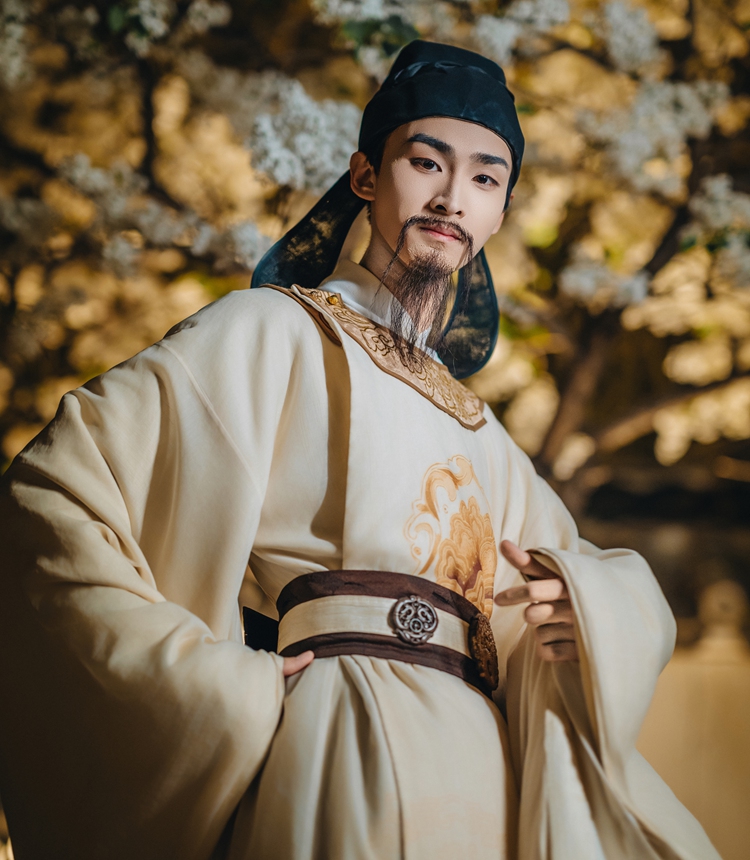
Wang Haonan's portrayal of Tang Dynasty poet Li Bai Photo: Courtesy of Wen Baolong
Under the glow of lanterns at a bustling cultural tourist resortin Tangshan, North China's Hebei Province, crowds have recently been drawn to a man portraying Tang Dynasty (618-907) poet Li Bai.Dressed in white robes with a long beard, the man engages visitors in spontaneous poetic exchanges, reciting verses with ease and creating a precious encounter with classical poetry.
Many tourists made a special trip just to see him in Hetou Old Street during the recent holidays. The portrayal of legendary poet Li Bai by actor Wang Haonan has gone viral on Chinese social media.
"The Li Bai in textbooks is a poet who has been immortalized through history, distant from our everyday lives. I can never truly be like him, nor can I become him. What I can do is capture certain qualities he embodies, such as his unrestrained spirit, and his bold, romantic approach to life," Wang told the Global Times.
"I'm not just portraying a historical figure. I genuinely hope to pass on the culture of classical poetry to every visitor," he said.
Known as the "Immortal Poet," Li Bai is a household name in China as William Shakespeare in the UK or Rabindranath Tagore in India.
He lived between 701 and 762, a golden age of Chinese poetry, and his poems are characterized by patriotism and romanticism.
His works include Quiet Night Thoughts and Bring in the Wine.
Expansive mindset
Whether responding to visitors seeking advice on life choices or young people complaining about pressure from parents to get married, Wang is able to produce impromptu verses or reply effortlessly with lines from classical poetry.
Given his talent, few could believe that he once stumbled for an answer when faced with an impromptu poetry challenge from a visitor.
In order to live up to the role and avoid the embarrassment of freezing up on the spot, Wang began putting in serious effort to study classical poetry.
He not only memorized the most iconic works of Li but also explored the stories and historical contexts behind them.
He also watched many documentaries and films related to the poet's life, seeking a deeper understanding of Li's experiences and character.
Through this process, he tried to better capture the poet's spirit and mannerisms.
Hoping to bring to life an image of Li that resonates with the public's imagination, Wang noted that he didn't limit himself to selected classical poetry.
"I also studied interpretations and analyses of Li's poetry by well-known scholars. I made an effort to understand the historical context of the Tang Dynasty, as well as the spirit and temperament of its literati, in order to get closer to Li Bai's personality and state of mind," he said.
Recently, Wang said he has been studying The Taoist Poet Li Bai and His Pain by Li Changzhi.
The book examines Li Bai's spiritual world, life experiences, and inner emotions from a deeper perspective, helping him develop a three-dimensional and nuanced understanding of Li, rather than remaining at a surface-level appreciation of his poetry alone.
The actor said getting closer to Li Bai is not just about understanding classical poetry, but about learning a broader way of approaching life.
"I used to get caught up in small matters and worry too much about gains and losses. After coming to understand his openness and free-spirited nature, my mindset has become calmer and more expansive," Wang said.
"I've also become more considerate in how I treat others, carrying a steadier sense of confidence shaped by reading. Less restless, less eager to show off, I try to let the composure and warmth found in his poetry quietly inform my everyday words and actions," he said.
Planting a seed
Once failing to answer one of Wang's poetry challenges, a sixth-grade student returned a week later and recited the entire poem flawlessly to him.
The moment deeply moved Wang. He had hoped that his interaction would plant a seed in children's hearts, a seed that inspires a love for classical poetry and Chinese cultural heritage.
"I feel that I'm not just playing a role but also helping to pass on and popularize the traditional Chinese culture," he said. "If children come to love classical poetry and grow closer to traditional Chinese culture because they admire Li Bai or enjoy this kind of ancient-style performance, then that's something truly meaningful.
"I'm simply using a more approachable way to bring poetry into everyday life and into children's hearts. That has always been the original reason I chose to keep doing this."
Reading Li's poems about homesickness and reflection helped Wang understand how, despite spending much of his life drifting from place to place, he still carried the rivers and mountains of his homeland in his heart; how, despite repeated frustrations in office life, he never lost his sincerity or his love for the world.
"At that moment, I realized that classical poetry is not just cold words on a page, but the voice and lived experience of our predecessors. Reading is not only about broadening one's knowledge, it is also a way to cultivate the mind and the spirit, teaching us how to let go, and how to face life with gentleness," he added.
Wang said he will continue reading classical poetry and works of traditional Chinese culture, and keep sharing the beauty of ancient verses and traditional Chinese culture with more people.
RELATED ARTICLES