ARTS / CULTURE & LEISURE
Montage ‘a language that facilitates cross-cultural communication’
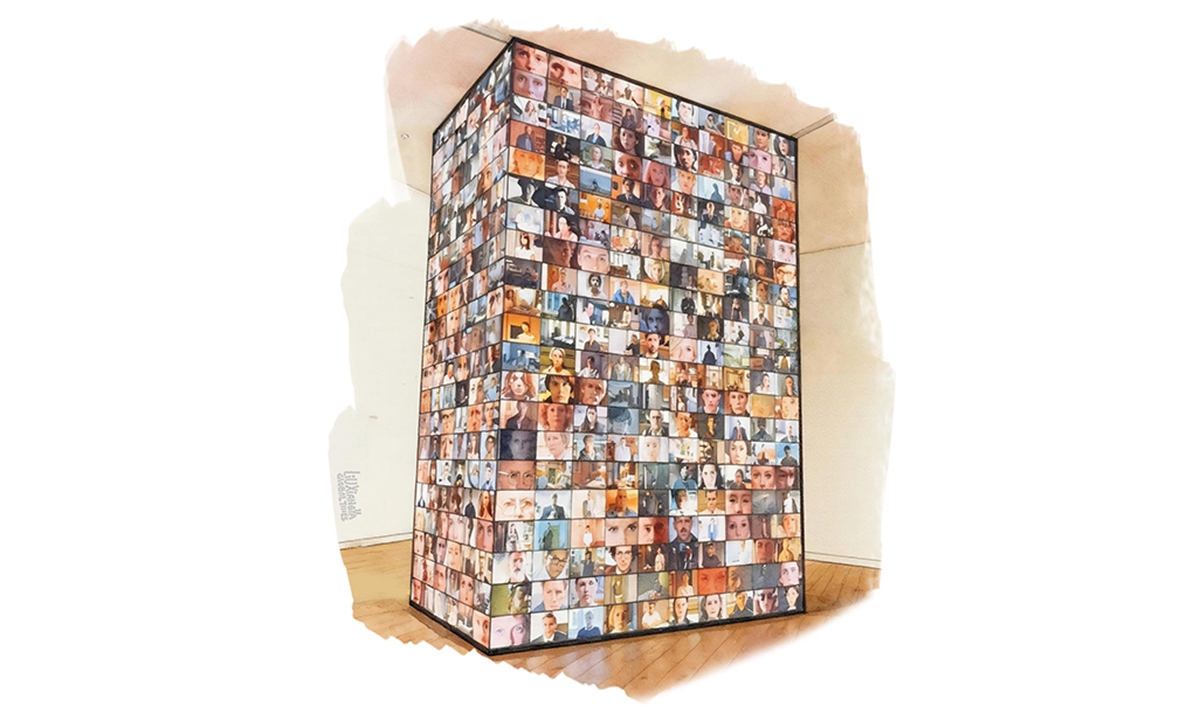
Illustration: Liu Xiangya/GT
Taking "montage" as its core theme, an exhibition titled Montage: From Dialectics to Dynamics is currently on view at the China Design Museum in Hangzhou, East China's Zhejiang Province. The museum itself is not only the first museum in China dedicated to design, but also one of the core exhibition venues of the China Academy of Art.With its rich design resources and solid academic support, why has the museum chosen "montage," an artistic incision that sounds minor, as the core theme of a blockbuster show? Most people associate "montage" with an editing technique common in films and even vlogs, but upon seeing the more than 300 montage exhibits from seven countries and across different mediums on site, the answer becomes clear.
A montage is, and has long been, more than a method: It is "a language that facilitates cross-cultural communication and transcends conventional ways of thinking," Zhang Chunyan, the director of the China Design Museum and chief curator of the exhibition, told the Global Times.
To understand how montages have evolved from a "method" into a "cultural language," we must trace their development back to their roots. The core idea of a montage is actually not difficult to grasp. It describes the process of "deconstruction, rearrangement and reconstruction." Its most widely recognized origin is Soviet cinema from the 1920s, with filmmaker Sergei Eisenstein standing out as one of its foremost figures.
Montages actually live all around us. For example, imagine your alarm clock ringing in the early morning, a crowded subway commute, the messy documents piled on your desk, and a bowl of hot soup eaten late at night when returning home. These fragments, seemingly unrelated when viewed separately, can be montaged together to produce meaning: They depict a restless soul navigating a bustling city.
It is precisely a montage's universal applicability that has made it a "language" across artistic disciplines.
The Hangzhou exhibition features six sections exploring montages' use in architecture, painting, poetry, theater, film, and beyond. In the section "Montage Ideals and Spatial Poetics," the legacies of masters like French-Swiss modern architecture pioneer Le Corbusier reveal the dialogue between architecture and montages. In "Montage as Visual 'Scalpel,'" Dadaist works showcase its experimental spirit in art.
Such exhibits explore the montage as a shared language in art, especially within the context of Western art. But what makes it go beyond an artistic language to a cultural language? The show's "Montage and China" section gives a glimpse at the answer to the question.
Although montages originated in the West, Zhang noted that traditional Chinese cultural arts such as Peking Opera, writing, and painting have crossed time and space to enrich the montage technique. Among them, an exchange between master Mei Lanfang and filmmaker Eisenstein is a prime example.
In 1935, Mei brought the artistic legacy of Chinese Opera along with him during his visit to the Soviet Union. Eisenstein, captivated by this great master of art, invited him to shoot a newsreel in which Mei performed scenes from Nihong Guan, also known as Rainbow Pass. Despite different backgrounds and artistic mediums, Eisenstein found a resonance between Chinese theater and his own montage theory.
"The aesthetics of time-space compression in Peking Opera, along with its highly codified emotions, presented Eisenstein with a different kind of montage," Zhang remarked. At the exhibition, an original photo of Mei and Eisenstein's interaction during Rainbow Pass is on display, along with it a costume once worn by the Chinese master himself. Many of Eisenstein's rare manuscripts are displayed as well.
More than theater, the Western montage pioneer later found inspiration in Chinese characters. Take the characters fei (吠) and ming (鸣) as examples. Eisenstein found that neither the "mouth" radical (口) alone nor the "dog" (犬) or "bird" (鸟) radicals alone can express the meaning fei (bark) or ming (bird song). However, when "mouth" (口) is combined with "dog" or "bird," those meanings suddenly appear. "This showed Eisenstein the profoundness of Chinese culture and an original form of montage logic," Zhang noted, adding that "a montage was born from the exchange of ideas between civilizations."
Examples like these abound in the "Montage and China" section. On the one hand, they invite us to rethink the Western-centric narrative that has long dominated montage studies. On the other hand, they reveal the montage as a cultural language that has always been shared across civilizations and time.
And of course, such reflection does not stop with the era of Eisenstein and Mei Lanfang. On the contrary, it offers valuable insight for our current age of AI and digital media - an age flooded with fragmented information.
The installation Gaze at the exhibition serves as the grand finale. This piece extracts shots from 365 family melodramas and recombines them through AI algorithms in a montage-like manner, inviting people to contemplate the meaning of life as technology reshapes modern life.
"We hope our exhibitions inspire people to see how art and design respond to global social cultural issues," said Zhang. Other than the current montage show, the China Design Museum has long been committed to promoting cross-cultural exchange. In the future, it will also organize exhibitions such as one related to Latin American literature and design, Zhang noted.
The author is a reporter with the Global Times. life@globaltimes.com.cn
RELATED ARTICLES