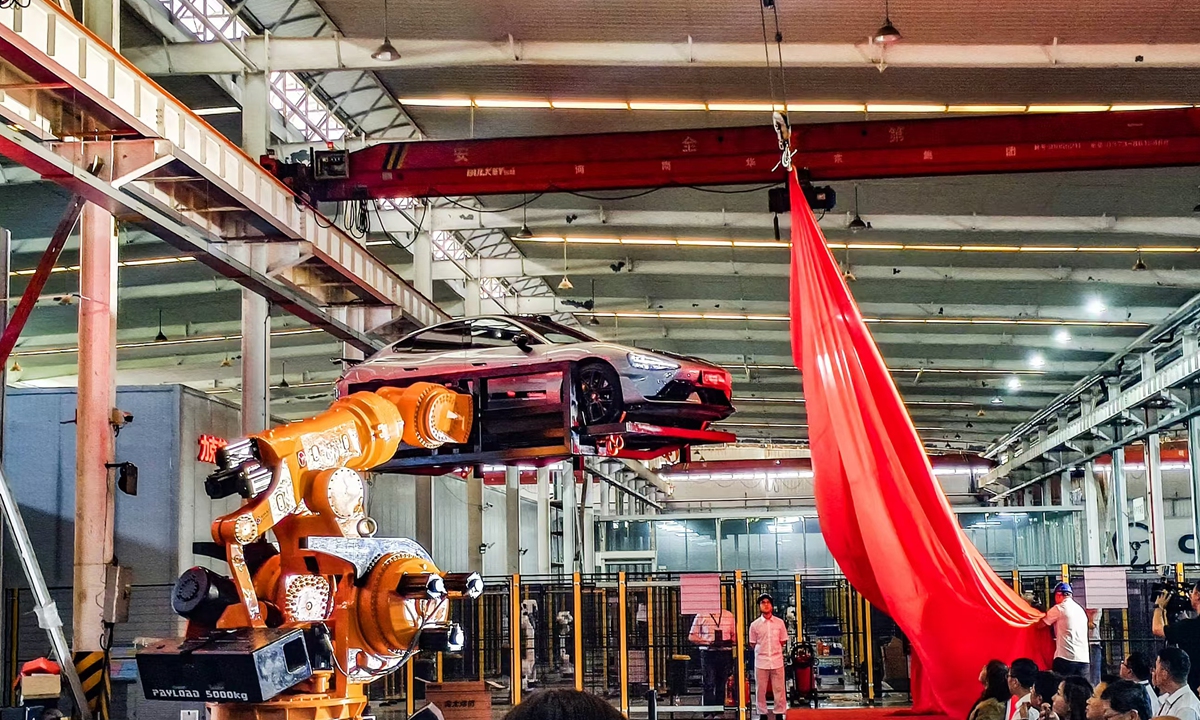
A massive industrial robot with a 5,000-kilogram payload capacity lifts a car during a demonstration in Shanghai, on May 15, 2026. Photo: Courtesy of Shanghai Chaifu Robot Co
On Friday morning, inside a smart factory in Zhangyan town, Jinshan district in Shanghai, a heavy-duty industrial robot made history. At a Guinness World Records certification event in Shanghai, official adjudicator Hu Xiaowen announced that a CR5000-3700 heavy-duty industrial robot self-developed by Shanghai Chaifu Robot Co had achieved a load capacity of over 5,000 kilograms, officially setting a new Guinness World Record for the heaviest industrial robot by load capacity, thepaper.cn reported.
In the heavy-duty robot segment, Chaifu's CR5000-3700 fills a critical gap in China's high-end offerings, delivering comparable performance with superior cost efficiency and localized service to help secure key industrial supply chains, according to a statement released on the Guinness World Records official website.
The achievement makes the robot the world's strongest industrial robot in terms of load-bearing capability, and represents a breakthrough for China's high-end equipment manufacturing sector, according to Chinese analysts.
The previous record was held by Japan's Fanuc Corporation which set the benchmark in 2016 with a load capacity of 2,300 kilograms. The new record set by the Chinese firm more than doubles that figure, pushing the global ceiling for industrial robot load capacity to a new level, according to thepaper.cn.
The Global Times learned from the company that the CR5000-3700 is designed for extreme heavy-load, high-precision and high-risk operations in industries including heavy manufacturing, port machinery, rail transit, tunnel construction, aerospace, new energy, nuclear power, metallurgy and chemicals.
The robot has already been commercialized and is in regular use in multiple industrial settings, including Shanghai rail transit, new energy vehicle production, nuclear power, metallurgy, chemical engineering and tunnel construction, said the company.
Cao Heping, professor at the School of Economics of Peking University, told the Global Times on Friday that this reflects China's push to strengthen self-reliance in core technologies and accelerate the integration of AI and manufacturing.
"It also highlights China's broader push to upgrade from a manufacturing giant into a manufacturing powerhouse," Cao said. "Such innovation is expected to inject new momentum into the high-quality development of China's high-end equipment manufacturing sector."
The latest breakthrough comes amid China's broader drive to advance smart manufacturing through automation, AI and robotics. In recent years, the country has stepped up efforts to improve industrial efficiency and upgrade its manufacturing base, particularly in sectors such as automotive production, heavy industry and logistics.
The achievement comes amid a broader wave of progress in China's robotics sector, highlighted recently by the 2026 Beijing E-Town humanoid robot half-marathon in April, where a Chinese humanoid robot beat the human record for the world's fastest half-marathon by finishing in just over 50 minutes.
The breakthrough underscored the rapid advances being made in both industrial and humanoid robotics, Cao said. However, such records represent more than a technical breakthrough. They also reflect China's broader strategy to upgrade manufacturing through automation, AI advancement and robotics, especially in sectors such as automotive production, heavy industry and logistics, he noted.
China's recent achievements in the fields of robotics did not happen overnight, nor were they the result of breakthroughs in any single project. Rather, they represent the manifestation of a comprehensive capability, Xiang Ligang, director-general of the Zhongguancun Modern Information Consumer Application Industry Technology Alliance, told the Global Times on Friday.
"China is currently in a phase of growth in its overall national strength, where robust infrastructure, high social efficiency, strong policy support, abundant talent reserves and a well-developed industrial ecosystem form a cohesive system," Xiang added.
In recent years, national and regional humanoid robotics innovation centers and embodied intelligence training facilities have expanded rapidly. Shanghai's heterogeneous robot training facility, for example, accommodates more than 100 robots for multi-scenario exercises, generating data across industrial and service environments. Open-source datasets and motion-control frameworks further reduce industry entry barriers, enabling faster commercialization, Xinhua News Agency reported.
A report from the International Federation of Robotics (IFR) has revealed China's unprecedented pace in expanding its industrial robot fleet and modernizing factories. According to the IFR's 2025 report, global industrial robot installations amounted to 542,000 units in 2024, more than double the figure a decade ago. China continues to lead the global market, with its industrial robot stock surpassing 2 million units in 2024 — more than half of the world's total. Annual installations rose 7 percent from 2023 to a record 295,000 units, underscoring the country's strong momentum in automation and manufacturing modernization, per Xinhua.
RELATED ARTICLES