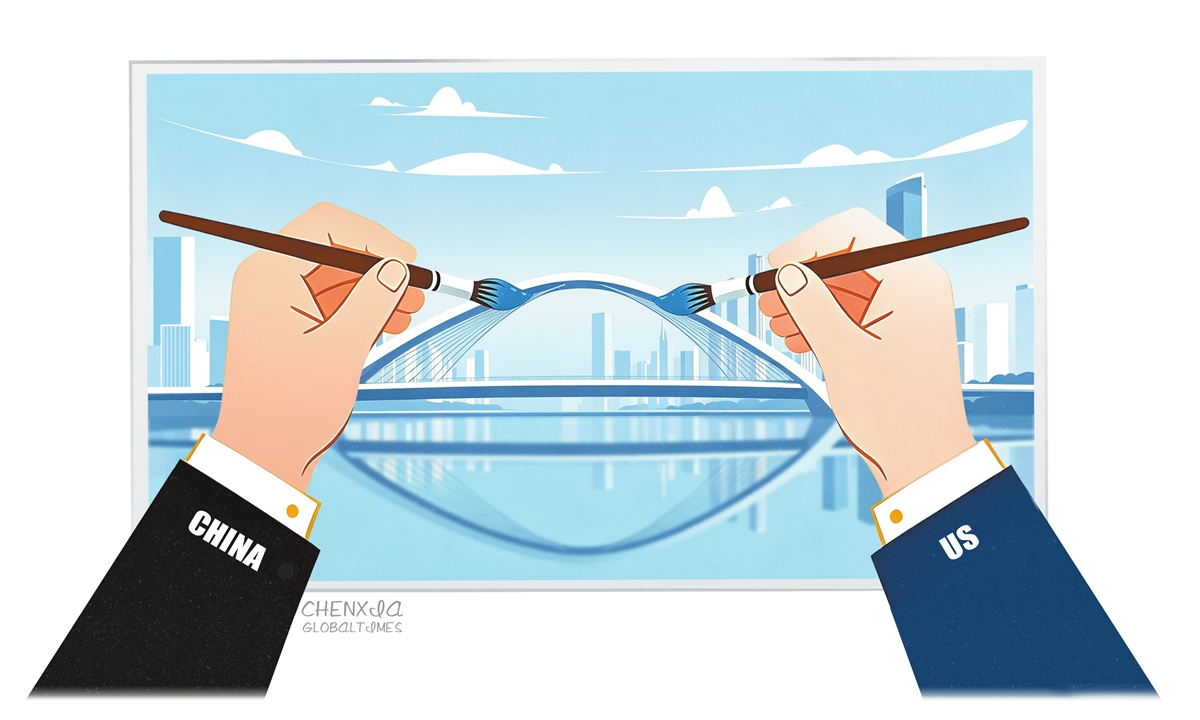
Illustration: Chen Xia/GT
The world woke up a little better today.
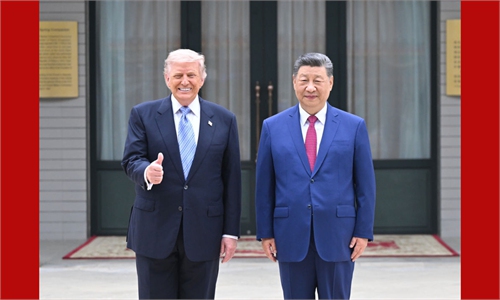
US President Donald Trump's visit to China may eventually be remembered as more than a diplomatic event or a high-level bilateral meeting. It could become a defining moment when the world's two largest powers finally began to understand a fundamental truth of the 21st century: Cooperation between Beijing and Washington is not optional; it's essential.
At a time when wars are multiplying, global institutions are weakening and geopolitical tensions are reshaping international relations, any serious attempt at dialogue between China and the US should be welcomed by all nations - especially those in the Global South.
The alternative is dangerous.
For years, much of the international system has been pushed toward a logic of confrontation reminiscent of the Cold War. China's rise has been treated in many Western political circles not as a historical transformation to be managed responsibly, but as a threat to be contained at all costs. That mentality has fueled trade wars, technological disputes, military tensions in Asia and growing instability across global markets.
But history offers a simple lesson: When great powers lose the ability to cooperate, the entire world pays the price.
The US and China are deeply interconnected economies. They are central actors in global finance, technology, trade, industrial production and climate policy. A prolonged strategic conflict between them would not produce winners. It would generate fragmentation, insecurity and economic disruption on a planetary scale.
This is precisely why Trump's visit matters.
Even symbolic gestures of rapprochement between Washington and Beijing can help reduce uncertainty and create political space for a more rational international environment. The message the world needs today is not one of ideological hostility, but of coexistence.
Countries such as Brazil have a direct interest in that outcome.
Brazil maintains strategic and mutually beneficial relations with both China and the US. China is Brazil's largest trading partner and a major source of investment in infrastructure, energy and industrial development. The US, meanwhile, remains a critical global economic, financial and technological power with enormous influence throughout the Western Hemisphere.
Brazil does not benefit from a divided world forced into geopolitical camps. Nor do most nations in Latin America, Africa or Asia.
In a new era of superpower rivalry, the Global South increasingly rejects the logic that countries must choose a side. What emerging nations seek instead is autonomy, multipolarity and the ability to cooperate with all major centers of global power according to their own national interests.
That aspiration is neither ideological nor anti-American. It is pragmatic.
A stable relationship between China and the US would create a far more favorable environment for global growth, investment, technological development and international cooperation. It would also reduce the risks of military escalation in sensitive regions such as the South China Sea and the Taiwan Straits - areas where miscalculation could have catastrophic global consequences.
There is another reason this moment matters.
The world is entering a period of profound transformation driven by artificial intelligence, energy transition, digital infrastructure and new industrial systems. Humanity faces enormous shared challenges, from climate change to inequality and food security. None of these issues can be solved through geopolitical obsession or permanent confrontation between superpowers.
They require coordination. They require maturity. And above all, they require leadership capable of understanding that coexistence is not weakness.
The rise of China is one of the central realities of our century. It will not be reversed through tariffs, containment policies or rhetorical escalation. At the same time, the US remains an extraordinarily powerful nation with unmatched scientific, military and financial capabilities.
The future of the international order will depend not on whether one side defeats the other, but on whether both can find a framework for peaceful competition combined with strategic cooperation.
That is the challenge of our time. For countries like Brazil, the best possible world is not one dominated by a single hegemonic power, nor one consumed by a bipolar confrontation. It is a world where major nations coexist, negotiate and compete without dragging humanity into conflict.
If Washington and Beijing move even one step closer toward that vision, then the world truly did wake up a little better after this historical moment.
The author is a Brazilian journalist, founder and CEO of Brasil 247. opinion@globaltimes.com.cn
RELATED ARTICLES