Trump reportedly warns Taiwan island not to expect a 'blank check' from US military, 'not looking to have somebody go independent'; expert says separatist forces are left behind by broader trend
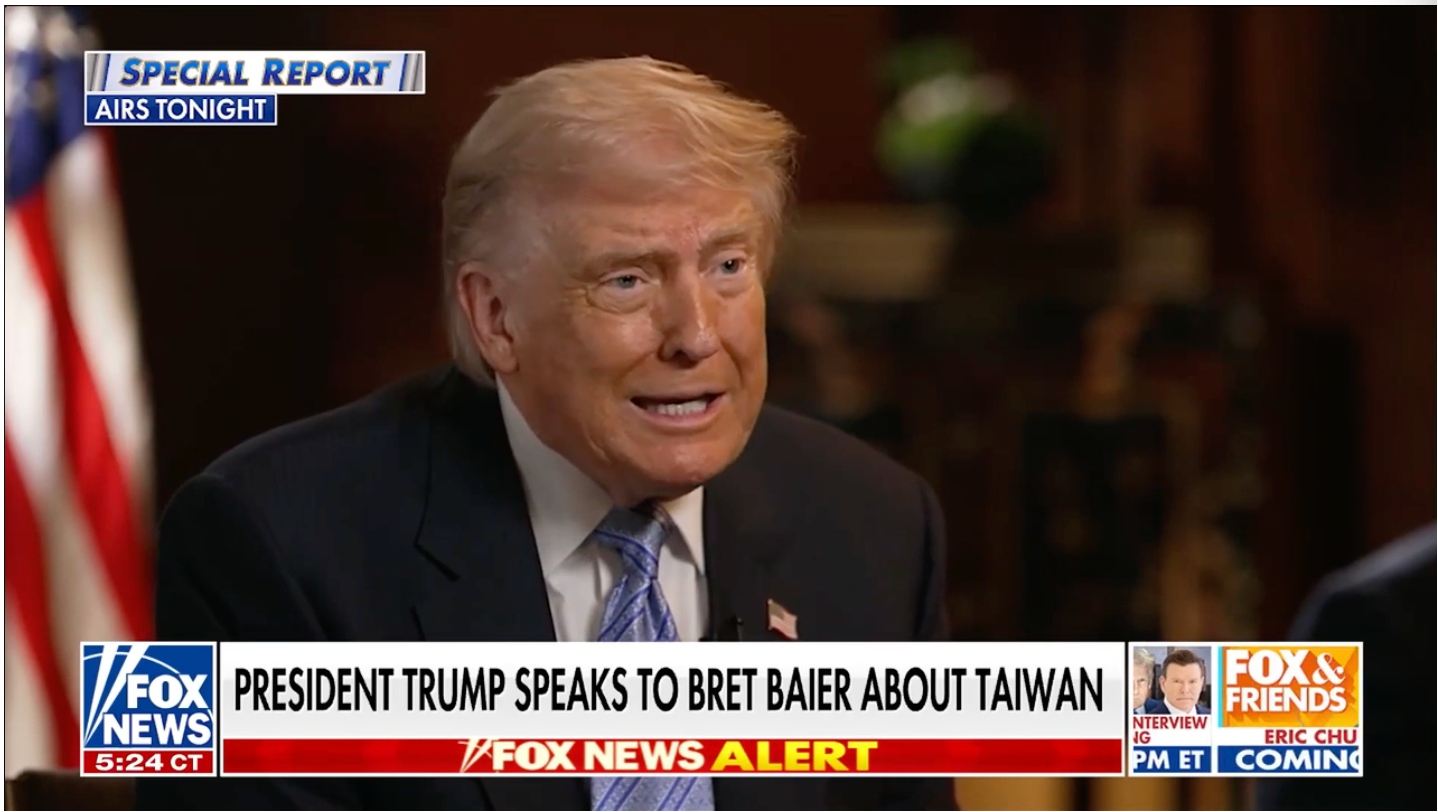
US President Donald Trump in a Fox News interview aired on May 15, 2026 US local time. Photo: Screenshot from Fox News
US President Donald Trump made remarks on the Taiwan question during an interview with Fox News that aired on Friday US local time, warning Taiwan island against pushing for "independence" because it believes the US is backing them. Fox News also highlighted Trump's warning that Taiwan should not expect a "blank check" from the US military in its headline following the interview.
In the interview in Beijing following his meeting with the Chinese leader, President Trump repeatedly used the phrase "not looking to have" when discussing the Taiwan question, saying, "I'm not looking to have somebody go independent ... we're not looking to have somebody say, let's go independent because the United States is backing us." He also stressed the distance involved, claiming that he was not looking for the US to travel 9500 miles to fight a war.
The US president also referred to the contrast in scale between the Chinese mainland and Taiwan island, as well as the geographical distances between the mainland and Taiwan island and between the US and Taiwan island during the interview. "You know, when you look at the odds, China is a very, very powerful, big country. That's a very small island. Think of it, it's 59 miles away. 59 miles. We're 9,500 miles away. That's a little bit of a difficult problem," CNN reported.
Trump demonstrated a certain degree of strategic clarity on this question, becoming the first US president in recent years to express such a position, observers noted, adding that Fox News is relatively trusted by the president, with both current US Defense Secretary Pete Hegseth and Trump's daughter-in-law Lara Trump, who accompanied the China visit, being Fox News hosts. "The network's interview accurately conveyed Trump's message," observers said.
Another positive signal came during another interview with the Fox News, when Trump referred to the Chinese military honor guard, which had drawn attention from both Chinese and foreign netizens, and repeatedly described it as "incredible."
While visiting the Temple of Heaven in Beijing, Trump was repeatedly asked about the Taiwan question, but he did not engage, NBC News reported. The moment was widely picked up by international media outlets.
The series of events quickly drew attention and reactions from media in Taiwan island. Liberty Times, in a commentary, called for "vigilance" over the fact that some people in Taiwan had recognized the real intention behind a recent series of statements and moves by the US side, claiming that Taiwan region has repeatedly faced waves of "doubts about the US alliance." Search keywords showed that, as of press time, Liberty Times had published dozens of related reports on the topic within a single Saturday.
Public opinion in Taiwan island also noted that the mainland's statements on the Taiwan question during this occasion were more forceful in tone compared with the past. An article in United Daily News argued that the remarks reaffirm the one-China principle as the political foundation and red line of China-US relations, and also serve as a reminder and warning to the US side that maintaining peace across the Taiwan Straits requires curbing "Taiwan independence."
Meanwhile, on Friday, Kuomintang Chairwoman Cheng Li-wun hosted an online program for the party, inviting former Taiwan regional official Chieh Wen-chi as a guest. Chieh said that he noted the relevant remarks during the meeting, stating that "safeguarding peace and stability across the Taiwan Straits is the biggest common denominator between China and the US," and " 'Taiwan independence' and cross-Straits peace are as irreconcilable as fire and water."
Cheng also remarked that "Taiwan independence" is a dead end with no viable path forward, saying it has completely shattered the DPP's illusions.
Just two days earlier, some media outlets and public opinion in Taiwan island were still portraying US Secretary of State Marco Rubio's remarks, who claimed that "US policy on the issue of Taiwan is unchanged as of today," as a lifeline, widely promoting them in what appeared to be an attempt at self-reassurance. However, Trump's silence and subsequent warnings quickly shattered that illusion, a mainland expert noted.
"By linking together a series of statements and interviews by Trump, Rubio, and US officials before and after this visit, you will reach one conclusion: separatist forces in Taiwan are engaging in self-comfort," Zheng Jian, a professor of Graduate Institute for Taiwan Studies of Xiamen University, told the Global Times on Saturday.
Zheng further noted the underlying logic behind these recent developments is largely consistent: Taiwan independence forces are increasingly being left behind by the broader trend rather than being part of it. In the context of intensifying China-US strategic competition, they increasingly resemble a shoe that could be kicked off at any moment, remaining in a state of constant anxiety and fearing abandonment. As a result, they rush to seize on any signs of reassurance, treating even brief statements or ambiguous signals as lifelines.
"Years of practice have proven that one should not only listen to what Americans say, but also observe what they do, and ultimately return to common sense in judging US behavior," the expert added.
That is, how the US perceives the balance of power across the Taiwan Straits. The series of major consensus points reached between China and the US during this meeting contains no element that Taiwan region could replace. The question of US choices ultimately returns to what Trump has repeatedly described as the relationship between"the tip of Sharpies pen and the Resolute desk," said Zheng.
The anxiety of separatist forces, he said, is itself a reflection of their real predicament — "in the current trend of realist diplomacy, no stable external reliance can be expected," Zheng stressed.
RELATED ARTICLES