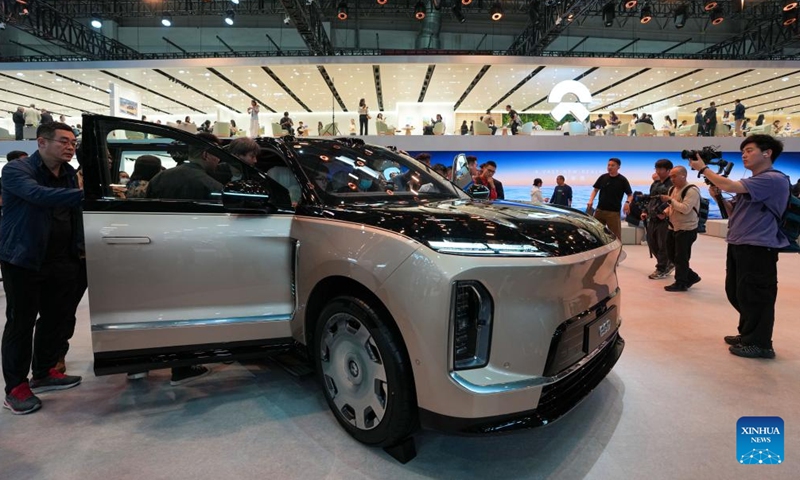
People visit the booth of NIO during the 2026 Beijing International Automotive Exhibition in Beijing, capital of China, April 24, 2026. The exhibition kicked off here on Friday and will last until May 3. (Xinhua/Ju Huanzong)
As Chinese domestic auto brands grow at remarkable speed, foreign media outlets are impressed by "China speed." But some have voiced undue concerns and even engaged in sensational hype. They argue that the rise of Chinese car brands is "putting pressure on established players," pushing a narrative that the development of China's auto industry and the global auto sector is a "zero-sum game." This not only misleads the international audience but also reveals a misunderstanding of China's automotive industry and its broader economic progress.The rapid development of China's domestic auto brands has, to a certain extent, reshaped the global automotive industry landscape. China will continue to consolidate its position as the world's largest automotive market, the largest automotive manufacturer, and the largest automotive exporter, the largest automotive manufacturer, and the largest automotive exporter. In particular, China's new-energy vehicles (NEVs) are leading the global market. In 2025, China's NEV production and sales reached approximately 16 million units respectively, accounting for about 70 percent of the global total.
The cooperation model in China's auto industry has also evolved significantly. In the past, foreign automakers mainly exported vehicles to China. They then moved to local manufacturing, and are now entering a new phase of deep collaboration - joint research and development with Chinese partners.
This shift is evident in several major projects, such as BMW Brilliance's 10 billion-yuan (about $1.4 billion) sixth-generation battery project, Volkswagen's accelerated development in East China's Anhui Province, Tesla's Shanghai Energy Storage Gigafactory, and Bosch's Intelligent Driving Control Industrial Innovation Project in Suzhou, East China's Jiangsu Province.
Backed by China's robust industrial base and improving business climate, foreign automakers and suppliers continue to ramp up investments in the country. This shows their confidence in the Chinese market and their appreciation for its dynamic and innovation-driven ecosystem.
China's complete and comprehensive industrial chain ecosystem not only empowers domestic automakers but also helps foreign automakers - especially multinational companies that have already established operations in China - reduce costs, accelerate their transformation, and enhance their global competitiveness. Taking advantage of this ecosystem, an increasing number of foreign automakers are turning to Chinese partners and local teams to co-develop their international NEV models.
Through close collaboration between Chinese and foreign companies, China has become a major global hub for automotive innovation. It is helping lead the industry into a new era of electrification and intelligent vehicles with practical, green, and sustainable solutions.
That said, as China's auto industry has grown rapidly, some foreign brands have experienced declining sales and lost market share in the country. However, this is a normal result of market competition. And guided by its high-level opening-up strategy, China has fully opened its automotive industry.
In 2022, China lifted foreign equity caps on passenger vehicle manufacturing. That same year, foreign investment in the automotive manufacturing sector surged by 263.8 percent.
In 2024, China fully eliminated all foreign investment access restrictions in the manufacturing industry. In December 2025, the National Development and Reform Commission and the Ministry of Commerce jointly issued the new "Catalogue of Industries Encouraging Foreign Investment: 2025 Edition," continuing to expand high-level opening-up in the smart vehicle sector.
The outline of the 15th Five-Year Plan (2026-30) for national economic and social development sets forth "Promoting High-Standard Opening Up and Creating New Horizons for Mutually Beneficial Cooperation" as an independent chapter for systematic deployment. All of these measures have laid the institutional foundation for foreign automakers to deepen their presence in the Chinese market.
Therefore, the idea is simply wrong that the rise of China's domestic auto brands and foreign carmakers is a "zero-sum game" where one side must lose for the other to win.
China will continue to welcome and support foreign automakers, just as it always has. In fact, the rapid growth of Chinese carmakers creates new opportunities for their foreign partners.
With its enormous market size and huge future potential, combined with policies that promote high-level opening-up, China will remain highly attractive to international automakers.
The author is a research fellow at the Academy of China Open Economy at the University of International Business and Economics in Beijing. opinion@globaltimes.com.cn
RELATED ARTICLES