IN-DEPTH / IN-DEPTH
China craze at Argentina’s University of Rosario reflects vibrant China-LAC people-to-people exchanges, growing desire to understand China
Enthusiasm rooted in campus
Editor's Note:
In an era of profound global shifts and increasingly complex regional dynamics, a proper understanding of the world must be rooted in "grounded experience" and localized insights. Global Times English edition, in collaboration with the Academy of International and Regional Communication Studies, Communication University of China, is proud to launch "Local Insights," an English-language column dedicated to original, field-based observations.
We invite Chinese scholars and professionals who are studying, conducting exchanges, or working outside China, as well as international students and friends living and studying in China who are familiar with the social contexts of their home countries or third countries, to begin from first-hand field experience and engage with social, cultural, and contemporary issues beyond China. The second article in this column features a Chinese scholar witnessing the growing enthusiasm for Chinese culture at an Argentine university, a vivid embodiment of ever-deepening people-to-people exchanges and win-win cooperation that opens a new chapter in China-LAC friendship.
The China craze at the National University of Rosario is no accidental cultural ripple; it is a vivid manifestation of people-to-people connectivity under the China-Latin America and the Caribbean (LAC) cooperative partnership. From the Confucius Institute to comparative culture classrooms, Argentine youth's spontaneous enthusiasm for Chinese language and traditions transcends geographical and cultural barriers, building a solid bridge of understanding and friendship at the grassroots level.
This grassroots' cultural affinity is precisely the deepest and most enduring force driving the cooperation under the Belt and Road Initiative (BRI) and the building a China-LAC community with a shared future.
In September 2023, I was invited by the National University of Rosario (UNR) in Argentina for an academic visit and exchange. This was my first time setting foot in this Latin American country, the farthest from China. What intrigued me during my visit was how this campus, over 20,000 kilometers away, was brimming with Chinese elements.
Language and beyond: UNR's window on China
In recent years, educational and cultural exchanges between China and Argentina have witnessed a vigorous momentum, with notable achievements in the construction of Confucius Institutes and language teaching. Argentina currently hosts four Confucius Institutes, established through partnerships between Chinese universities and the University of Buenos Aires, the National University of La Plata, the National University of Cordoba, and the University of Congress. These institutes have formed a Chinese language teaching network spanning from the north to the south of the country. Beyond offering regular courses such as Hanyu Shuiping Kaoshi (HSK) or the Chinese proficiency test, the Confucius Institutes have also become important bridges promoting dialogue and academic exchange in higher education between China and Argentina. Meanwhile, frequent visits between Chinese and Argentine universities have taken place, and the number of exchanged students has steadily expanded. Cooperation in scholar exchanges and joint talent cultivation continues to deepen, injecting people-to-people and cultural impetus into a closer partnership across political, economic, cultural and other domains.
Speaking of Rosario, one famous soccer star who cannot be avoid mentioning is Lionel Messi, the Argentine football legend, as this city is his birthplace and where he began his soccer career. UNR is one of the five best universities in Argentina. Its Confucius Institute has played a significant role in driving the local "China craze." It not only attracts a large number of local youth to learn Chinese but also has the qualification to administer the HSK.
UNR's comparative culture courses take a unique approach. Instead of merely introducing China superficially, they juxtapose cultural phenomena from both countries for discussion. Topics like comparing Tango with Peking opera, or the way and rituals of mate tea versus Chinese tea, have become the most popular subjects in class. Students are surprised to find that these seemingly distant cultures share many similarities in areas like family ethics and interpersonal communication.
Discussions in class often go beyond language itself, covering differences in Chinese and Argentine cuisine, Spring Festival customs, and Chinese family values. During a discussion on traditional Chinese culture, Argentine students were amazed to discover how the importance of family ties in Chinese culture closely resembles their own cherished traditions. "So we are not that far from China," a student said.
The popularity of UNR's comparative culture courses reflects a profound shift in how Argentine youth perceive China - they are no longer satisfied with knowing "what" China is, but are eager to understand "why." This attempt to understand the other through one's own cultural lens is perhaps the most valuable outcome of China-Latin America cultural exchange.
This spontaneous cultural interest has also steadily raised the level of the "Chinese Bridge" competition in Argentina. When it was first held in Argentina in 2005, there were few participants, and they were limited to the capital region. Now, the "China craze" has brought young people from Rosario and other provinces into the fold, creating a virtuous cycle.
Dialogue inside and outside classroom: How Argentines understand China
At UNR, I had the privilege of meeting a legendary professor, Eduardo Oviedo. He was the first Argentine student to study in China, earning his doctorate in International Relations from Peking University in 1993 after starting in 1988. "When I left China over 20 years ago after five years of study, I never imagined it would achieve such great success," Professor Oviedo remarked. As he is married with a Chinese woman, his life is deeply intertwined with China. After returning, he began teaching a course on "China's Foreign Policy and Relations with Argentina" at UNR, becoming a key figure promoting academic exchange between the two countries.
Filled with curiosity and respect, I sat in on Professor Oviedo's class, where students were engaged in a lively discussion on China-Argentine economic cooperation. He views China's successful economic reform as a microcosm of Global South development. Frequently invited to lecture at Chinese universities, he shares the Argentine perspective on the development of bilateral relations. As he notes, China's growth over the past decade has boosted commodity prices, benefiting Argentina. He believes that as more Argentine youth enter Chinese language classrooms, the understanding and friendship between China and Latin America will inevitably deepen across generations.
Thanks to UNR's arrangements, I had the opportunity to give a lecture titled "Higher Education in a Comparative Key: Latin America and China" to faculty from the School of International Relations and the School of Humanities. From a comparative education perspective, I discussed the similarities and differences in the development of higher education in Argentina and China, sparking keen interest among the Argentine faculty in China's educational progress. This, I believe, is another dimension of the educational resonance brought by the "China craze."
In the classroom teaching at the UNR, Chinese elements have been deeply integrated into the professional curriculum system. In comparative culture courses, the Confucian concept of "harmony in diversity" engages in a cross-temporal dialogue with Latin American liberation philosophy; the School of Economics uses China's 40-year poverty alleviation cases from its reform and opening-up as classic models in development economics. This pedagogical practice of incorporating Chinese experiences into academic frameworks enables students to move beyond fragmented perceptions of China from media or social media platforms, and instead understand the internal logic of China's path within a systematic disciplinary context, thereby laying a solid foundation for deep mutual trust between the two countries at the cognitive level.
The China-LAC resonance
Rosario is more than just a university town; it is Argentina's - and indeed one of the world's most important agricultural product hubs. The region handles 80 percent of the country's soybean and corn exports, with its port complex moving over 100 million tons annually. Driven by the "China craze," several Chinese companies have established a long-term presence here, and local Argentine traders are well-acquainted with the cooperation processes of Chinese firms. On supermarket shelves, "Made in China" is quietly changing its image. From inexpensive trinkets to modern appliances and electronics, Chinese brands are gradually winning the acceptance of Argentine consumers.
For young people in Rosario, learning Chinese is no longer just a matter of curiosity but a career consideration. Mastering the language means more opportunities to work for Chinese companies or to gain an advantage in the increasingly frequent trade between the two nations. As one UNR student puts it, learning Chinese is hard, but diligent effort leads to success.
In the economic and trade realm, the depth of China-Argentina cooperation far exceeds what is seen on campus. Argentina is a major global exporter of soybeans, corn, and beef, while China has been consistently ranked as Argentina's second-largest trading partner. In recent years, the bilateral trade structure has continued to improve. Beyond traditional agricultural products, Argentina's lithium resources have increasingly become an important link in China's new energy industrial chain. Several Chinese enterprises have invested in lithium development projects in Argentina's northern provinces, not only boosting local employment but also introducing green mining technologies. These projects have become typical examples of complementarity between resource-rich Latin American countries and China's industrial advantages under the BRI framework. Such economic and trade ties have shifted Argentines' perception of China from a distant producing nation to a partner from whom they can tangibly benefit from cooperative gains.
These pragmatic collaborations that span geographical distances echo the "China craze" on the campus of the University of Rosario, together painting a panoramic picture of China-LAC relations that ranges from people-to-people cultural exchanges to intergovernmental strategic coordination. It is precisely this multi-level, wide-ranging interaction that has made China-LAC friendship not merely a grand narrative but something deeply rooted in the lives and aspirations of ordinary people.
The story of Rosario and China is a microcosm of the Global South dialogue between China and LAC countries. Here, the earnest expressions of students tracing Chinese characters, the academic passion of a professor discussing bilateral relations, and the bustling activity of dockworkers handling exports for China paint a vivid picture of cross-cultural exchange. These everyday cultural encounters are far more real and enduring than any grand diplomatic narrative. As Professor Oviedo noted, the future holds even greater promise for mutual understanding and friendship, carried forward by generation after generation.
The author is professor of School of International Studies, director of Research Center of the Pacific Island Countries at the Academy of International and Regional Communication Studies, Communication University of China
In an era of profound global shifts and increasingly complex regional dynamics, a proper understanding of the world must be rooted in "grounded experience" and localized insights. Global Times English edition, in collaboration with the Academy of International and Regional Communication Studies, Communication University of China, is proud to launch "Local Insights," an English-language column dedicated to original, field-based observations.
We invite Chinese scholars and professionals who are studying, conducting exchanges, or working outside China, as well as international students and friends living and studying in China who are familiar with the social contexts of their home countries or third countries, to begin from first-hand field experience and engage with social, cultural, and contemporary issues beyond China. The second article in this column features a Chinese scholar witnessing the growing enthusiasm for Chinese culture at an Argentine university, a vivid embodiment of ever-deepening people-to-people exchanges and win-win cooperation that opens a new chapter in China-LAC friendship.
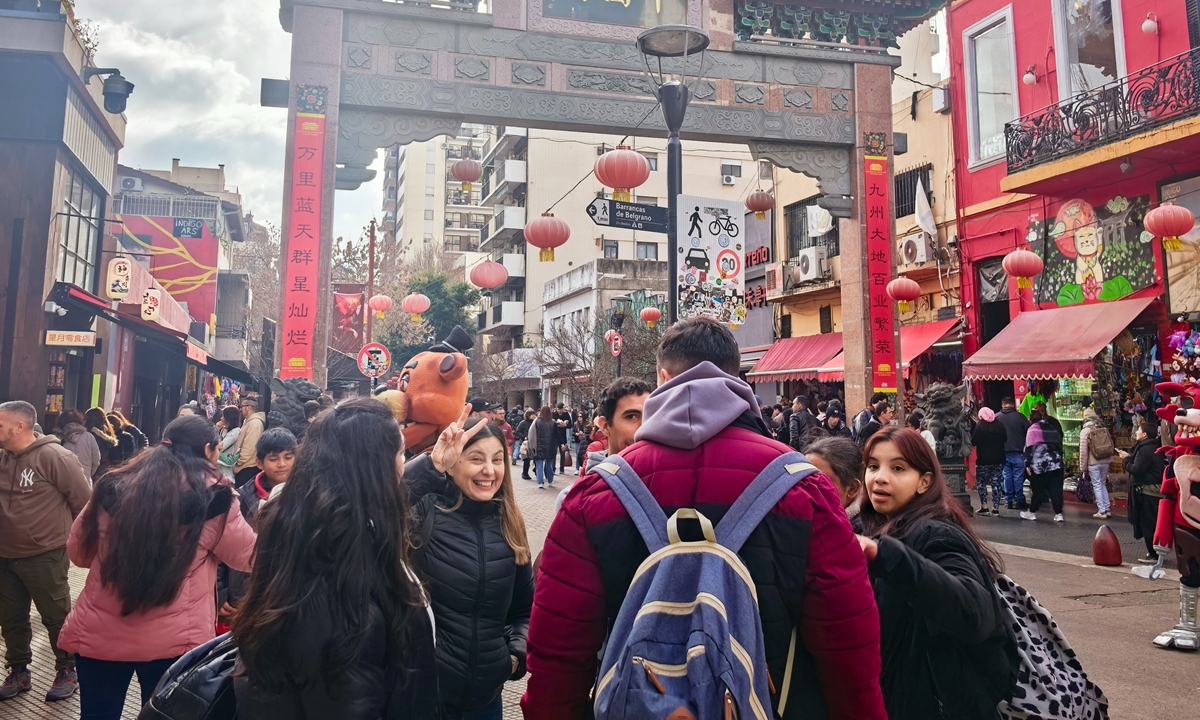
Chinatown in Buenos Aires, Argentina Photo: Liu Yang/GT
The China craze at the National University of Rosario is no accidental cultural ripple; it is a vivid manifestation of people-to-people connectivity under the China-Latin America and the Caribbean (LAC) cooperative partnership. From the Confucius Institute to comparative culture classrooms, Argentine youth's spontaneous enthusiasm for Chinese language and traditions transcends geographical and cultural barriers, building a solid bridge of understanding and friendship at the grassroots level.
This grassroots' cultural affinity is precisely the deepest and most enduring force driving the cooperation under the Belt and Road Initiative (BRI) and the building a China-LAC community with a shared future.
In September 2023, I was invited by the National University of Rosario (UNR) in Argentina for an academic visit and exchange. This was my first time setting foot in this Latin American country, the farthest from China. What intrigued me during my visit was how this campus, over 20,000 kilometers away, was brimming with Chinese elements.
Language and beyond: UNR's window on China
In recent years, educational and cultural exchanges between China and Argentina have witnessed a vigorous momentum, with notable achievements in the construction of Confucius Institutes and language teaching. Argentina currently hosts four Confucius Institutes, established through partnerships between Chinese universities and the University of Buenos Aires, the National University of La Plata, the National University of Cordoba, and the University of Congress. These institutes have formed a Chinese language teaching network spanning from the north to the south of the country. Beyond offering regular courses such as Hanyu Shuiping Kaoshi (HSK) or the Chinese proficiency test, the Confucius Institutes have also become important bridges promoting dialogue and academic exchange in higher education between China and Argentina. Meanwhile, frequent visits between Chinese and Argentine universities have taken place, and the number of exchanged students has steadily expanded. Cooperation in scholar exchanges and joint talent cultivation continues to deepen, injecting people-to-people and cultural impetus into a closer partnership across political, economic, cultural and other domains.
Speaking of Rosario, one famous soccer star who cannot be avoid mentioning is Lionel Messi, the Argentine football legend, as this city is his birthplace and where he began his soccer career. UNR is one of the five best universities in Argentina. Its Confucius Institute has played a significant role in driving the local "China craze." It not only attracts a large number of local youth to learn Chinese but also has the qualification to administer the HSK.
UNR's comparative culture courses take a unique approach. Instead of merely introducing China superficially, they juxtapose cultural phenomena from both countries for discussion. Topics like comparing Tango with Peking opera, or the way and rituals of mate tea versus Chinese tea, have become the most popular subjects in class. Students are surprised to find that these seemingly distant cultures share many similarities in areas like family ethics and interpersonal communication.
Discussions in class often go beyond language itself, covering differences in Chinese and Argentine cuisine, Spring Festival customs, and Chinese family values. During a discussion on traditional Chinese culture, Argentine students were amazed to discover how the importance of family ties in Chinese culture closely resembles their own cherished traditions. "So we are not that far from China," a student said.
The popularity of UNR's comparative culture courses reflects a profound shift in how Argentine youth perceive China - they are no longer satisfied with knowing "what" China is, but are eager to understand "why." This attempt to understand the other through one's own cultural lens is perhaps the most valuable outcome of China-Latin America cultural exchange.
This spontaneous cultural interest has also steadily raised the level of the "Chinese Bridge" competition in Argentina. When it was first held in Argentina in 2005, there were few participants, and they were limited to the capital region. Now, the "China craze" has brought young people from Rosario and other provinces into the fold, creating a virtuous cycle.
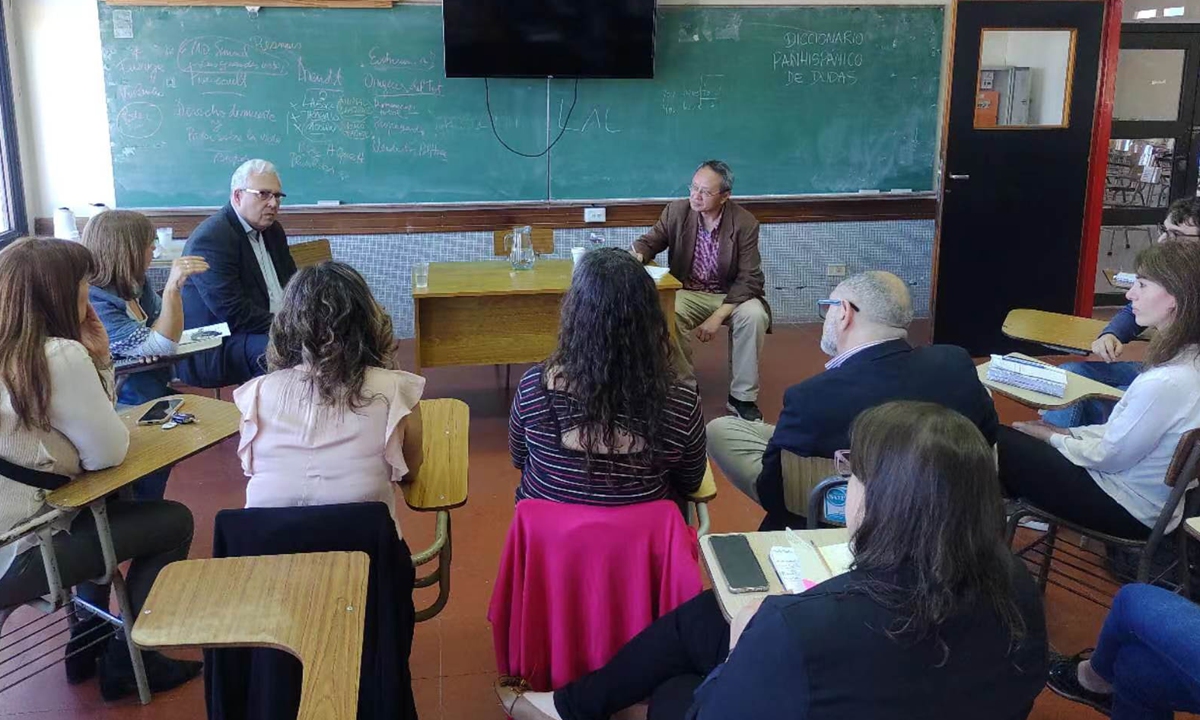
Professor Zhao Shuo holds an academic exchange with Professor Eduardo Oviedo and other teachers at the National University of Rosario, Argentina, in September 2023. Photo: Courtesy of Zhao
Dialogue inside and outside classroom: How Argentines understand China
At UNR, I had the privilege of meeting a legendary professor, Eduardo Oviedo. He was the first Argentine student to study in China, earning his doctorate in International Relations from Peking University in 1993 after starting in 1988. "When I left China over 20 years ago after five years of study, I never imagined it would achieve such great success," Professor Oviedo remarked. As he is married with a Chinese woman, his life is deeply intertwined with China. After returning, he began teaching a course on "China's Foreign Policy and Relations with Argentina" at UNR, becoming a key figure promoting academic exchange between the two countries.
Filled with curiosity and respect, I sat in on Professor Oviedo's class, where students were engaged in a lively discussion on China-Argentine economic cooperation. He views China's successful economic reform as a microcosm of Global South development. Frequently invited to lecture at Chinese universities, he shares the Argentine perspective on the development of bilateral relations. As he notes, China's growth over the past decade has boosted commodity prices, benefiting Argentina. He believes that as more Argentine youth enter Chinese language classrooms, the understanding and friendship between China and Latin America will inevitably deepen across generations.
Thanks to UNR's arrangements, I had the opportunity to give a lecture titled "Higher Education in a Comparative Key: Latin America and China" to faculty from the School of International Relations and the School of Humanities. From a comparative education perspective, I discussed the similarities and differences in the development of higher education in Argentina and China, sparking keen interest among the Argentine faculty in China's educational progress. This, I believe, is another dimension of the educational resonance brought by the "China craze."
In the classroom teaching at the UNR, Chinese elements have been deeply integrated into the professional curriculum system. In comparative culture courses, the Confucian concept of "harmony in diversity" engages in a cross-temporal dialogue with Latin American liberation philosophy; the School of Economics uses China's 40-year poverty alleviation cases from its reform and opening-up as classic models in development economics. This pedagogical practice of incorporating Chinese experiences into academic frameworks enables students to move beyond fragmented perceptions of China from media or social media platforms, and instead understand the internal logic of China's path within a systematic disciplinary context, thereby laying a solid foundation for deep mutual trust between the two countries at the cognitive level.
The China-LAC resonance
Rosario is more than just a university town; it is Argentina's - and indeed one of the world's most important agricultural product hubs. The region handles 80 percent of the country's soybean and corn exports, with its port complex moving over 100 million tons annually. Driven by the "China craze," several Chinese companies have established a long-term presence here, and local Argentine traders are well-acquainted with the cooperation processes of Chinese firms. On supermarket shelves, "Made in China" is quietly changing its image. From inexpensive trinkets to modern appliances and electronics, Chinese brands are gradually winning the acceptance of Argentine consumers.
For young people in Rosario, learning Chinese is no longer just a matter of curiosity but a career consideration. Mastering the language means more opportunities to work for Chinese companies or to gain an advantage in the increasingly frequent trade between the two nations. As one UNR student puts it, learning Chinese is hard, but diligent effort leads to success.
In the economic and trade realm, the depth of China-Argentina cooperation far exceeds what is seen on campus. Argentina is a major global exporter of soybeans, corn, and beef, while China has been consistently ranked as Argentina's second-largest trading partner. In recent years, the bilateral trade structure has continued to improve. Beyond traditional agricultural products, Argentina's lithium resources have increasingly become an important link in China's new energy industrial chain. Several Chinese enterprises have invested in lithium development projects in Argentina's northern provinces, not only boosting local employment but also introducing green mining technologies. These projects have become typical examples of complementarity between resource-rich Latin American countries and China's industrial advantages under the BRI framework. Such economic and trade ties have shifted Argentines' perception of China from a distant producing nation to a partner from whom they can tangibly benefit from cooperative gains.
These pragmatic collaborations that span geographical distances echo the "China craze" on the campus of the University of Rosario, together painting a panoramic picture of China-LAC relations that ranges from people-to-people cultural exchanges to intergovernmental strategic coordination. It is precisely this multi-level, wide-ranging interaction that has made China-LAC friendship not merely a grand narrative but something deeply rooted in the lives and aspirations of ordinary people.
The story of Rosario and China is a microcosm of the Global South dialogue between China and LAC countries. Here, the earnest expressions of students tracing Chinese characters, the academic passion of a professor discussing bilateral relations, and the bustling activity of dockworkers handling exports for China paint a vivid picture of cross-cultural exchange. These everyday cultural encounters are far more real and enduring than any grand diplomatic narrative. As Professor Oviedo noted, the future holds even greater promise for mutual understanding and friendship, carried forward by generation after generation.
The author is professor of School of International Studies, director of Research Center of the Pacific Island Countries at the Academy of International and Regional Communication Studies, Communication University of China
RELATED ARTICLES