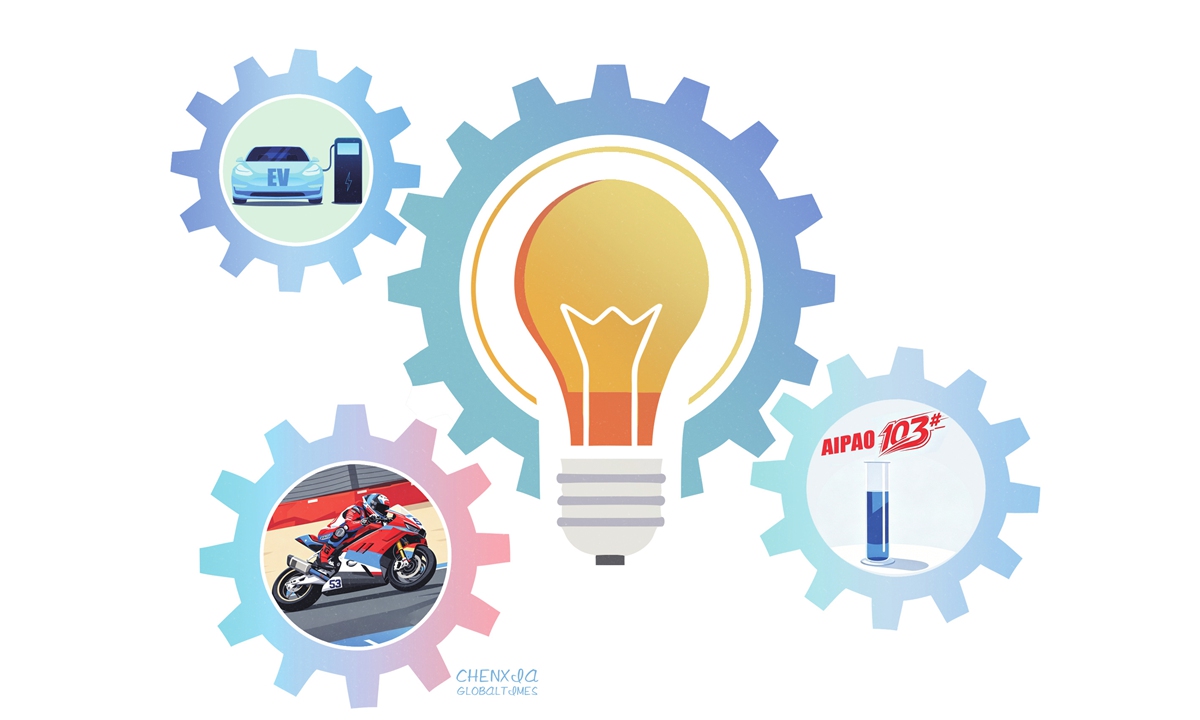
Illustration: Chen Xia/GT
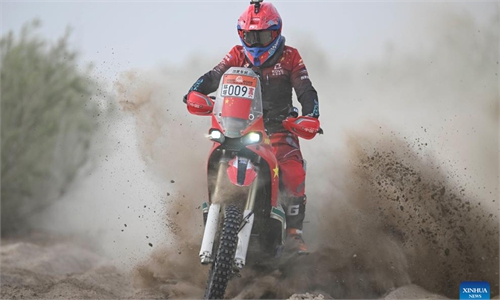
On May 16, French rider Valentin Debise of China's ZXMOTO claimed victory in Race 1 of the FIM Supersport World Championship at the Czech Round on Saturday, securing his fourth win of the season with the Chinese manufacturer.
On the very same day, it was reported that Sinopec officially unveiled its self-developed "Aipao 103" racing fuel, ending China's long-standing reliance on imported fuel for top-tier motorsports.
A motorcycle manufacturer and an oil refiner - two industries long dismissed by the West as mere "copycats" - have both shattered their respective glass ceilings. This is what we call the systemic resonance of Chinese-style innovation.
Some Western politicians and economic commentators are currently obsessed with a particular buzzword: "overcapacity." This term has become the most frequently used term in the latest iteration of the "China threat" narrative.
They argue that China is producing more electric vehicles (EVs), batteries, and solar panels than its domestic market can absorb, flooding the global market with cheap goods to drive Western automakers out of business. Historically, this argument was used to criticize China's massive production of consumer goods, such as clothing and footwear, which indeed triggered the outsourcing of Western manufacturing. But this time things are different.
The capacity utilization rate of Chinese new energy vehicle (NEV) manufacturers consistently exceeds 80 percent, with BYD alone maintaining a staggering 99.5 percent for four consecutive years. Can an industry operating at near 100 percent capacity truly be labeled "overcapacity"?
In the first quarter of 2026, China exported 2.31 million fully assembled vehicles, a year-on-year increase of 40.9 percent. Among these, NEV exports reached 954,000 units, surging by 116.3 percent. This signifies that global consumers prefer Chinese cars. Why? Because these products are selling on pure merit. Many Chinese EV brands already lead the world in both quality and technology.
The West isn't failing to understand the data; they are simply refusing to face the truth behind it. These achievements represent an industrial revolution driven by systemic innovation. The most accurate thermometer to measure the depth of this revolution is corporate research and development (R&D) investment.
In the first half of 2025, BYD invested 30.9 billion yuan in R&D, a 53 percent year-on-year increase, making it the undisputed "king of R&D" in China's A-share market. Geely's R&D investment for 2025 exceeded 21.8 billion yuan. Overall, the R&D spending of Chinese listed auto companies grew by 20.31 percent year-on-year.
If industrial competition is a game of poker, some Western car makers are still busy counting how many chips they have left. Meanwhile, China has already begun to redefine what constitutes a "good car."
Let's return to ZXMOTO. The 820RR's ability to challenge four Yamahas isn't powered by "state subsidies"; it is the result of hard-won technological accumulation forged in every single link of the supply chain.
The ability of racing fuel to achieve a Research Octane Number (RON) of over 103 isn't the result of "administrative orders"; it stems from breakthroughs in Sinopec's decades of refining expertise. This isn't a sudden flash of brilliance; it is the result of sheer, teeth-gritting determination.
Whether it is ZXMOTO's fourth championship or the domestication of world-class racing fuel, the underlying signal is identical: The growth model of Chinese industry has fundamentally shifted from merely "manufacturing a product" to "perfecting a product to its absolute limits."
Under this new paradigm, the traditional Western toolbox of protectionism - tariffs, quotas, and trade barriers - will crumble one by one. This is no longer a war of quantities; it is a life-or-death struggle over creativity, and the latter cannot be contained by protectionism. The inevitable fate of those who build walls is that the industries sheltered behind them become increasingly comfortable, increasingly dull, and eventually forget how to innovate entirely.
In an article titled Global carmakers desperately want to be more Chinese, published in the May 9 edition of The Economist, the author asks: "Will efforts to become more Chinese work?" The piece notes that Pedro Pacheco of Gartner, a consultancy, warns that "China speed is 'not a magic formula but a mind-set' that will be very hard to match."
Hence, the only viable path is cooperation.
However, the prerequisite for this is that the West must step down from its self-appointed altar of automotive manufacturing, abandon its arrogance, and view China objectively as a new automotive powerhouse. Only by meeting eye to eye can there be a genuine possibility for deep, mutual learning. Because in this era, "China speed" is not a formula that trade barriers can block; it is the mind-set of the future.
RELATED ARTICLES