Beijing emerges as focal point of global diplomacy as Putin, Trump visit in succession within a week
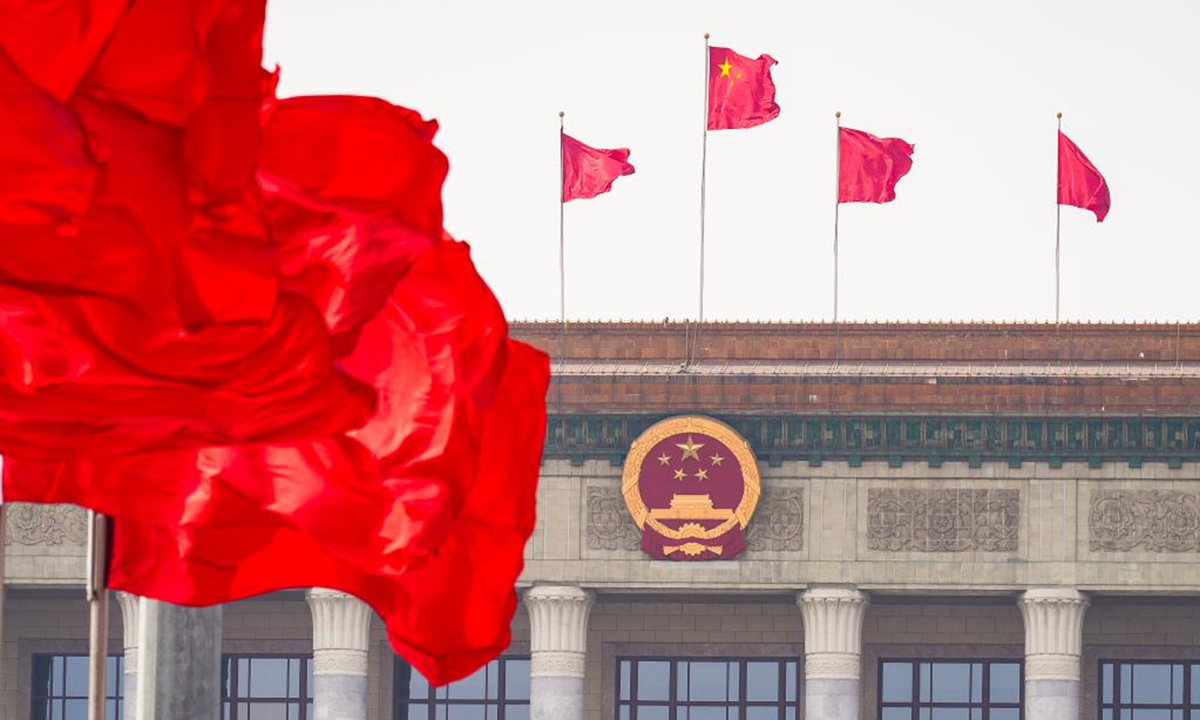
This photo taken on March 12, 2026 shows the Great Hall of the People in Beijing, capital of China. (Xinhua)
Beijing is fast emerging as the focal point of global diplomacy. China's Foreign Ministry has confirmed that Russian President Vladimir Putin will visit China from May 19 to 20—just days after US President Donald Trump wrapped up his own trip. The tightly sequenced visits have sparked widespread attention, with analysts noting that it is extremely rare in the post-Cold War era for a country to host the leaders of the US and Russia back-to-back within a week.The development comes amid a sustained influx of world leaders to China in recent months, including visits by leaders of other permanent members of the UN Security Council. French President Emmanuel Macron visited in December 2025, followed by British Prime Minister Keir Starmer in January 2026. Trump's visit, the first of an American president in nine years, has been quickly followed by preparations for Putin's arrival—an overlap that underscores both the intensity of China's diplomatic calendar and its expanding influence on the world stage.
"While the US and Russia, as major global powers, have long been at odds over issues such as the Ukraine crisis and European security, both have nonetheless designated Beijing as a 'must-visit' destination," Li Haidong, a professor at the China Foreign Affairs University, told the Global Times on Sunday. "In diplomatic history, the fact that a single country simultaneously becomes a key destination for two major powers is itself a highly symbolic moment."
Trump's visit has drawn global media attention. Trump described the trip as a "great success" and repeatedly called it "incredible" and "unforgettable." He stated that the relationship between China and the US "is going to be better than ever before."
CNN said the hours the two leaders spent together over Trump's three-day stay were full of great-power bonhomie and effusive praise from the American president, who called the US-China relationship one of the "most consequential" in world history.
"All those soundbites and pats on the back created a fitting backdrop for China's announcement of a new era of 'constructive strategic stability' between the two powers - one focused on cooperation and managed competition, rather than the volatile rivalry of last year," CNN reported, adding that "a stable US-China relationship can have positive effects for the global economy, just as its frictions can upend trade."
Following the release of China's official readout on the outcomes of Trump's visit, the announcement drew immediate and widespread international media attention.
Major global outlets, including Reuters, CNN, the New York Times, and Bloomberg, quickly highlighted key results such as China's commitment to purchase Boeing aircraft, increased imports of US agricultural products, and the establishment of new bilateral mechanisms like the Board of Trade and the Board of Investment.
Malay Mail, a Malaysian news outlet, reported that analysts broadly agree the summit reflects a shared near-term interest in stabilizing China-US relations.
"The goal in Beijing is not necessarily to bridge a decade-long trust deficit in a three-day summit, but to prevent further accidental escalation," the report cited Zhao Hai, director of the International Politics Program at the National Institute for Global Strategy, as saying, adding that careful coordination and transparent dialogue are essential to maintaining long-term stability.
Behind the simultaneous engagement of all four UN Security Council permanent members lies a collective recognition among major powers of China's global standing, Li said, further noting that on core issues such as economic recovery, climate governance, nuclear non-proliferation, and regional security, no major international agenda can move forward without China.
According to Li, Russia seeks to deepen China-Russia strategic coordination, while further advancing cooperation in energy, trade, and industry to help stabilize the Eurasian security landscape. The US, he said, adopts a more pragmatic approach, aiming to engage China to help address both domestic challenges and external pressures. France, for its part, pursues European strategic autonomy, seeking to leverage China's market to reduce external dependence, while expanding cooperation in aviation and nuclear energy to enhance Europe's global influence. UK Prime Minister Keir Starmer, meanwhile, seeks to preserve trade and financial ties with China in an effort to find economic relief in the post-Brexit context.
Despite differing priorities and positions, all four countries share certain common ground: none seeks full decoupling or confrontation with China, all recognize the irreplaceability of the Chinese market, and all view China as a stabilizing force in an increasingly turbulent world, experts said.
Beyond the visits by major powers, a wider pattern is taking shape as leaders from across the world continue to arrive in China. Beijing has seen a string of symbolic moments in recent months, including the Spanish king's first visit in nearly two decades and Spanish Prime Minister Pedro Sanchez's fourth trip in four years. Addressing an audience at Tsinghua University, Sanchez cited Matteo Ricci's historic map to argue that the modern world must move beyond the Eurocentric perspectives formed 400 years ago.
South Korea's president also ended a nine-year diplomatic hiatus with a renewed visit to China. Leaders from Ireland, Canada, the UK, and Finland have also made trips after years-long gaps. Against this backdrop, 2026—marked as the APEC "China Year"—will see China host major multilateral gatherings, highlighting Beijing's expanding influence at the center of global governance.
Unlike traditional diplomatic negotiations marked by formality and restraint, this wave of leaders' visits to China carries a more vivid human dimension, becoming a window through which Western audiences are reassessing the country, experts noted.
Macron was seen jogging in sportswear along a lakeside in Chengdu, Southwest China's Sichuan Province. Starmer strolled through Shanghai's Yuyuan Garden, sampling traditional Chinese snacks and engaging warmly with local residents, and also appeared alongside actress Rosamund Pike - praised online for her fluent Chinese - at a cultural exchange event. Trump visited Beijing's Temple of Heaven, with the same vantage points later becoming popular photo spots among domestic and international tourists alike.
By stepping into local neighborhoods and everyday settings, visiting leaders have shown efforts to better understand China's real society and the logic of Chinese modernization, experts said.
'Rock-solid' ties
Prior to Putin's visit, on Sunday, Chinese President Xi Jinping and Putin each sent congratulatory letters to the 10th China-Russia Expo, Xinhua News Agency reported.
This expo is an opportunity for various sectors of the two countries to leverage their geographical proximity and complementary advantages, deepen all-round practical cooperation, further promote the economic and social development, and enhance the well-being of the two peoples, thereby making contributions to the steady and long-term development of the China-Russia comprehensive strategic partnership of coordination for a new era, Xi said in the letter, per Xinhua.
In his message, Putin said the expo has evolved into the largest exhibition event between the two countries, providing a platform for direct and in-depth dialogue between the two sides. This expo will bring new prospects of mutually beneficial cooperation between the two countries, Putin said, per Xinhua.
Among visiting leaders, Putin is undoubtedly the incumbent head of a major country who has visited China most frequently, Zhang Hong, a research fellow at the Institute of Russian, Eastern European and Central Asian Studies at the Chinese Academy of Social Sciences, told the Global Times.
China-Russia relations are currently at their best in history. Quoting a poem by Tang Dynasty poet Du Fu, Chinese Foreign Minister Wang Yi described China-Russia ties at a press conference on the sidelines of the Two Sessions this year as "unmoved by wind and rain, as steady as a mountain."
Speaking at a previous press conference, Putin described cooperation between states like China and Russia as "undoubtedly a factor of deterrence and stability" in global affairs, said Xinhua on May 10.
According to the Russian statement, the timing of Putin's visit was highlighted at the outset: "The Russian President's visit is timed to coincide with the 25th anniversary of the Treaty of Good-Neighborliness and Friendly Cooperation, which serves as the basis for interstate relations."
Putin's upcoming visit has also drawn media attention. Russia's TASS news agency, citing Kremlin spokesperson Dmitry Peskov, reported that Putin will discuss the full spectrum of bilateral ties as well as international affairs during his visit to China.
"The agenda is clear: bilateral relations come first, including our special privileged partnership and impressive trade and economic cooperation, with its annual value consistently above $200 billion," Peskov noted. "Of course, active discussions of international affairs will also be on the agenda," he added.
With China-Russia comprehensive strategic partnership of coordination for a new era, China and Russia have numerous practical cooperation needs. Putin's visit to China this time acts as an accelerator for the development of China-Russia relations, playing a facilitating role in steadily advancing bilateral ties, Zhang said.
According to the Kremlin, a joint statement along with a number of bilateral intergovernmental, interdepartmental, and other agreements, will be signed following the talks. Experts noted that this reflects a concrete intergovernmental cooperation agenda, with China-Russia relations combining top-level strategic guidance and extensive implementation through coordinated government and enterprise cooperation.
"The international landscape is undergoing profound transformation,'' Feng Shaolei, director of the Center for Russian Studies at East China Normal University in Shanghai, told the Global Times. Developments such as the rise of artificial intelligence, shifts in global power structures, and changes in major countries' domestic and foreign policies are reshaping the world in ways that were difficult to anticipate 30 years ago. Against this backdrop, he stressed the need for China-Russia cooperation to remain adaptive and responsive while staying grounded in its founding principles.
RELATED ARTICLES