China cracks down on illegal drone hacking as altered flights pose public safety, state security risks
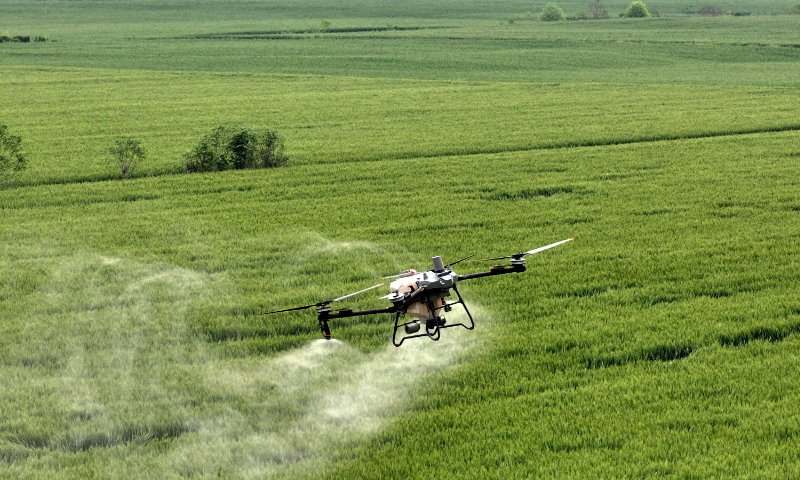
A farm-use drone sprays pesticides at wheat fields to control diseases in Mengcheng county, East China's Anhui Province, on April 29, 2026. Mengcheng county government recently deployed nearly 1,000 plant protection drones to help local farmers control pests and increase harvest. Photo: VCG
Chinese police have intensified a nationwide crackdown on the illegal hacking of drone flight control systems, as the Ministry of Public Security (MPS) on Monday released 10 typical cases involving suspects illegally hacking drone flight control systems to bypass no-fly zones, altitude limits, and other safety restrictions, seriously disrupting airspace order and posing risks to public and national security, with some cases potentially involving the leakage of state secrets.
In recent years, unauthorized "black flights" by drones with hacked flight control systems seriously disrupt airspace order and pose potential risks to public and national security, according to a post published on the official WeChat account of the ministry's cybersecurity department.
The MPS said that providing unauthorized services for drone owners to remove no-fly zones, altitude limits, and other restrictions, and evading regulatory oversight, is an illegal and criminal act, per the post.
Drones with their altitude limits removed may intrude into civil aviation routes, increasing the risk of collisions and potentially causing serious consequences. Drones with their no-fly zone restrictions hacked may fly into restricted areas such as military management zones, potentially leading to the leakage of state secrets. Drones with their performance parameters such as payload capacity altered are extremely prone to losing control and crashing during flight, directly endangering the safety of the people's lives and property, according to the MPS.
The MPS said its cybersecurity department has maintained high-pressure oversight against hacking activities, targeting those who provide services to remove built-in drone restrictions or conducting such "black flights."
In one case uncovered by police authorities in Luzhou, Southwest China's Sichuan Province, a suspect surnamed Hou led a gang that tampered with the payload parameters of large agricultural drones. The modified drones could cause damage to high-voltage power facilities, fall out of control, or drop heavy objects, leading to forest fires or public safety incidents. Hou and four others were arrested in March, and more than 30 drones were found altered.
In Shanghai's Fengxian District, a suspect named Li was caught in March for creating and selling software that removes drone flight restrictions. Li had sold the hacking tools via e-commerce platforms since 2022 and illegally modified over 100 drones.
Other cases were reported in localities including East China's Fujian Province, Central China's Hunan Province, and Northwest China's Gansu Province. The suspects, mostly in their 20s to 40s, provided hacking services to remove no-fly-zone and altitude restrictions, often through online channels. Law enforcement has arrested all individuals involved, and investigations were ongoing.
According to the MPS, illegally hacking drone flight control systems may violate certain articles in the Criminal Law, constituting offenses such as illegally controlling computer information systems or providing programs and tools for such intrusions.
Operating hacked drones in controlled airspace is also strictly forbidden. Under relevant regulations on unmanned aircraft flight management, violators may face fines of up to 500 yuan ($69). In serious cases, the drone will be confiscated, and fines ranging from 1,000 to 10,000 yuan may be imposed.
Those who violate public security regulations may face administrative detention; if the violations constitute crimes, criminal liability will be pursued. Offenders will also bear civil liability for any damage caused.
Airspace is not a lawless zone, the MPS warned, vowing to continue the tough stance against illegal hacking and unauthorized drone flights.
Xiang Ligang, director-general of the Zhongguancun Modern Information Consumer Application Industry Technology Alliance, a telecom industry association, told the Global Times on Monday that proper regulation is the prerequisite for the low-altitude economy to take off.
"Setting up the legal boundaries for the emerging sector is of great importance to its sound development in the future," Xiang said, noting that drones can cause great hazard to public safety and security if unregulated.
RELATED ARTICLES