AFP Fact Check debunks AI video clip of ‘Chinese government tearing down Tibetan temple’ that misleads online
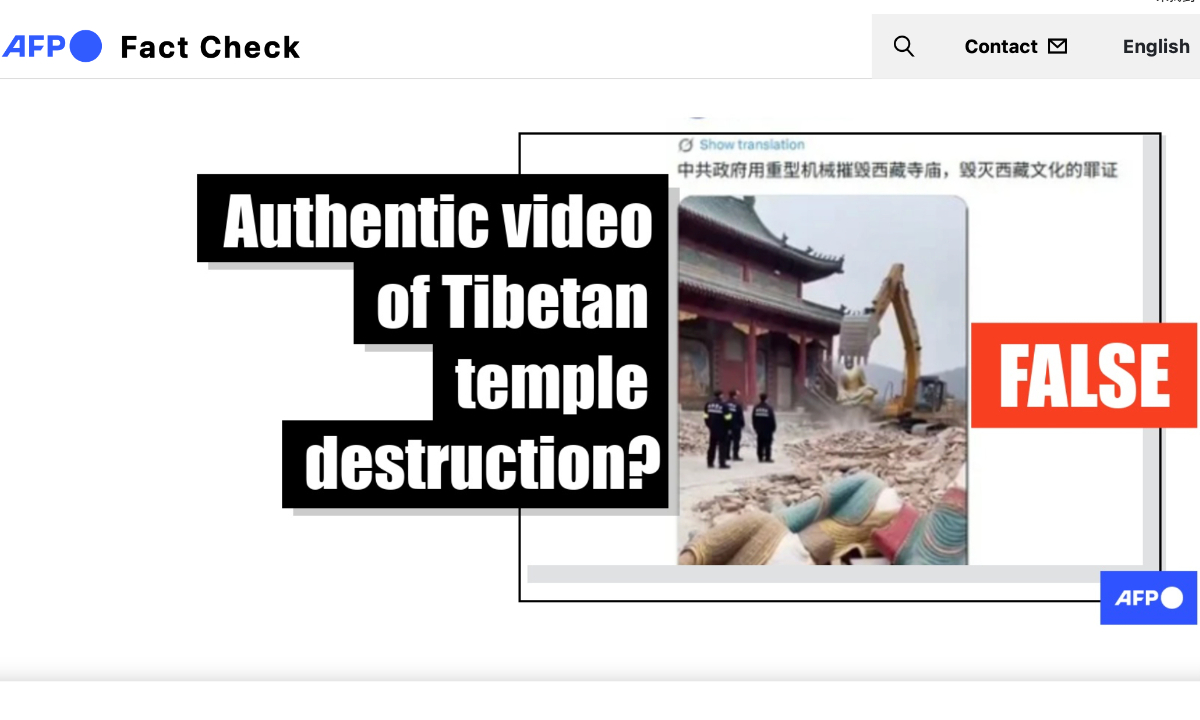
Photo: Screenshot from the website of AFP Fact Check
AFP Fact Check has debunked a video clip claiming that the Chinese government tore down a Tibetan temple in Southwest China’s Xizang Autonomous Region, pointing out that the AI-generated video contains “visual and logical inconsistencies that are characteristic of synthetic content.”
AFP Fact Check traced the video’s earliest version to an X account @xinwendiaocha, known for frequent anti-China posts, according to its May 7 report.
The video purportedly showing the demolition in Xizang spread across social media, with the claims also spreading in English, Japanese and Korean posts on X, according to AFP.
The account published on April 27 the video titled “Evidence of the Chinese Communist Party's government’s use of heavy machinery to destroy Tibetan temples and Tibetan culture,” AFP reported.
The 15-second clip shows officials apparently giving instructions to an excavator operator attempting to destroy a Buddha statue outside a temple, with debris scattered in the foreground, according to AFP.
An analysis by the Hive Moderation AI detection tool found the video was “likely to contain AI-generated or deepfake content.” The tool identified Sora 2 – OpenAI’s now-defunct video generator – as the probable source. The tool gives users the option to generate clips up to 15-seconds long, the AFP report said.
The report also pointed out that a close look at the video also reveals visual and logical inconsistencies that are characteristic of synthetic content.
According to AFP, the excavator operator tries and fails to lift a statue, but when it drops to the ground the debris beneath does not appear to react to the impact. In addition, text on the men’s jackets is blurred and illegible.
A piece of a Buddha statue in the foreground appears to be a single leg with two feet attached, while the voices heard in the video appear to warn the excavator about a pillar behind it, though the video shows the building is in front of it, per AFP.
AFP said a US-based non-profit advocacy group, told the news agency on May 6 that it did not recognize the building in the clip as distinctly Tibetan.
Many netizens also debunked the video, commenting that it was AI-generated.
One netizen commented that “They really think we’re fools who can’t tell it’s AI.”
"Are you serious? Does this temple even look Tibetan?" another questioned.
Another netizen speculated that it might be a fake temple built by some unscrupulous merchant to defraud tourists of their money, and the netizen supported authorities in cracking down on this kind of illegal activity in accordance with the law.
According to chinanews.com, under relevant regulations such as China’s Regulations on Religious Affairs and the measures for the administration of Tibetan Buddhist temples, all legally registered religious sites, including Tibetan Buddhist monasteries, are protected by law. Legally compliant ethnic and religious buildings would never be arbitrarily demolished.
A closer look at the X account @xinwendiaocha, which means “news investigation” in English, shows that its feed is filled with anti-China content based on unclear sources and taken out of context. Under the guise of producing in-depth content, the account chases traffic without regard for professional standards, recklessly undermining the credibility of journalism and showing no sense of professional ethics, chinanews.com reported.
AI-generated anti-China disinformation campaigns have repeatedly been exposed by international media, according to chinanews.com. Last October, AFP Fact Check also debunked a fake video that alleges Chinese authorities demolished a Muslim mosque, finding the structure was actually an illegal structure at an amusement park in Indonesia. More recently, Asahi Shimbun reported a black-market chain has emerged in Japan that uses AI to mass-produce anti-China videos, involving deepfake-based opinion manipulation and historical revisionism, per chinanews.com.
Global Times
RELATED ARTICLES