Photo: VCG
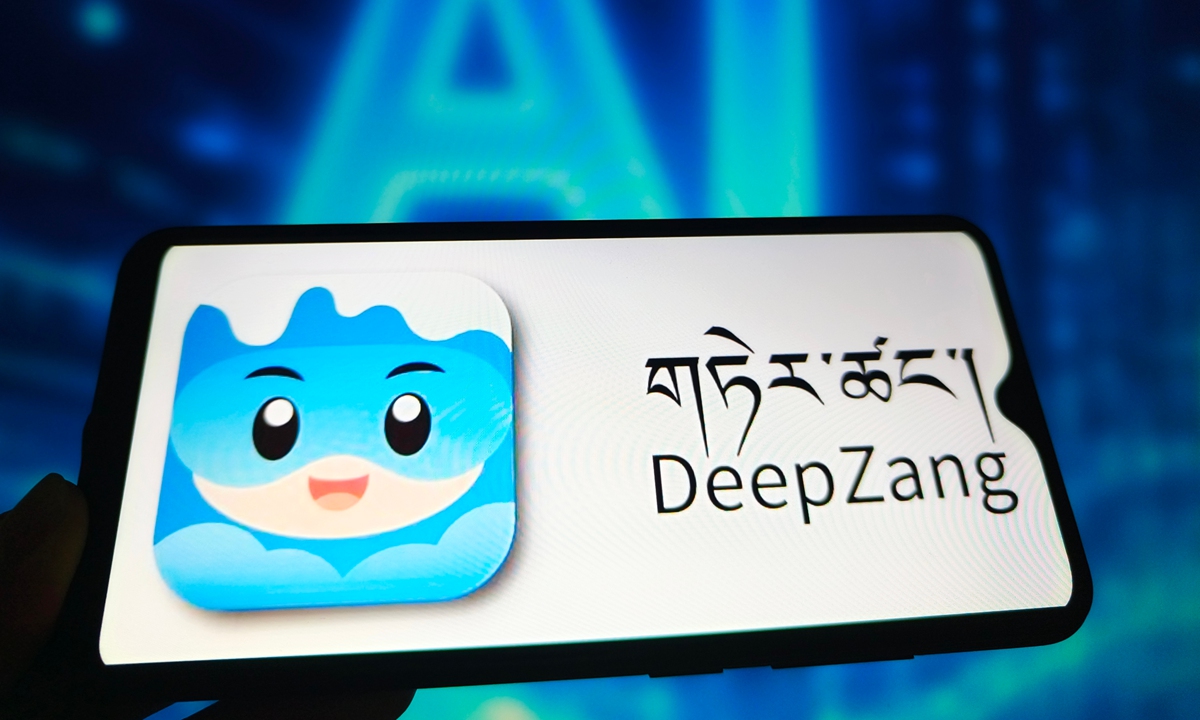
The world's first Tibetan large language model and its application, DeepZang, has been officially unveiled in Lhasa, Southwest China's Xizang Autonomous Region. This model fills the gap in indigenous large language models at both the national and ethnic levels, while also facilitating the innovation and inheritance of Tibetan ethnic culture in the AI era, the company's chairman told the Global Times.
Developed independently by CHOKNOR Information Technology Co., Ltd. in Xizang, the model and its application are the first Tibetan large language model to complete national filing for generative AI in China, filling a technological gap in this field globally, according to local media Tibet.cn.
The World Record Certification Agency (WRCA) also awarded the certification of "the World's first Tibetan large language model" at DeepZang's launch event, chinanews.com reported on Monday.
Tenzin Norbu, chairman of the CHOKNOR company, told the Global Times on Monday that this open-source large model platform is China's first ethnic language AI open platform designed for multilingual and multimodal capabilities. The DeepZang platform supports over 80 languages, including Tibetan, Putonghua, English, Mongolian and Uygur, enabling an integrated approach to listening, speaking, translating, recognizing and thinking, Tenzin added.
The DeepZang model marks a strategic leap for China to take the lead in the AI field for ethnic languages, officially inaugurating the high-quality AI development of Tibetan-language in Xizang and dawning the era of AI for the Tibetan language, Tibet.cn reported.
The DeepZang application was also launched on Sunday, supporting intelligent interactions in Tibetan, Putonghua and English. Users can speak or type a sentence to access real-time mutual translation, Tibetan-language Q&A and cultural knowledge inquiries, according to the report.
Shortly after its launch on Sunday, the app recorded an average of 4,000 downloads per hour, the Global Times learned from the company.
Tenzin said the company has built a high-quality parallel corpus of nearly 70 million precise Tibetan-Putonghua language pairs. Additionally, they have completed large-scale speech data collection across the three major Tibetan dialect regions, establishing China's largest and accurately annotated Tibetan speech database to date, he added.
As shown in a video released by the Xizang Daily, several users voice-inputted instructions in different Tibetan dialects, and the application achieved accurate recognition and delivered prompt responses with high efficiency.
Tenzin said the development of this large language model has filled the gap in Tibetan large language models at the national and ethnic levels, and it also gives full play to the Tibetan cultural value, facilitating the innovation and inheritance of Tibetan ethnic culture in the AI era.
An official from Lhasa people's government was quoted by Tibet.cn as saying that the successful development of DeepZang has provided a valuable exploratory model for the global AI community in the processing of low-resource languages. It stands as a testament that modern information technology can effectively underpin the preservation and development of traditional cultures, the official added.
"Through this large language model and its application, we also aim to provide an authentic platform for global users seeking to learn about Tibetan culture, history and politics, thereby preventing the dissemination of distorted ideologies and values," Tenzin said.
In another video posted by the Lhasa Women's Federation on its official WeChat account, a student from Xizang University said that DeepZang's translation function is very useful, though the translation of some four-character idioms is still not fully developed.
Tenzin said that the model is currently limited by the scope of its corpus data, and the company will continue to refine and update it based on user feedback.
In the future, this large language model is set to extend its capabilities to sectors including education, healthcare and ecology, delivering convenient and efficient services to enterprises and government agencies, according to Tenzin.
RELATED ARTICLES