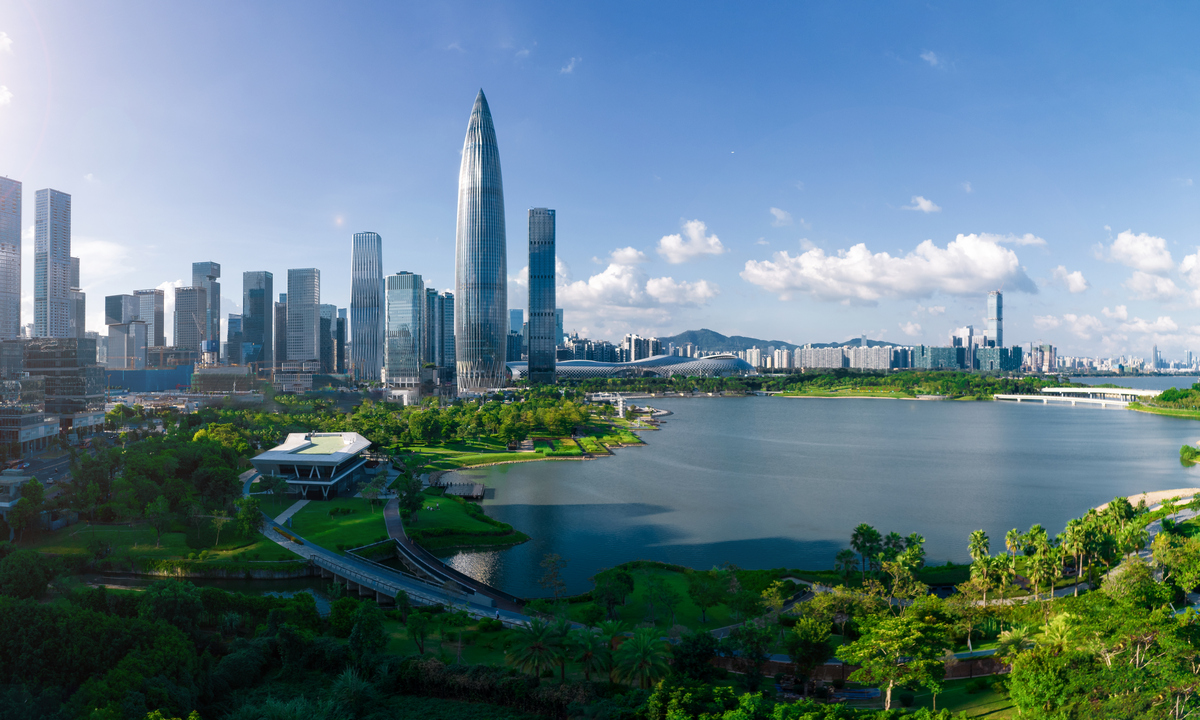
Aerial view of Shenzhen's CBD area in South China's Guangdong Province File photo: VCG
In the first quarter, China recorded better-than-expected GDP growth of 5 percent. This strong performance sends a clear and positive message to the world, effectively refuting the narrative promoted by some Western analysts that China's economy is on the brink of collapse or already in crisis. It is true that China faces certain economic challenges. However, every country encounters its own difficulties and overall, China maintains a very solid and resilient economy.
A key factor behind this strength is the Chinese government's effective top-level design, including its five-year plans and targeted industrial policies in strategic sectors such as robotics and semiconductors. This is precisely the kind of approach European leaders could learn from. While the European market often struggles to respond effectively during crises, European governments — instead of actively encouraging investment — tend to impose more regulations that create additional obstacles for investors.
China does the opposite. The government plays a strong, proactive role in driving and supporting investment. This approach is what makes China's vast market, backed by steady 5 percent GDP growth in the first quarter, highly attractive to European companies and forward-looking European leaders, many of whom have been visiting China in increasing numbers in recent months.
Economic success
China's new-energy vehicle (NEV) exports reached 1.384 million units in the first four months of the year, up 1.2 times year-on-year, according to data released by the China Association of Automobile Manufacturers (CAAM). This offers a tangible example for international observers and the media to gauge the broader strengths of the Chinese economy. The NEV sector is a perfect example of China's economic success. It's not just about quantity — China has gone from having a very small EV industry just a few years ago to becoming the world's largest.
Another highlight of the world's second-largest economy is the strong industrial investment. In the first quarter, China's high-tech industrial investment grew 7.4 percent year-on-year, according to data from the National Bureau of Statistics. One explanation for this first-quarter growth is that, contrary to what some Western analysts claim, China was investing even more. This increased investment leads to higher-quality production, which in turn attracts more talent. Ultimately, this helps address wage levels and stabilize employment.
China is now at the start of the 15th Five-Year Plan (2026-30) period and is embarking on a high-quality economic development trajectory, with a focus on such sectors as green transformation, the digital economy, and expanding domestic demand.
From my perspective, this represents a clear win-win opportunity for European companies. Take the green transformation as an example. As artificial intelligence (AI) takes off, global energy demand will surge dramatically as AI is extremely energy-intensive. Against this backdrop, Europe, which lacks sufficient oil and gas resources, faces a serious energy supply challenge. In principle, Europe could deepen cooperation with energy-rich countries, but current geopolitics makes that difficult. And at the same time, Europe has been slow to develop its own large-scale green technologies like solar and wind due to various environmental and regulatory constraints.
This is where China can play a constructive role. China has an abundant supply of solar panels and other green technologies, which could be supplied to Europe at competitive prices. I also suggest that China and Europe could jointly develop large-scale solar power plants in third-party markets, such as North Africa. Using Chinese components and technology, combined with European expertise and investment, these plants could generate clean electricity in the sun-rich Sahara Desert and transmit it back to Europe via modern high-voltage lines with relatively low transmission losses.
In short, this kind of joint development between China, Europe, and Africa would be a genuine trilateral win-win-win project, as Chinese companies could gain access to major new markets and project opportunities, and Europe could secure reliable and affordable green energy. For African host countries, it also represents a full utilization of their natural resources, upward movement in the value chain, job creation, and support for their own energy needs.
I also encourage foreign investors and European companies willing to invest in the Chinese market to consider investing in industries included in the 15th Five-Year Plan (2026-30), for example brain-computer interfaces, embodied AI, quantum technology and biomanufacturing.
Lesson for EU
Recent months have seen numerous European leaders visiting China, yet at the institutional level, the EU continues to introduce restrictive measures against Chinese companies, such as the EU's Industrial Acceleration Act and the Cybersecurity Act. This contradictory approach — engaging individually while erecting barriers collectively — undermines cooperation and harms economic and trade relations. Ironically, while the West once hoped China would become more open, it is now Europe that is becoming increasingly closed.
EU leaders should rethink their foreign policy stance on China. They had once labeled China a "systemic rival," imposed tariffs on Chinese EVs, and pushed for so-called decoupling from China. They later shifted to terms such as "de-risking" and "diversification." I suggest that the European leaders adopt a long-term vision that extends beyond short electoral cycles. Europe should learn from China's successful practice of five-year plans. Developing similar five- to ten-year strategic frameworks would provide clearer direction and enable consistent policy execution.
The author is a former Italian undersecretary of state and NYU Shanghai adjunct professor.
RELATED ARTICLES