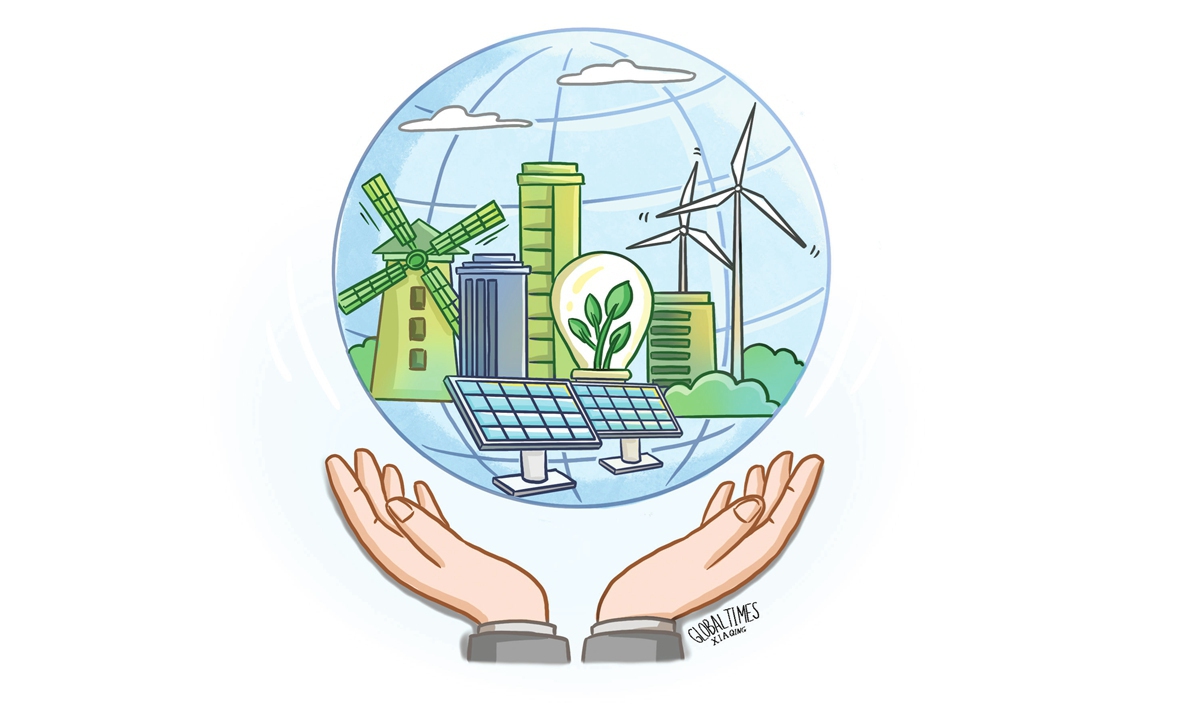
Illustration: Xia Qing/GT
The Indian government has advised private companies and organizations to adopt a two-day work-from-home policy in order to reduce daily energy consumption and ease supply pressures, China's state broadcaster CCTV News reported on Monday.The move is part of the Indian government's broader effort to curb fuel use amid rising international crude prices. Behind this fuel-saving campaign lies not merely short-term energy pressure, but the structural shortcomings of India's energy system, and challenges that go beyond a spike in oil prices.
India is in a critical juncture of rapid economic growth and accelerating urbanization. Its industrial scale is expanding, its total energy consumption in production and daily life continues to expand, and its demand for energy is climbing steadily.
For a long time, however, India has been highly dependent on energy imports due to its limited domestic energy production capacity. In a world where geopolitical tensions disrupt supply chains and cause volatile international oil and gas prices, this dependence is both expensive and risky.
As India's industrialization accelerates, the energy pressure will only intensify. This is precisely why renewable energy has moved from being a nice-to-have to an absolute necessity. This is not only a matter of India's energy security but also of its industrialization path and its commitment to carbon neutrality.
Indeed, India has set an ambitious goal of meeting its target of 500 gigawatts of non-fossil fuel power capacity by 2030. However, in key areas such as photovoltaic modules, wind power equipment, and battery storage systems, India still relies heavily on external supply. All of this points to a new opportunity for deeper cooperation between India and China in the new-energy field.
A pragmatic path for India lies in strengthening communication and cooperation with neighboring countries, including China, and tapping the potential of new-energy cooperation. Chinese companies produce solar modules, wind turbines, and other types of equipment that hold a dominant position in the global market, with clear cost advantages. For India, importing Chinese clean-energy technology and equipment would not only significantly reduce the cost of new-energy projects but also accelerate its own energy transition and enhance self-sufficiency. For China, India's vast energy market and rapidly growing installed capacity offer broad overseas development opportunities for Chinese new-energy businesses.
There is no denying that in recent years, China-India relations have experienced some twists and turns. However, the trend since 2025 suggests that bilateral ties are moving beyond a reset and fresh start toward a new level of improvement. As Chinese Ambassador Xu Feihong stated in February, exchanges at all levels have become more frequent, and economic and trade cooperation has reached new heights. In 2025, bilateral trade reached a record high of $155.6 billion, a year-on-year rise of more than 12 percent.
In the first fourth months of this year, India's exports to China surged by 36.7 percent year-on-year, according to latest data from Chinese customs.
There is huge potential for economic and trade cooperation between the two countries, not only proving the high complementarity of the two economies but also laying a solid foundation for further expanding cooperation in emerging fields, including new-energy technology.
If this momentum can be maintained and transformed into a more open and stable policy environment, cooperation in the new-energy field is expected to become a new growth point of China-India economic relations.
The deepening of China-India new-energy cooperation aligns with the development interests of both countries and will have a positive impact on regional and even global energy governance. Collaborative efforts in solar energy, wind power, and other fields could reduce the cost of clean-energy technologies, promote South-South cooperation, and provide a replicable model for other developing countries.
It is hoped that India will seize the window of improving bilateral relations, take steps in new-energy cooperation, show greater sincerity at the policy level, and remove cooperation obstacles at the operational level, so as to truly transform complementary advantages into tangible cooperation projects.
RELATED ARTICLES