‘Intergenerational support’ reveals emerging digital consumption of silver economy
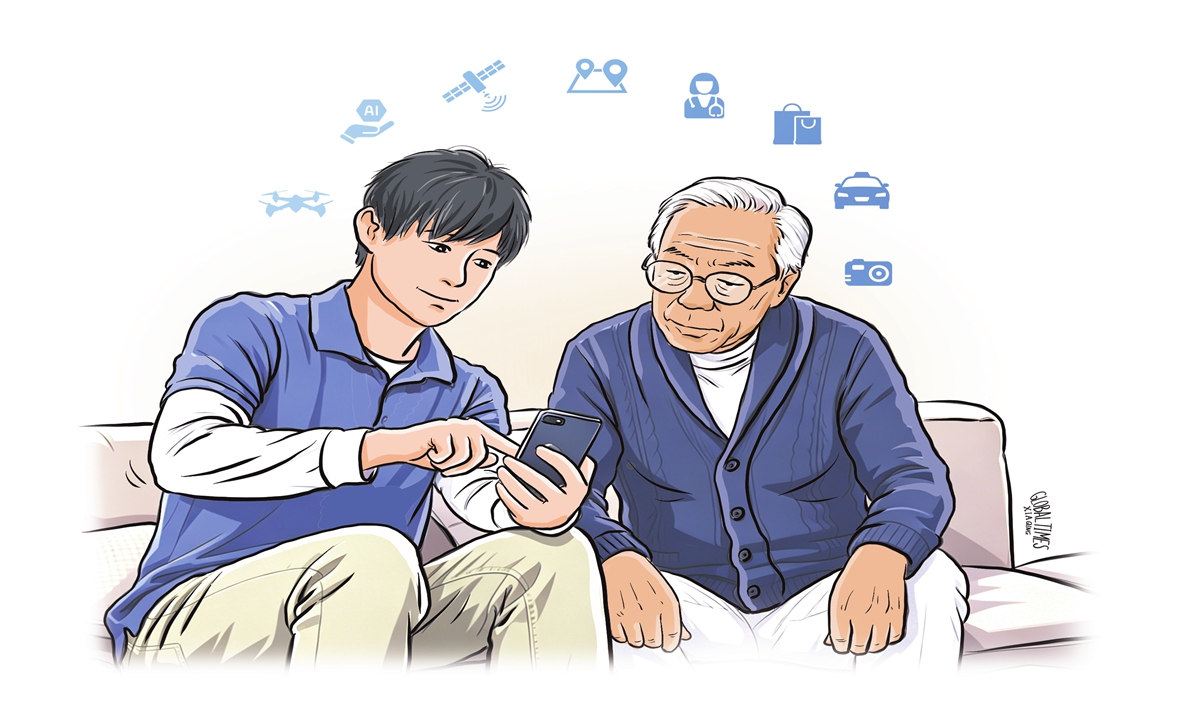
Illustration: Xia Qing/GT
Click here, swipe there, tap to close… Young adults in many Chinese households guide their parents and grandparents through the routines of digital apps and online services.A report by the People's Daily overseas edition on Monday highlighted this phenomenon, akin to intergenerational digital support, which is becoming increasingly common as younger family members help older relatives order food, schedule medical appointments, or interact with artificial intelligence (AI) tools.
Beyond these everyday interactions, the trend reflects a broader development: China's elderly population is engaging with the digital economy at a growing pace, improving daily life while gradually influencing how goods and services are consumed.
For both domestic and international businesses, catering to this demographic - technologically capable, economically active, and increasingly engaged in digital consumption - provides a practical entry point into China's silver economy.
A number of today's over-60s were born in the 1950s and 1960s and received a relatively good education. They came of age during decades of sustained economic growth in China, which, for some, provided a degree of disposable income and a willingness to explore new experiences. Retirement has given many the time to adopt new technologies and try emerging forms of consumption, enabling them to update their lifestyles and participate more fully in the digital economy.
The elderly are not relying solely on younger family members as technology guides; many are actively pursuing their own learning. The wide range of courses offered by universities for older adults across China reflects the growing diversity of lifestyles and interests among the country's silver-haired population.
Beyond traditional classes such as music or dance, many institutions now offer technology-focused courses, including 3D printing, drone photography, and AI applications, allowing older learners to engage directly with emerging digital tools.
Digital consumption among older adults is taking several directions. First, technology is influencing everyday life. For many, particularly those at the younger end of the over-60 population, digital payments, apps, and online shopping have become routine. This has prompted some providers to adapt their offerings for older users, with adjustments such as larger font sizes and simplified interfaces, reflecting a gradual adaptation of digital tools to the practical needs of this population.
Second, technology is contributing to a growing demand for companionship. Advances in AI have led to the development of robots with interactive or companion features. Short videos and mini-dramas have also become an increasingly important part of online consumption. According to a report by the China Internet Network Information Center (CNNIC), user profiles of paid short-drama consumers on China's short-video platform Douyin, the Chinese version of TikTok, indicate that users aged over 50 account for nearly 20 percent of the total. Meanwhile, 45.6 percent of online shoppers aged 60 and above are willing to pay for products and services that deliver emotional value.
Third, interest-driven consumption represents another important dimension. According to a survey released in March by the China National Committee on Aging, demand among the silver-haired population for photography-themed travel as well as new technologies and smart products are generally much higher than current consumption levels, indicating that substantial potential remains to be unlocked.
Illustrating this trend, a drone aerial photography experience and training activity for senior citizens held last year in Wuxi, East China's Jiangsu Province, attracted participants including people in their 80s, according to a report by news outlet thepaper.cn.
Beyond these areas, the digital economy is influencing silver-haired consumption in fields such as health, caregiving, and medical services.
As older adults become increasingly engaged with digital technologies, new opportunities are steadily emerging for the wider market.
According to data from the CNNIC, the number of digital consumers aged 60 and above in China has reached 117 million, accounting for 12.2 percent of the country's total digital consumer base. The digital consumption structure of the silver-haired population has evolved from basic spending toward higher-quality consumption. New consumption scenarios centered on "enjoying senior life" services are also continuing to emerge.
As technology continues to advance, particularly in the field of AI, China's population 60-plus is emerging as a group that should not be overlooked. Over past decades, this generation has made substantial contributions to the country's economic growth. Many have accumulated extensive life experience and resources, and their willingness to adopt new technologies may exceed common expectations. In doing so, they bring fresh energy to both society and the consumer market, reinforcing the role of older adults as active participants in China's evolving digital economy.
The author is a reporter with the Global Times. bizopinion@globaltimes.com.cn
RELATED ARTICLES