ARTS / CULTURE & LEISURE
Scholar revives pottery-based lacquerware skills
A remarkable fusion
By Published: May 18, 2026 09:18 PM

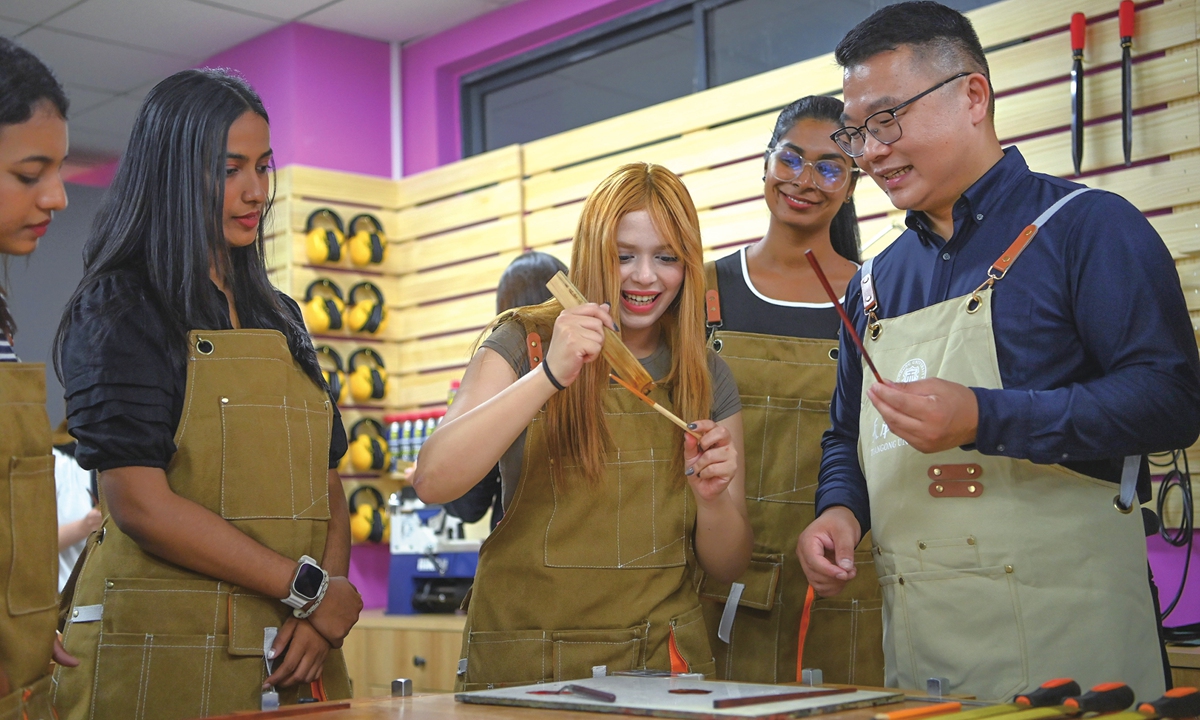
Zheng Yong (right) guides international students during a hands-on activity involving lacquerware chopstick coating techniques. Photos on this page: Courtesy of Zheng Yong
A pristine white fan surface glides gently into water, as traditional Chinese lacquer swirls and dances with the ripples before settling into an elegant Oriental pattern. This "Wuji Nafu Fan," crafted using the ancient drift-lacquer technique, is one of the signature works by Professor Zheng Yong and his team from Tiangong University.
The piece, along with other creations, drew widespread admiration at the 2025 Shanghai Cooperation Organization (SCO) Summit in Tianjin. At the welcome banquet, heads of state were captivated by another masterpiece: a grape-patterned jar, which is a stunning example of pottery-based lacquerware.
What makes these works truly remarkable is not merely their aesthetic appeal, but their role in resurrecting a lost chapter of Chinese craftsmanship. Pottery-based lacquerware, which traces its origins to thousands of years ago, was lost for over a millennium due to the extreme complexity of its techniques and fragile transmission. Its revival and subsequent inclusion in municipal intangible cultural heritage list were achieved not by traditional workshops, but by a young university team led by the 39-year-old Zheng Yong.
"We use fragments from the past to infer the wisdom of our ancestors, then verify and interpret it through modern scientific methods," said Zheng in an interview with the Global Times.
"This journey from 'loss' to 'rebirth' proves that our ancestors' ingenuity was no legend — it can withstand scientific scrutiny, be mastered by our generation, and be proudly shared with the world."
In Zheng's studio on the Tiangong University campus, time appears to slow. The scholar, often seen bending over a ceramic blank, meticulously applies layers of lustrous raw lacquer with a fine brush.
His personal journey began in 2005 when he entered the university to study decorative arts. A childhood passion for clay evolved into a profound affinity for both ceramics and lacquer. After earning his master's degree, he joined the faculty.
A pivotal moment came during a study tour abroad with his mentor, where they encountered exquisite Chinese lacquerwares displayed as national treasures in foreign museums. "These superb techniques originated in China," his mentor remarked.
The words struck a deep chord. "Seeing our cultural treasures exhibited prominently overseas while we had lost the ability to create them was unsettling," Zheng recalled. "It ignited not just urgency, but a profound sense of cultural mission."
Decoding ancient craft
Pottery-based lacquerware represents a remarkable fusion of two seemingly incompatible materials: inorganic ceramic clay and organic lacquer. Replicating a craft extinct for over a thousand years was extraordinarily challenging. Zheng and his team pored over ancient texts, consulted artisans, sourced raw materials from traditional mines, and conducted countless experiments in applying and polishing lacquer. A single piece demands more than 10 intricate steps — forming the base, baking, layering, patterning, grinding, and polishing — often spanning over a year.
"The ceramic is the 'bone,' lacquer is the 'clothing,'" Zheng explained. "Achieving the perfect bonding is like turning two people with entirely different personalities into lifelong friends — you must discover their resonance." For years, Zheng worked persistently to knock on the door of this ancient technique.
After hundreds of failures, a distinctive "Zheng-style lacquerware" emerged. He innovatively combined high-level intangible heritage skills — such as thousand-year-old jump-knife patterns and Tang Dynasty (618-907) "mojinlü" (gold-thread inlay) — with the warm texture of pottery bases and the profound depth of lacquer.
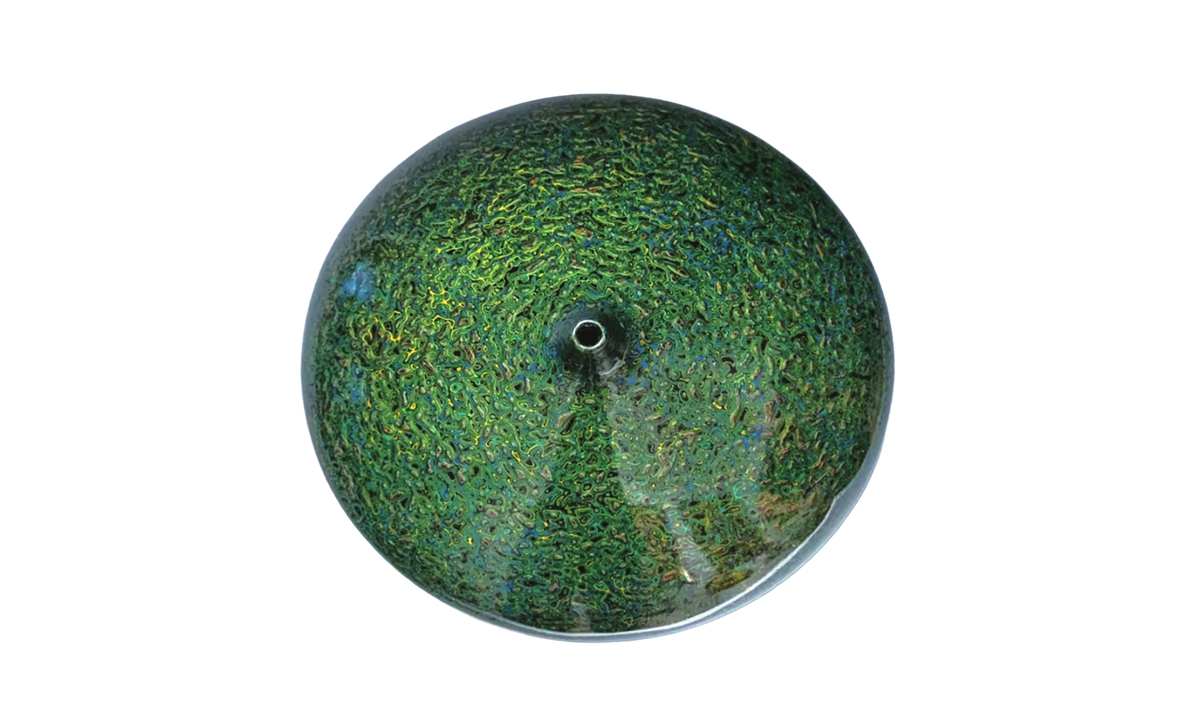
A pottery-based lacquerware created by Zheng Yong
Science bridges gap
Early efforts hit repeated bottlenecks due to material incompatibility. Shelves of "failed works" in the studio bear witness to these struggles. A breakthrough came through Tiangong University's "Art-Engineering Integration" platform. Multidisciplinary teams from Materials Science, Textile Science, and Computer specialties joined forces. Materials scientists analyzed interfaces under microscopes and introduced surface modifiers as "molecular interpreters."
Textile experts incorporated ceramic fibers into the clay, creating a lighter, microporous structure after firing that provided better anchors for lacquer layers. Computer specialists used 3D scanning and intelligent sensors to map microscopic stress distributions. The result was a breakthrough: lacquer plates with mirror-like surfaces, rich vibrant colors, and the perfect fusion between pottery and lacquer after a millennium.
"We used scientific data and microscopic analysis to prove our ancestors relied not on magic, but on extraordinarily refined empirical techniques," Zheng said. "We didn't just restore the appearance — we decoded the underlying logic of ancient creation."
From museums to modern life
A single pottery-based lacquerware requires 60 to 80 layers of lacquer and more than a year of dedicated work. To make the craft viable, Zheng's team introduced modern innovations: constant-temperature and humidity drying systems, intelligent sensors, and "digital drying curves" that maintain quality while significantly shortening production time.
"Technology is an accelerator, not a shortcut for laziness," Zheng emphasizes. "We want lacquerware to 'live' in the present, not merely 'lie' in museums."
The team has re-engineered traditional designs into contemporary tea sets, incense utensils, and scholarly accessories that blend minimalist aesthetics with ergonomic functionality.
"When young people find it 'cool' to drink tea from a lacquer cup, lacquerware has truly returned to daily life," he noted. "This is the best form of living heritage."
As a university educator, Zheng stresses to his students the value of dedication: "Real worth lies in locating your era's cultural coordinates within a thousand-year-old craft." It took him roughly 15 years to revive pottery-based lacquerware.
"This is our generational responsibility — reconnecting broken cultural genes." To youth interested in cultural preservation, he advises: "Don't fear the 'cold bench.' Be willing to become guardians of time. In this fast-paced era, slow down to deeply engage with our culture. In every cut, chisel, and brushstroke of lacquer lies the soul of our nation — and a quiet strength capable of withstanding modern clamor."
Zheng's story transcends the revival of one craft. It exemplifies how China's younger generation, equipped with modern science and deep cultural confidence, is bridging ancient wisdom with contemporary needs. At a time when intangible cultural heritage faces global preservation challenges, his team's success shows that tradition and innovation are not opposites, but powerful allies in carrying forward the brilliance of Chinese civilization.
RELATED ARTICLES