Beijing’s Siyuan Bridge, an inner-city artery link, completes renovation in 4 weekends, opening to traffic on Tuesday
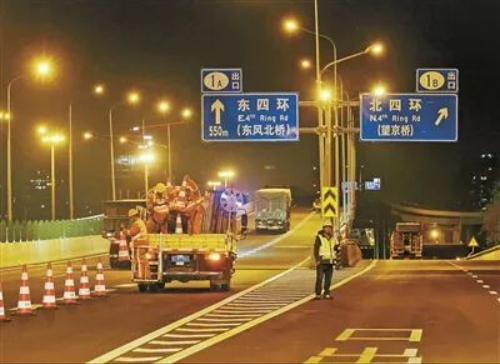
Beijing Siyuan Bridge concrete pavement renovation project Photo: Beijing Youth Daily
The Siyuan Bridge, a transport artery link in Beijing, completed renovation in the early hours of Tuesday, the Beijing Youth Daily reported. The project was finished in four 48‑hour weekends, setting a benchmark for urban infrastructure upgrading in the Chinese capital and highlighting China’s construction efficiency.
The overpass is a vital bridge connecting Beijing’s Fourth Ring Road, the Capital Airport route and other major highways often with heavy daily traffic flow. The renovation covers 13 of the overpass system’s 19 bridges.
Most bridges have been in service for more than three decades. Heavy traffic and protracted weather exposure have caused pavement aging and surface cracks, requiring urgent renovations.
The project marks the first surface renovation of an overpass at the city’s key traffic hub. It required solid technical expertise, minimal traffic disruption and stringent safety standards. To minimize disruption to residents’ daily travel, the project adopted a construction schedule featuring four 48-hour construction windows during weekends.
The construction teams deployed experienced workers to undergo round-the-clock operations. Work was carried out in strict accordance with unified standard workflows: full milling of worn asphalt layers, dismantling of deteriorated concrete pavement and original waterproof structures, casting of new concrete slabs and laying of new waterproofing materials.
Seven construction steps were completed in orderly sequence, namely defect inspection, base surface treatment, steel reinforcement arrangement, concrete placement, maintenance curing, asphalt paving and traffic marking application.
How was the renovation finished within four weekends? This was achieved through optimized construction arrangements, upgraded construction technologies and sound emergency response mechanisms.
Zhang Peng, Director of the Technology and Quality Department at the Beijing Urban Construction Municipal Engineering Group, told Beijing Youth Daily that the project’s biggest highlight lies in its weekend-focused construction schedule. By carrying out construction on weekends while reopening roads on workdays, the scheme well balances engineering progress and local residents’ daily travel needs.
Another highlight is construction technology. The 48-hour weekend construction windows placed extremely high demands on construction process, material sciences and on-site arrangements. “It’s similar to household floor laying—one process must be completed before the next can start. The limited construction window places strict demands on workflow coordination and efficiency,” Zhang noted. To address the issue that conventional C40 concrete would not dry and open to traffic within 48 hours, the team replaced it with C70 concrete, which shortens construction process while ensuring project quality.
The project team also equipped key on-site personnel with walkie-talkies to improve coordination efficiency. And, the project formulated detailed hour-by-hour contingency plans for material transportation routes, equipment deployment and key timelines for different construction phases, ensuring smooth work progress.
A third highlight lies in the emergency contingency plan for abrupt weather shifts such as rain and wind. The project team has established communication links with Chaoyang District Meteorological Bureau to obtain accurate weather forecasts.
During last weekend’s rainfall, the construction team did not simply wait for fine weather. Instead, they assigned dedicated staff on site to monitor weather changes and provide real-time rainfall updates. Meanwhile, based on meteorological forecasts, they moved forward rain-sensitive procedures such as steel bar installation to avoid delays to the overall construction schedule.
Nowadays, the bridge known as the "No.1 Gateway Bridge" that has served urban traffic for 33 years has reopened to traffic with smooth pavement, clear road markings and restored traffic flow. Its brand-new look delivers safer and more comfortable travel conditions for local residents.
RELATED ARTICLES