Large number of Filipinos living, working on Taiwan island and geographic proximity are not excuse for interference in another country’s internal affairs, says FM over Marcos’ Taiwan-related remarks
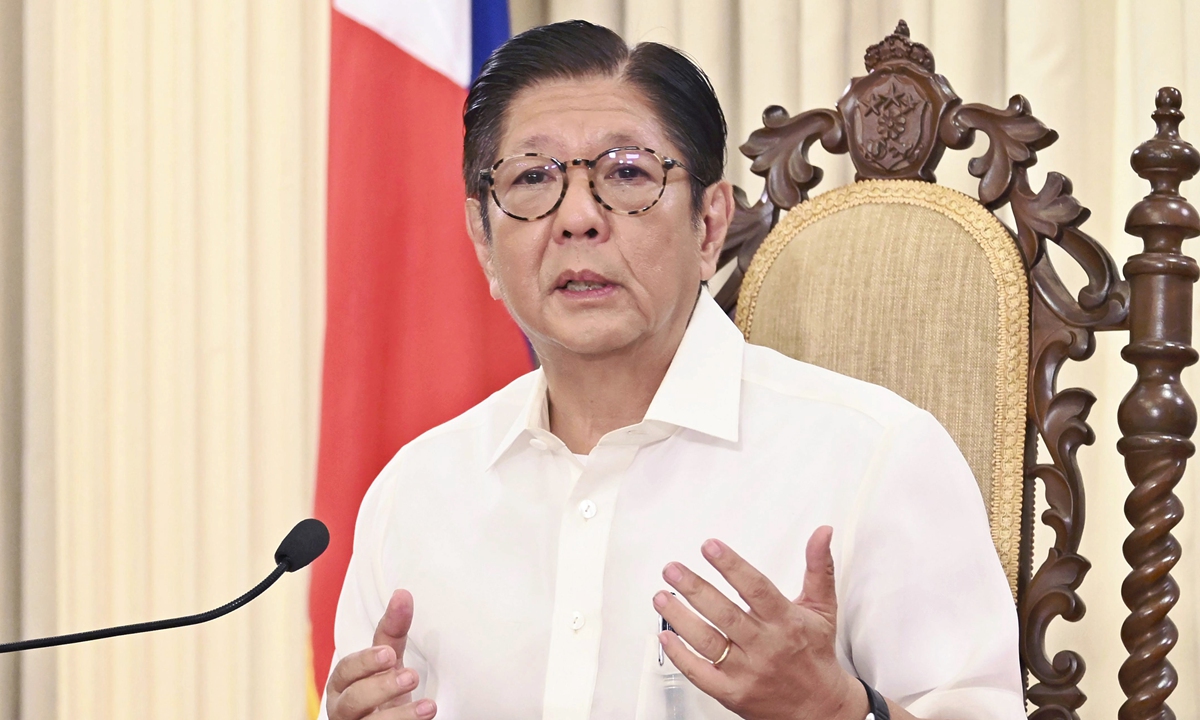
Philippine President Ferdinand R. Marcos Jr. speaks during an interview with Japanese media at Malaca?ang Palace in Manila, Philippine, on May 18, 2026. Photo: VCG
China has taken note of the Philippine leader reaffirming the adherence to the one-China policy and stressing that the country would not interfere in issues concerning Taiwan, and it should be emphasized that a large diaspora population and geographic proximity are not excuse for interference in other countries' internal affairs or involvement in other countries' sovereign issues, Chinese Foreign Ministry spokesperson Guo Jiakun said on Tuesday.
The remarks came after Philippine President Ferdinand R. Marcos Jr., in an interview with Japanese media ahead of his planned visit to Japan next week, said on Monday that the Philippines would not interfere in issues concerning China's Taiwan region, however meanwhile, claimed that the Philippines would unavoidably be affected in the event of any heightened tensions in Taiwan, particularly since there are almost 200,000 Filipinos working and living on the island, according to Philippine media outlets.
China hopes the Philippines will honor its commitments, act consistently, and uphold the one-China principle in practice, Guo told a regular press conference.
A Chinese expert said the remarks show Marcos' duality in that he says he is adhering to the Philippines' established one-China policy, while also tends to adopt an ambiguous stance on the Taiwan question for strategic interests. The expert also noted that Marcos' remarks may also be intended to align with Japan amid the latter's continuous military expansion.
In an interview with Japanese media on Monday, Marcos said the Philippines has consistently observed the one-China Policy, which recognizes the People's Republic of China as the only Chinese sovereign state, the Philippine News Agency (PNA) reported.
"I have to make it very clear. The Philippines has, from the very start, always held a one-China policy. We have always held a one-China policy, and we will continue to do that," Marcos said, per the PNA.
While Marcos said the Philippines does not meddle in what it considers an internal matter, he also claimed to call for the peaceful resolution of tensions involving Taiwan, and that is "what everyone's ultimate goal is in Japan, the Philippines, and all the countries around the region," according to the PNA.
The Philippine President also claimed that the Philippines would unavoidably be affected in the event of any heightened tensions in Taiwan, particularly since there are almost 200,000 Filipinos working and living on the island, the Philippine Daily Inquirer reported.
Xu Liping, director of the Center for Southeast Asian Studies at the Chinese Academy of Social Sciences, told the Global Times on Tuesday that these remarks reflect Marcos' duality mindset. While the one-China policy is an established diplomatic policy of the Philippines that Marcos cannot violate as head of state, he meanwhile appears inclined to adopt an ambiguous stance on the Taiwan question in an attempt to gain strategic advantages and elevate the country's standing in regional affairs.
The expert noted that the Philippines takes its workers as an excuse, but such concerns are irrelevant to the essence of the Taiwan question, which falls squarely within China's internal affairs that brook no interference. The Philippines is well aware of China's red lines, and any opportunistic tactics it tries to adopt over the Taiwan question will backfire on itself.
Xu also said that since the interview was given to Japanese media, the Philippine President may also tend to align with Japan amid the latter's continuous military expansion, in a bid to reap relevant defense benefits from Tokyo.
According to Bloomberg, the Philippine leader's claims came ahead of a state visit to Japan next week, where he'll meet with Prime Minister Sanae Takaichi to discuss security cooperation.
During his meeting with Takaichi, Marcos said he would seek clarity on Japan's security posture after Tokyo eased rules on defense exports, the Bloomberg report said.
Japan's easing of arms exports not only runs counter to its own laws, but will also fuel regional arms races and undermine peace and stability across the region. Against such a backdrop, the increasing security engagement between Japan and the Philippines merits close vigilance from regional countries, Xu said.
It's not the first time that Marcos made provocative claims about Taiwan. In August 2025, Marcos claimed his country would inevitably be drawn "kicking and screaming" into any war over Taiwan due to its proximity to the island and the presence of large numbers of Filipino workers there, according to the Associated Press (AP).
Refuting such claims, a Chinese Foreign Ministry spokesperson said in August 2025 that the Taiwan question is China's internal affair which is at the very core of China's core interests. How to settle it is a matter for the Chinese ourselves, which brooks no interference.
It needs to be further stressed that "geographic location" and "large volume of Filipinos" in Taiwan should not be used as pretexts to interfere in the internal and sovereign affairs of other countries. These claims not only contravene international law and the ASEAN Charter, but also harm regional peace and stability and the fundamental interests of its own people, the spokesperson said.
"We urge the Philippines to earnestly abide by the one-China principle and the spirit of China-Philippines Joint Communiqué on the establishment of diplomatic relations, and refrain from playing fire on issues bearing on China's core interests," the Chinese spokesperson stressed.
RELATED ARTICLES