China's robotics industry growth gains pace, helped with rapid tech advancement, sufficient funding: analysts
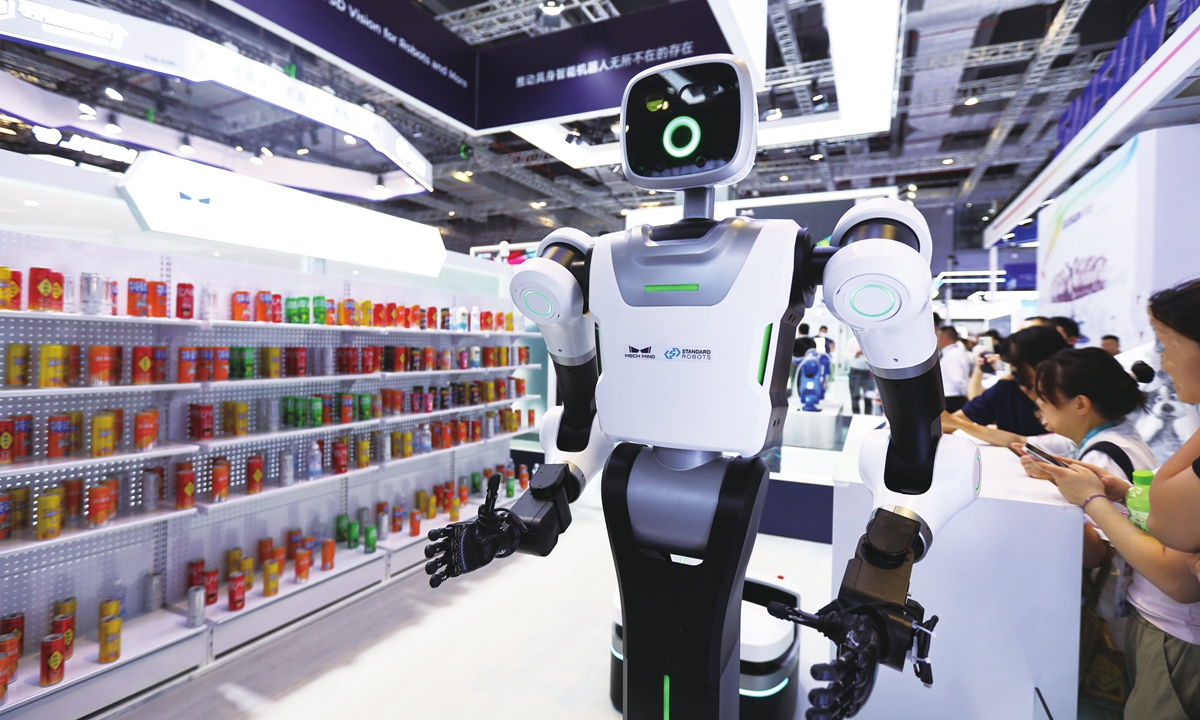
A humanoid robot seeks to retrieve items from a shelf at an industry fair in Shanghai on September 24, 2025. File photo: VCG
China's robotics industry growth is entering the fast lane, driven by rising market demand, stronger capital support and faster commercialization across industrial and services scenarios, industry analysts said on Tuesday.AGILINK, a Chinese dexterous robotic hand manufacturer, has secured hundreds of millions of yuan in a new funding round, pushing its valuation above $1 billion and achieving unicorn status. This marks the company's 4th funding round since its founding in January 2026, the company told the Global Times on Tuesday.
According to AGILINK, the fresh capital will be used to develop large-language models for dexterous hands, build open-source datasets, upgrade hardware products and accelerate large-scale deployment in industrial automation, services robotics and specialized operations.
Founded in January 2026, AGILINK - a dexterous hand subsidiary of AGIBOT, one of China's leading humanoid robotics makers - has delivered more than 8,000 dexterous hands and over 10,000 grippers, with more than 1,000 units deployed in industrial, logistics and services scenarios.
China's embodied intelligence sector continues to attract strong investor interest.
According to industry data, more than 50 financing events were held in the first quarter of 2026, involving more than 30 companies and a total funding of 20 billion yuan ($2.94 billion), up nearly 60 percent year-on-year.
In another development highlighting the sector's growth momentum, Xianheng International Science & Technology Co announced that its embodied intelligence business aims to generate 1.5 billion to 2 billion yuan in revenue over the next five years, domestic media outlet Jiemian News reported on Tuesday. The company said that it plans to invest in a domestic robotics unicorn and has reached a broad strategic partnership with Hangzhou-based DEEP Robotics. In 2026, it plans to help DEEP Robotics sell 100 robot dogs at an average price of 900,000 to 1 million yuan, mainly for power grid inspection and related uses, the Jiemian News reported.
"China's advantage in the global embodied intelligence race does not lie in a single technical parameter, but in the depth of manufacturing scenarios, the completeness of the supply chain, and the efficiency of coordination between capital and industry," Tian Feng, former dean of SenseTime's Intelligence Industry Research Institute, said on Tuesday.
Tian told the Global Times that 2026 is regarded as a crucial year for mass production and large-scale validation in embodied intelligence.
He added that competition in embodied intelligence is shifting from full-stack humanoid robot development toward modular specialization. Dexterous hand, which account for about 20 percent of the total cost of a humanoid robot, is seen as a critical factor determining both the intelligence ceiling and practical usability of the entire machine, Tian noted.
China's embodied intelligence financing landscape is showing new characteristics this year, Wang Feili, an industrial sector analyst with UBS Securities China, said in a note sent to the Global Times on Tuesday.
Robotmakers are concentrating on AI large-language models, while component suppliers focus on core parts such as dexterous hands, Wang said, adding that robot leasing is an emerging business this year. "Leasing not only helps manufacturers sell products, but also allows original equipment manufacturers to reach different customers faster and obtain data more efficiently," Wang said.
China's robotics sector is projected to grow from $47 billion in 2024 to $108 billion by 2028, reflecting a 23 percent annual growth rate, according to Morgan Stanley.
Global Times
RELATED ARTICLES