China-Russia bilateral ties forge stability amid turmoil
By Published: May 19, 2026 08:16 PM

Illustration: Xia Qing/GT
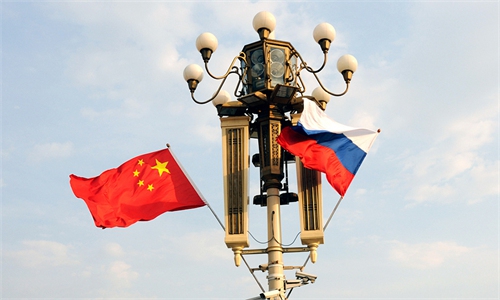
Russian President Vladimir Putin will pay a state visit to China from Tuesday to Wednesday. Only eight months ago, he made his last visit to Beijing in early September 2025.However, one can state not without reason that the world is very different today from what it was at the beginning of the fall last year.
There are important issues in the Beijing-Moscow bilateral agenda that deserve close attention from the two top leaders.
The year 2025 was not a particularly successful year for the Russia-China trade, which went down by almost 7 percent. It was a loud warning call for the two sides that they could no longer count on an automatic, extensive growth of the economic cooperation, but should rather look for intensive ways to deepen it and to invest more into industrial collaboration and into forging bilateral and multilateral production chains.
On the positive side, one should mention an almost 20 percent trade rebound in January-April 2026 after the 2025 contraction and an accelerating diversification of trade relations that now expand to a number of new high-tech sectors and advanced services.
Another important recent change in the relationship was the trial visa-free policy initiated in 2025. China launched this new policy in September, and Russia followed suit in December. Both parallel measures are tied to a period ending on September 14, 2026. Yet, even such limited measures resulted in a steep rise in the two-way tourist flows. China has already become one of the most popular tourist destinations in Russia. In its turn, Russia is gaining popularity in China, getting closer to such attractive locations for tourists as South Korea and Thailand. Of course, many people in both Russia and China would like to see the trial mechanism turn from a yearlong experiment into a permanent, limitless arrangement.
The ongoing trip of President Putin to Beijing should have a symbolic meaning as well. Twenty-five years ago, in the summer of 2001, the two sides signed the Treaty of Good-Neighborliness and Friendly Cooperation Between the People's Republic of China and the Russian Federation for twenty years. Five years ago, in the summer of 2021, the treaty was extended for another five years. Now it would be timely and appropriate for the two leaders to discuss a new extension of the treaty.
The second half of 2026 will be full of important multilateral summit-level events that require close China-Russia coordination. For example, the next Shanghai Cooperation Organisation will take place in early September in Bishkek, Kyrgyzstan, the next BRICS summit in mid-September in New Delhi, India. In mid-November, the Chinese city Shenzhen will host the 2026 APEC Economic Leaders' Meeting. One can expect that the two sides will try to synchronize their agendas for all of these events to the extent possible.
Needless to say, the recent dramatic events in the Persian Gulf call for additional dimensions in China-Russia interaction. One can argue that the immediate interests of the two countries in this crisis might diverge.
These tactical divisions notwithstanding, Beijing's and Moscow's strategic priorities in the Persian Gulf and around the Persian Gulf essentially coincide: Neither Russia nor China can be interested in a further escalation of the conflict in one of the most explosive regions of the planet.
The China-Russia relations have their own dynamics and their own momentum. It is only natural for the two big neighboring powers with a long stretch of shared border to explore opportunities coming from mutually complementary economies and coinciding or overlapping political interests.
However, the highly volatile, risky and challenging international environment makes the communication lines between Beijing and Moscow - including those at the very top level - even more valuable for both sides and more significant for the rest of the world. These lines contribute to making the China-Russia relations an island of stability in the roaring sea of the global turmoil.
The author is a member of the Russian International Affairs Council. opinion@globaltimes.com.cn
RELATED ARTICLES