Putin kicks off 25th China visit, hails ties as reaching ‘truly unprecedented level’; non-alliance partnership advances multipolarity, global stability: experts
By and Li Yu Published: May 20, 2026 12:25 AM

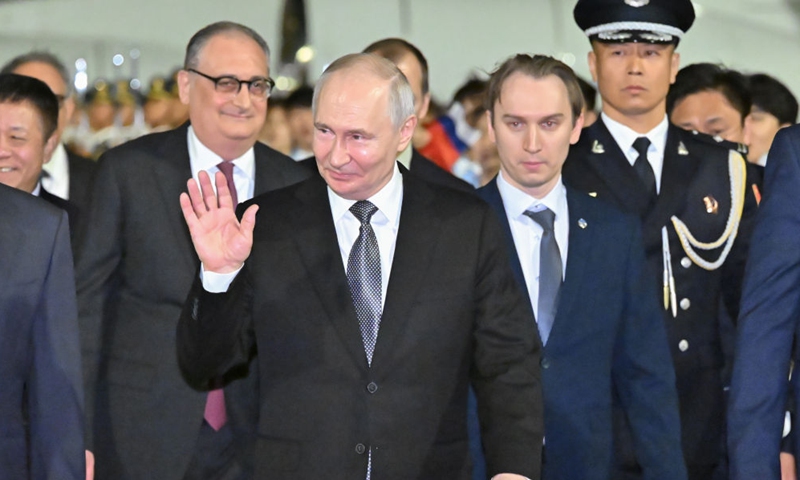
Russian President Vladimir Putin starts state visit to China on May 19, 2026. Photo: Xinhua
Russian President Vladimir Putin touched down in Beijing on Tuesday night, where he was greeted by senior Chinese diplomat Wang Yi, placing the Chinese capital back in the international spotlight just days after US President Donald Trump's visit.
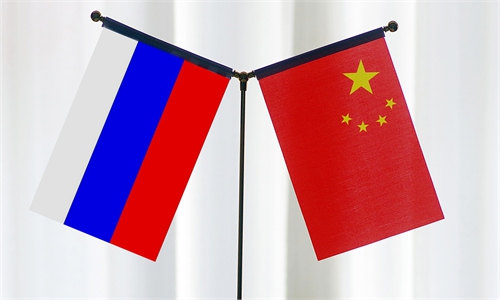
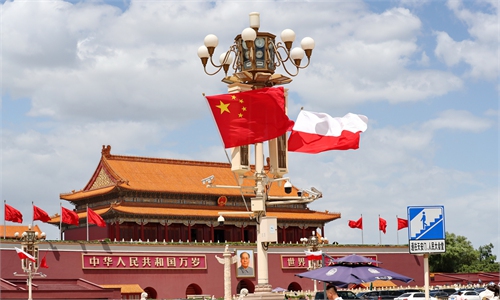
"China welcomes President Putin's state visit to China," said Chinese Foreign Ministry spokesperson Guo Jiakun at a press conference on Tuesday, when Chinese and Russian national flags fluttered along several major streets across Beijing.
The visit marks Putin's 25th trip to China - more than any other incumbent leader of a major country.
Observers said the frequency of such exchanges reflects the depth of China-Russia ties. In a complex and shifting global landscape, the relationship has demonstrated notable resilience, with both sides emphasizing non-alliance, non-confrontation and a commitment not to target third parties - an approach they say supports global stability and a more multipolar international order.
'Unprecedented level'
In a video address delivered before his state visit to China, Putin said Russia-China relations have reached "a truly unprecedented level," Xinhua News Agency reported.
Putin also noted that 25 years ago, Russia and China signed the Treaty of Good-Neighborliness and Friendly Cooperation, which laid a solid foundation for a genuinely strategic relationship and comprehensive partnership for the benefit of the two countries and two peoples.
This year also marks the 30th anniversary of the establishment of China-Russia strategic partnership of coordination.
The special nature of Russia-China relations is reflected in the atmosphere of mutual understanding and trust, a commitment to pursuing win-win and equitable cooperation, conducting respectful dialogue, and supporting each other on matters affecting the core interests of both countries, including protection of sovereignty and state unity, he said.
International media have drawn attention to the close and enduring ties between Beijing and Moscow.
In a report on Monday, The Guardian noticed that Putin's visit to Beijing came just "four days after Donald Trump left China after a high-stakes summit," adding that the two leaders have met on more than 40 occasions, far outstripping Chinese leaders' encounters with Western leaders.
The AP reported that the last time Putin visited China, the two heads of state called each other "friend," and noted Putin is also scheduled to visit China for the APEC summit in the city of Shenzhen in November.
German media DW said that Putin's visit "highlights China's influential position in a geopolitical landscape that is increasingly fractured and marked by great power rivalries."
Some Western media outlets have revived the old narrative of an "alliance" between China and Russia. CNBC, for instance, reported that "Washington is likely to closely monitor what emerges," reflecting heightened attention from the US side.
On Monday, Russian presidential aide Yury Ushakov said that Moscow and Beijing "are not allying against anyone," "we are working together in the name of peace and everyone's prosperity," per Tass.
Li Yongquan, director of Eurasian Social Development Research at the Development Research Center of the State Council, said the principle of developing China and Russia ties based on non-alliances, non-confrontation, and not targeting any third country represents the historical wisdom of the experience gained in China-Russia relations.
Guided by this principle, the two countries have forged a model of a new type of major-country relations, which has also exerted a very positive impact on regional security and the global order, the expert said.
Practical cooperation, multipolar vision
On Tuesday, Ushakov told a press briefing that the Russian delegation accompanying the president on his visit to China will be "quite representative,'' Tass reported. It added that the delegation includes five deputy prime ministers and eight ministers, ranging from sectors like agriculture, culture, transport, economy, finance, construction, and education.
Besides, Russia's Central Bank governor Elvira Nabiullina, heads of a number of Russian regions, CEOs of state corporations and Russia's largest, as well as top executives of Russia's largest companies will accompany the Russian leader.
Ushakov said that Russia and China will sign around 40 documents, per Tass.
Citing an analyst, CNBC commented that the size and composition of the Russian delegation suggest Moscow hopes to expand bilateral cooperation across multiple areas.
Li Yongquan said that China-Russia trade has grown rapidly in total volume in recent years. Moreover, the trade structure was changing from the previous heavy reliance on energy. For instance, China's exports of automobiles and electronic products to Russia have increased notably, and industrial and supply chains cooperation in science and technology is also expected to deepen further.
According to China's Ministry of Commerce, bilateral trade reached approximately $228 billion in 2025, exceeding the 200-billion-dollar threshold for a third consecutive year. China has remained Russia's largest trading partner for 16 consecutive years.
Both China and Russia have well-established policy frameworks for aligning their respective development strategies, and are steadily elevating the status of emerging markets and developing countries in their foreign policies, said Li Haidong, a professor at the China Foreign Affairs University.
China-Russia relations have always been, are now and will always maintain a sound momentum for steady progress, marked by aligned development blueprints, all-round practical coordination and proactive diplomatic strategic interactions, he added.
Beyond deepening bilateral cooperation, Beijing and Moscow, two major powers of pivotal importance in the world, have also drawn global attention for their coordination.
In a video address before his departure, Putin stressed that the close strategic relationship between Russia and China plays a major, stabilizing role globally. "Without allying against anyone, we seek peace and universal prosperity," according to Xinhua.
"It is in this spirit that Moscow and Beijing act in a coordinated manner to defend international law and the provisions of the UN Charter in their entirety, completeness and interconnectedness," Putin said.
"We support active cooperation through the UN, the Shanghai Cooperation Organization, BRICS, and other multilateral entities, making a substantial contribution to resolving pressing global and regional challenges," he added, per Xinhua.
On the same day, Ushakov also told media that the two sides will adopt a Joint Declaration on the Emergence of a Multipolar World and a New Type of International Relations.
Both China and Russia are staunch supporters of the UN-centered international system and firm advocates of multipolarity, said Li Haidong.
Positioned as a partnership free of alignment and targeting no third party, China-Russia relations not only serve as a successful practice in advancing global peace, prosperity and stability, but also represent active efforts to steer the world away from outdated mindsets and paths, he said.
Bilateral coordination between Beijing and Moscow proves that major powers can rise above bloc confrontation and zero-sum games, effectively advance multipolarity and foster greater stability and certainty amid global changes, the expert added.
RELATED ARTICLES