US, Japan officials target China as G7 ministers urge action on 'trade imbalances'; expert warns blaming China won’t help solve own structural issues
Tariff Photo:VCG
A renewed push by some Group of Seven (G7) officials to frame "trade imbalances" as a point of pressure against China reflects an attempt to turn global economic woes and Western economies' own structural strains into a political case against Chinese manufacturing, a Chinese expert said on Wednesday.
G7 finance ministers and central bank governors, meeting in Paris, agreed on the need for action on economic imbalances in a fragmented global economy, with US Treasury Secretary Scott Bessent arguing for more protections against "cheap Chinese imports," Reuters reported on Tuesday.
Bessent told Reuters in an interview that he had warned his European counterparts that they needed trade protections against what he described as "a flood of Chinese exports" that could damage their economies, claiming that China continues to build excess industrial capacity.
Japanese Finance Minister Satsuki Katayama also put much of the blame on China for the imbalances, claiming that China "does not appear willing to correct these imbalances itself," according to Reuters.
So-called problems such as trade imbalances, overcapacity and dumping have become a well-worn scapegoating narrative for the US and other developed economies when grappling domestic structural strains and intensifying industrial competition, He Weiwen, a senior fellow at the Center for China and Globalization, told the Global Times on Wednesday.
"To bundle together their own problems - weak industrial competitiveness, insufficient investment and an imbalanced consumption structure - and then blame China is not a way to solve problems. It is an attempt to externalize domestic contradictions and politicize structural issues," the expert said.
A country's production capacity is not designed only for its domestic market, but is part of global trade and market competition shaped by comparative advantages, He said. "Whether there is genuine overcapacity should be assessed under international standards and the multilateral trade framework, rather than being unilaterally defined by the US or Europe as a pretext for protectionist measures."
In a separate Reuters interview, Bessent said G7 finance leaders' discussions on curbing global imbalances put a lot of emphasis on confronting China with International Monetary Fund (IMF) data showing what he described as the detrimental impact of China's export push.
However, the IMF data does not support such a one-sided attribution. In its 2025 External Sector Report, the IMF said that "homegrown surpluses and deficits can be met with homegrown solutions," and pointed to an alternative policy mix involving "lower US government debt" and "higher public spending in the euro area."
In an article published in April, IMF economists said global imbalances will be shaped by domestic macroeconomic trajectories and policies, while warning against the use of trade barriers, which they described as "a costly fix with unreliable effects on imbalances."
The G7's own discussion also showed that the "China-only" framing is not convincing. Reuters reported that French Finance Minister Roland Lescure suggested a more balanced approach, noting that overconsumption in the US and underinvestment in Europe also contributed to imbalances, along with so-called Chinese overproduction.
Also, a coordinated G7 response targeting China still appeared to face obstacles. Katayama said there was pressure on G7 leaders, who are scheduled to meet in June in the French Alpine town of Evian-les-Bains, to agree on actions, Reuters reported.
He, the Chinese expert, said these details point to the need for domestic structural adjustment. "For the US, the problem is excessive consumption and large deficits. For Europe, it is underinvestment and weak industrial competitiveness. These are domestic structural challenges, not grounds for singling out China," the expert said.
The "China's overcapacity" does not really exist and should not be used as a pretext for political manipulation, Chinese Foreign Ministry spokesperson Guo Jiakun said in March, in response to new US trade probes into alleged excess industrial capacity among 16 major trading partners, including China.
"We oppose any form of unilateral tariff measures. Tariff and trade wars serve no one's interests. Both sides should resolve relevant issues through consultation on the basis of equality, respect and mutual benefit," Guo said.
China is not seeking an excessively large trade surplus, He said, noting that its policy priority lies in domestic structural adjustment, including expanding demand, building a unified national market and advancing industrial restructuring, rather than pursuing export growth for its own sake.
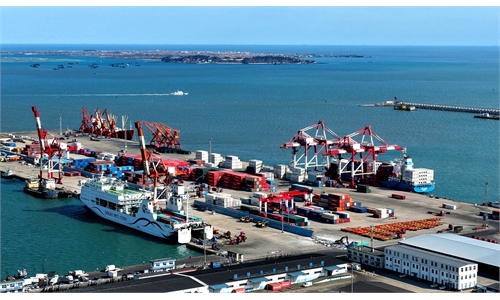
Customs data released earlier this month showed that in the first four months of 2026, China's exports rose 11.3 percent year-on-year to 9.33 trillion yuan ($1.31 trillion), while imports jumped 20 percent to 6.9 trillion yuan, indicating that China's import growth is accelerating.
He Weiwen also pointed to China's import structure shift with industrial upgrading. "China's imports of integrated circuits jumped more than 40 percent in the first four months, showing resilient demand in advanced manufacturing."
He said that "to ignore such structural changes and attribute China's export competitiveness simply to weak demand is to seek an external scapegoat for their own industrial pressure."
Despite tariff pressure, China's foreign trade expanded last year, with total goods imports and exports reaching a record high, which "speaks to the irrepressible demand of the global market for China's industrial capacity," Chinese Ambassador to the US Xie Feng said in an exclusive interview with Newsweek on May 5, when asked to comment on the so-called industrial overcapacity issue.
Xie stressed that China's products are all much-needed high-quality industrial goods, which not only meet China's domestic demand, but also help bridge the global gap between renewable energy supply and demand and make a significant contribution to energy conservation, emission reduction and decarbonization.
Bessent's remarks followed the recently concluded China-US economic and trade consultations, in which the two sides reached generally balanced and positive outcomes and agreed to establish trade and investment councils, according to China's Ministry of Commerce.
He Weiwen said the hard-won outcome and positive momentum should be preserved, urging the US to abandon bloc-confrontation thinking and work with China to keep bilateral economic and trade ties on a healthy track, bringing more certainty to both countries and the world economy.
RELATED ARTICLES