Head-of-state diplomacy guides China-Russia relations to ‘new heights’: Global Times editorial
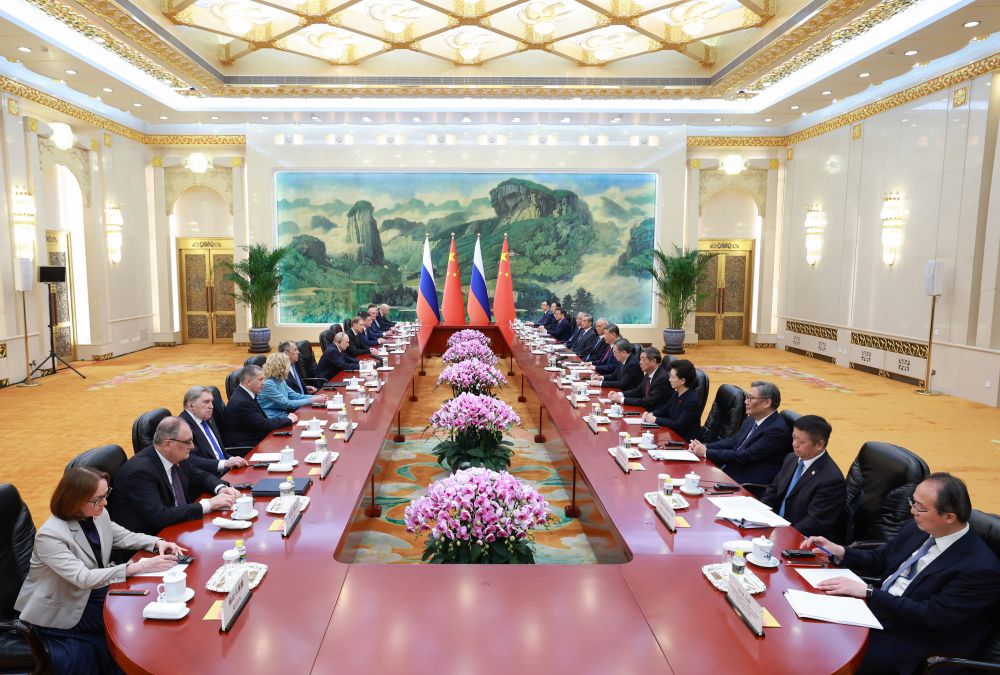
Photo: Xinhua
On May 20, Beijing witnessed another important moment in the development of China-Russia relations. Chinese President Xi Jinping held talks with visiting Russian President Vladimir Putin at the Great Hall of the People in Beijing on Wednesday, with the two sides agreeing to further extend the China-Russia Treaty of Good-Neighborliness and Friendly Cooperation.
President Xi outlined efforts to promote higher-quality development of China-Russia relations in four dimensions, during a joint press meeting with President Putin after the talks: First, Xi called for efforts to consolidate higher-quality political mutual trust and strengthen strategic support for each other; second, Xi stressed the need for China and Russia to empower higher-quality mutually beneficial cooperation and jointly promote their respective development and revitalization; third, Xi stressed the need to promote higher-quality people-to-people exchanges and strengthen the foundation for lasting friendship between the two peoples across generations; and fourth, Xi called on China and Russia to pursue higher-quality international coordination and work together to reform and improve global governance. These four dimensions clearly chart a path for the higher-quality development of China-Russia relations from a new starting point.
This visit yielded fruitful outcomes and carried far-reaching significance. The two heads of state signed a joint statement on further enhancing the comprehensive strategic coordination and deepening good-neighborliness and friendly cooperation between the two countries, and witnessed the conclusion of a number of important bilateral cooperation documents. The two countries also issued a joint statement on promoting a multipolar world and a new type of international relations. In addition, the two heads of state also attended the opening ceremony of the China-Russia Years of Education. In a single day, such an intensive schedule of activities, with so many major outcomes being introduced one after another, is fully evident that, under the strategic guidance of the two heads of state, the China-Russia comprehensive strategic partnership of coordination for a new era is characterized by full substance, a high level of mutual trust, a solid foundation, and broad prospects.
Standing at the historical juncture marking the 30th anniversary of the establishment of the China-Russia strategic partnership of coordination, the 25th anniversary of the signing of the China-Russia Treaty of Good-Neighborliness and Friendly Cooperation, and the launch year of the China-Russia Years of Education, the two heads of state once again held face-to-face communication. This not only injects new political momentum into bilateral relations, but also sends a clear signal of stability, cooperation, and mutual benefit to the world. This shows that the two countries regard the development of bilateral relations as a long-term strategic choice, rather than a matter of expediency. As President Xi emphasized, "As permanent members of the UN Security Council and important major countries in the world, China and Russia should take a strategic and long-term perspective, drive the development and revitalization of our respective countries through comprehensive strategic coordination of even higher quality, and work to make the global governance system more just and reasonable."
What does a strategically far-sighted China-Russia relationship mean for the world? First, it means a stronger safeguard for global peace and stability. By upholding the international system centered on the United Nations and adhering to the purposes and principles of the UN Charter, China and Russia serve as key forces in opposing hegemony, promoting multipolarity, and stabilizing the global situation. Moreover, the forces defending international fairness and justice have become stronger. China and Russia maintain close ties under multilateral frameworks such as the United Nations, the Shanghai Cooperation Organization (SCO), BRICS, and the G20, jointly safeguarding the legitimate development rights and interests of Global South countries. Both sides remain firmly committed to defending the post-World War II international order and the authority of international law, opposing all forms of unilateral bullying and actions that seek to reverse the course of history, especially provocations that deny the outcomes of World War II and attempt to whitewash and revive fascism and militarism. Together, they are working to build a more just global governance system. History shows that when China and Russia stand firmly together, there is greater hope for international fairness and justice, greater certainty amid once-in-a-century global changes, and greater strength for human progress and development.
At present, the international landscape is marked by turbulence and uncertainty, with various forms of "unpredictability" posing major challenges to peace and development. Against this backdrop, China and Russia's willingness and ability to "take a strategic and long-term perspective" is itself an important contribution to the international community. This strategic resolve demonstrates that the two countries consistently uphold the principles of "non-alliance, non-confrontation, and not targeting any third party." They adhere to equality, mutual respect, good faith, and win-win cooperation. The China-Russia relationship, which transcends traditional military and political alliances, is a model for interactions between major powers and neighboring countries alike. It possesses strong internal momentum and enduring strategic resilience, and has become a key stabilizing factor amid global uncertainty.
Under the strategic guidance of the two heads of state, China-Russia relations have reached a new starting point. China-Russia comprehensive strategic partnership of coordination is not about creating confrontation, but about opposing hegemony; not about exclusivity, but about upholding multilateralism; not about zero-sum rivalry, but about promoting common security and shared development. The China-Russia relationship that has entered a new stage of "greater achievements and faster development" aligns with the global trend toward peace, development, cooperation, and mutual benefit. It benefits both countries and the world.
China and Russia are good neighbors and friends who stand together through adversity; and valuable partners that help each other succeed. Standing at a new historical starting point, China-Russia relations will continue to maintain strategic resolve amid changing global circumstances, unleash potential through mutually beneficial cooperation, and demonstrate responsibility amid international transformation. As the two countries move together toward a future of higher-quality development, they will inject strong momentum into each other's growth and national rejuvenation. China-Russia close strategic coordination on the international stage will also continue to serve as an important stabilizing force in a turbulent world, making irreplaceable contributions as major countries to safeguarding international fairness and justice and to building a more just and reasonable global governance system.
RELATED ARTICLES