Nauru orders public servants, state-owned enterprises employees to observe one-China principle; move suggests understanding of principle evolving into a more institutionalized practice: Chinese expert
By Published: May 21, 2026 01:04 PM

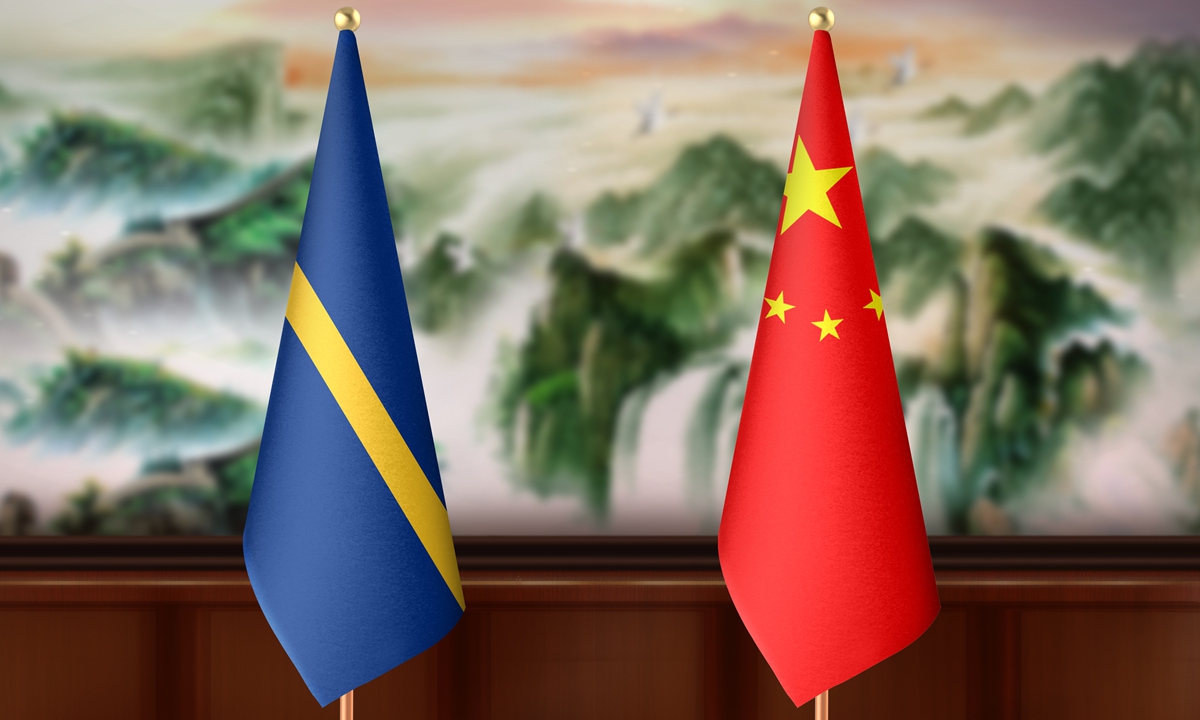
China-Nauru. Photo: VCG
Nauru's government has issued a directive to all public servants and employees of state-owned enterprises in-country and abroad to observe the one-China principle, which advised that in official capacity, personnel to "avoid using terminology, symbols, flags, emblems, or representations which are inconsistent with the One China Principle", according to a government statement released on Wednesday."Following Cabinet decision on 15 May 2026, all personnel representing the Government and State-owned Enterprises of the Republic of Nauru in-country and abroad are further directed by Cabinet to observe the One-China Principle," the government said in a statement on Wednesday.
It added officials must "ensure consistency in the use of terminology and references in official conduct, communications, engagements, and administrative practices across all government departments, instrumentalities, statutory authorities, state-owned enterprise, government-controlled enterprise, agencies, and affiliated bodies".
It further advised in official capacity, personnel "avoid using terminology, symbols, flags, emblems, or representations which are inconsistent with the One China Principle".
"All official communication relating to the Taiwan Province of China must comply with the diplomatic position of the Government of Nauru. Officials must not enter into official relations and arrangements with the Taiwan Province authorities or participate in programs funded by the Taiwan Province."
In 2024, the Republic of Nauru announced that it will recognize the one-China principle and sever "diplomatic relations" with Taiwan, according to Xinhua News Agency.
When commenting on Nauru's announcement to break diplomatic ties with the Taiwan region and seek to reestablish diplomatic ties with China, a spokesperson from China's Ministry of Foreign Affairs said in January 2024 that "China has established diplomatic relations with 182 countries on the basis of the one-China principle. The Nauru government's decision of reestablishing diplomatic ties with China once again shows that the one-China principle is where global opinion trends and where the arc of history bends."
In January this year, the Nauru government reaffirmed its commitment to the one-China principle that is in line with the basic norms of international relations recognized by the United Nations (UN) and is a broad consensus of the international community, Nauru's Minister for Foreign Affairs and Trade Lionel Aingimea has said, per Xinhua.
As of press time, the Global Times reporter has not found any reports of the Nauru government's order in Taiwan's local media.
The Nauru government's directive came after the Solomon Islands' newly elected Prime Minister Matthew Wale has announced on May 17 that his government will continue to firmly adhere to the one-China principle and make efforts to deepen cooperation with China across various fields.
Wale's remarks also defied Western some foreign media's speculation such as the Japan Times which claimed that his election is "a signal of change for the South Pacific's closest backer of Beijing," and he is considered "a former leader who supported ties with Taiwan and a China critic."
Recent statements by countries such as Nauru and the Solomon Islands suggest that Pacific Island countries' understanding of the one-China principle is evolving from a diplomatic commitment made at the time of establishing diplomatic ties with China into a more institutionalized practice embedded in governance and external cooperation, Chen Hong, director of the Australian Studies Center at East China Normal University, told the Global Times, noting that those countries are gradually realizing that the principal serves as a key political foundation for building mutual trust with China and expanding cooperation in areas such as infrastructure, livelihood improvement, climate change, fisheries, education, and other multilateral initiatives.
Against this backdrop, the space for "Taiwan independence" separatist forces making maneuver in the South Pacific is steadily shrinking, Chen said. He added that some external powers have long sought to treat Pacific Island countries as pieces on a geopolitical chessboard and use the Taiwan question as a tool to contain China.
Chen said that Nauru's move could have a certain demonstrative effect for Pacific Island countries, as it has moved the one-China principle from a diplomatic statement to the level of administrative implementation. This effectively reminds other Pacific Island countries that have established diplomatic ties with China to maintain consistency in official signage, documents, and all forms of expression—making it impossible to formally recognize the one-China principle while leaving operational ambiguities.
RELATED ARTICLES