Foreign financial firms intensively hold China-themed forums
Nation’s resilient economy, rapid AI development attract continuous inflows of international capital
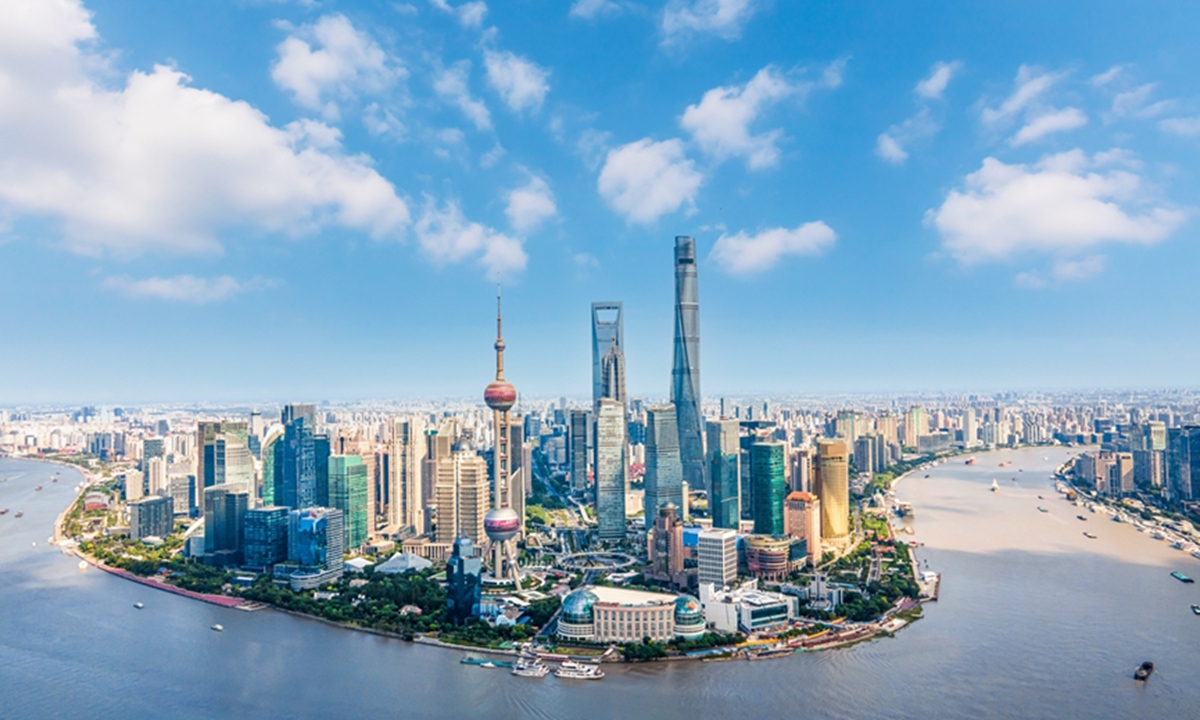
A view of the Lujiazui area in Shanghai Photo: VCG
Multiple foreign financial institutions including JPMorgan Chase, UBS, and Morgan Stanley have recently held forums focused on China. Analysts said that these events demonstrate international investors' growing attention to Chinese assets, given the nation's resilient macroeconomy and capital market, while also underscoring the growing trend of China's rapid rise in frontier technology fields.
The 22nd JP Morgan Global China Summit is being held in Shanghai on Thursday and Friday, bringing together more than 1,300 enterprises from more than 35 countries and regions, according to a press release on the company's WeChat account.
Ho Yiu-tung, JP Morgan's co-senior country officer for China, said that this summit gathers leading figures from key industries such as technology, healthcare, new energy, and vehicles. It will serve as a high-value platform for exchanging diverse perspectives, fostering cross-sector collaboration, uncovering breakthrough opportunities, and driving future growth for both China and the global economy.
UBS will hold the Asian Investment Conference in the Hong Kong Special Administrative Region and Singapore from May 25-29, according to a press release sent to the Global Times.
The forum will focus its discussions on three areas of particular interest to global investors: artificial intelligence (AI) innovation and related high-tech industries, the globalization strategies of high-quality Chinese enterprises, and investment opportunities brought about by China's anti-involution campaign, said Fang Dongming, head of China Global Markets at UBS.
From late March to early April, the 2026 Morgan Stanley China Summit was held in Shenzhen, South China's Guangdong Province for the first time, bringing together executives from more than 200 companies and nearly 800 global investors. "This summit underscores an increasingly important trend: the rapid rise of China in frontier technology sectors," according to the company's WeChat account.
In its latest mid-year outlook, Morgan Stanley upgraded China's 2026 and 2027 real GDP growth forecasts to 4.8 percent and 4.7 percent, respectively, citing China as one of the biggest beneficiaries of global AI development and energy transition.
Morgan Stanley's Chief China economist Robin Xing highlighted a "K-shaped recovery," with a strong performance in China's exports and high-end manufacturing. Meanwhile, AI and energy investment will also drive economic growth.
From January 1 to May 15, China equities received a net inflow of $13.1 billion, significantly higher than the same period in previous years, reflecting a notable trend of increasing foreign capital allocations to Chinese assets, the Shanghai Securities News reported on Thursday.
"China's certainty in three dimensions attracts the continuous inflow of foreign capital," Tian Lihui, dean of the Institute of Financial Development at Nankai University, told the Global Times on Thursday.
The economy grew 5 percent in the first quarter of 2026, outpacing the expectations of some foreign institutions, underlying the resilience and vitality of the world's second-largest economy despite a complex external environment. Moreover, since the implementation and effectiveness of the Nine-Point Guideline and related policies on the sound development of the capital market, there have been frequent interactions between the regulator and markets, sending transparent and predictable policy signals. Third is the leadership in industrial upgrading, Tian said.
These three certainties collectively constitute the unique appeal of Chinese assets, distinct from developed markets, giving foreign investors the confidence to increase their allocations to China, the expert said.
The opportunities in China's capital market are "enormous," Michael Spence, a Nobel Laureate in Economic Sciences, told the Global Times on Monday on the sidelines of the 2026 Tsinghua PBCSF Global Finance Forum held in Chengdu, Southwest China's Sichuan Province.
For both domestic and foreign investors, the opening-up and continuing development of China's capital markets is really a big deal, Spence said, stressing that capital markets help boost the development of various sectors including technology.
Yang Delong, chief economist at Shenzhen-based First Seafront Fund, told the Global Times on Thursday that dividends from China's comprehensive reform, the development of new quality productive forces, and the diversified investment portfolio of household deposits mean long-term opportunities in China's capital market.
RELATED ARTICLES