Illustration: Xia Qing/GT
May 21, 2026 marked the 75th anniversary of the establishment of diplomatic relations between China and Pakistan. On this very day, China's Foreign Ministry announced that Pakistani Prime Minister Shehbaz Sharif will pay an official visit to China from May 23 to 26.Over the past seven and a half decades, the two countries have developed what is widely characterized as an "all-weather strategic cooperative partnership." This relationship is frequently described in both official discourse and public narratives as "higher than the mountains, deeper than the seas, sweeter than honey and stronger than steel." In fact, even "higher than the mountains" may fall short - Pakistani astronauts will soon join China's space station, a privilege no other country enjoys.
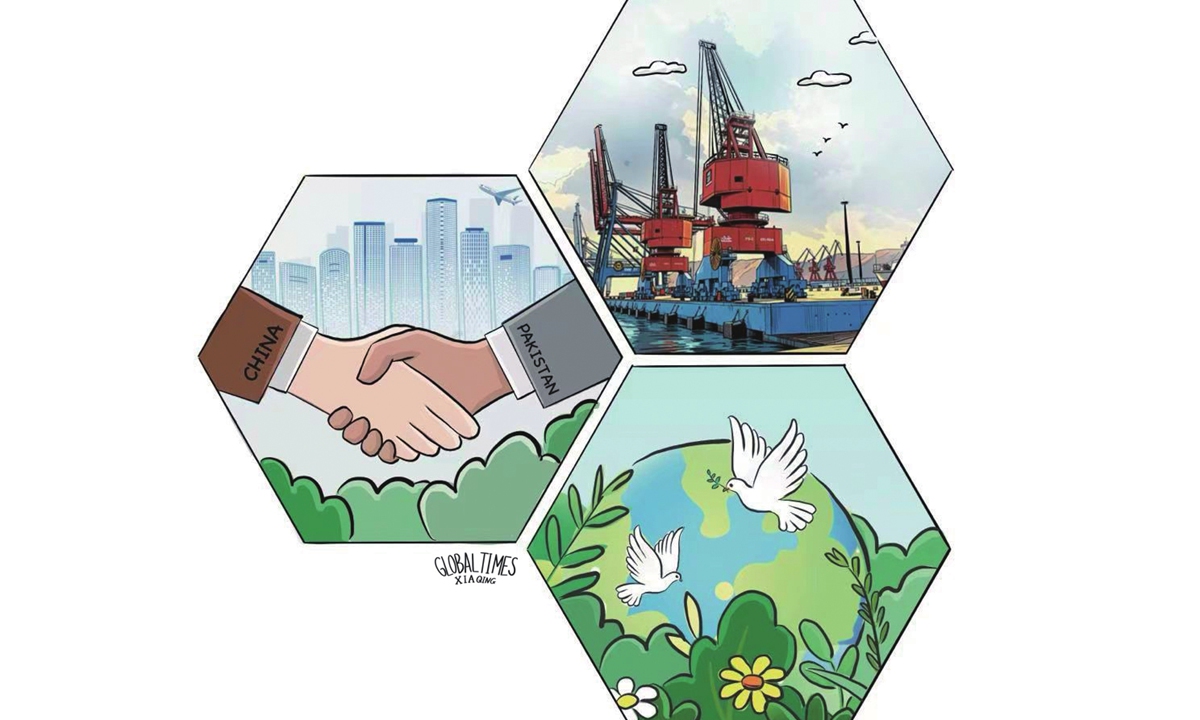
Structurally, China-Pakistan relations rest on three closely interrelated pillars: strategic and security cooperation, economic integration, and people-to-people exchange.
Strategic and security cooperation constitutes the foundation of the relationship. The two countries have maintained close coordination on regional security issues and developed sustained military cooperation, contributing not only to their respective national security and integrity objectives but also to broader regional stability.
Economic cooperation forms the second pillar, with the China-Pakistan Economic Corridor (CPEC) serving as its central component. CPEC has facilitated infrastructure development, enhanced connectivity and strengthened trade linkages. More broadly, it reflects China's intention to support Pakistan's long-term economic transformation.
The third pillar, people-to-people exchange, reflects the historical continuity of bilateral friendship. Since the establishment of bilateral relations, societal and cultural ties have evolved alongside official cooperation. Frequent academic exchanges, research collaborations, language programs, and university partnerships have significantly deepened people-to-people connectivity. These interactions have provided an important social foundation for the durability of bilateral relations between both sides.
Beyond the bilateral level, China and Pakistan have also coordinated positions on a range of regional and global issues. Both countries have emphasized support for the Global South, engagement with the Islamic world, and the promotion of regional stability and economic integration. In this regard, China-Pakistan relations are often viewed as a model of sustained strategic partnership.
These strengths provide a solid foundation for addressing emerging challenges together, paving the way for continued growth in the relationship.
First, looking ahead, strengthening people-to-people bonds represents a key area for focused investment. With the founding generation of the relationship beginning to pass the torch, there is a natural and exciting opportunity to cultivate deeper engagement between the next generation in both countries. Addressing current gaps in familiarity and easing linguistic barriers are tangible steps through which we can build a more robust and lasting foundation for mutual understanding.
Second, CPEC plays a key role in supporting Pakistan's industrialization - a complex but necessary process. Pakistan should steadily advance the domestic reforms, institutional capacity, and policy coherence needed to make this transformation a reality. Meanwhile, security for Chinese personnel and projects needs to be actively managed as a shared priority.
Third, the strategic and security partnership between China and Pakistan continues to adapt and thrive amid a shifting global landscape. Pakistan's efforts to diversify its external relations - including ties with major powers and regional players - demonstrate strategic maturity, and China has consistently responded with understanding and respect, particularly regarding Pakistan's commitment to staying clear of major power rivalries.
In the future, China-Pakistan relations will continue to demonstrate significant resilience and strategic value. The sustainability and further advancement of this partnership require both to adopt a pragmatic and forward-looking manner to enable bilateral relations to evolve toward greater depth, stability and long-term strategic alignment.
The author is director of the Center for South Asia Studies at the Shanghai Institutes for International Studies. opinion@globaltimes.com.cn
RELATED ARTICLES