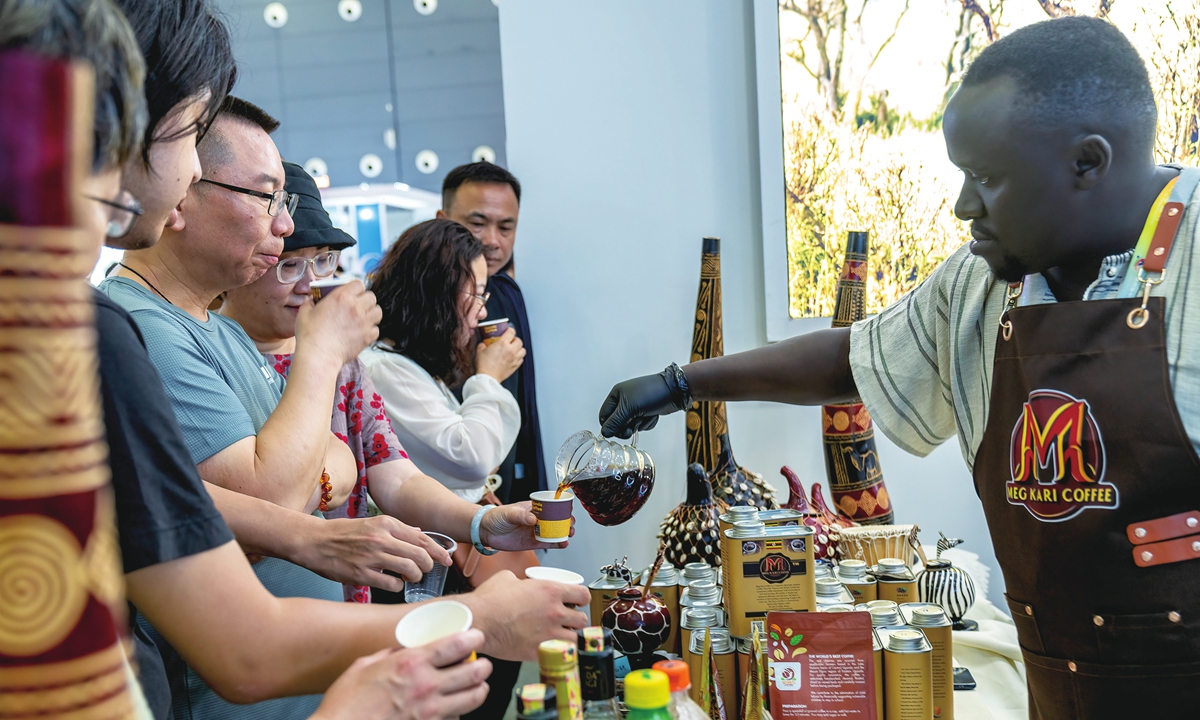
Ethiopian coffee attracts large crowds of local visitors for tastings at the fourth China-Africa Economic and Trade Expo in Changsha, Central China's Hunan Province, on June 14, 2025. Photo: VCG
China will allow the import of coffee beans from African countries that have established diplomatic relations with China, provided they comply with relevant laws and regulations. The policy will take effect on July 20, 2026, according to Chinese customs. This comes after China granted zero-tariff treatment to 53 African countries with diplomatic ties from May 1 this year.
The exporting country of coffee beans must be an African country that has established diplomatic relations with China. Production and processing enterprises should establish a traceability system to ensure that coffee beans exported to China can be traced back to the planting areas, according to a notice published on the official WeChat account of the General Administration of Customs (GAC).
Production and processing enterprises must be officially reviewed by the exporting country and registered with the GAC. The goods must be accompanied by a valid phytosanitary certificate, read the notice.
Coffee beans from Ethiopia and Burundi have already obtained quarantine access approval from China, the GAC said in the notice.
According to the Ministry of Commerce, China has implemented zero-tariff treatment for 53 African countries with diplomatic ties starting from May 1, 2026, effective for two years.
During the two-year implementation period, China will continue to promote the signing of economic partnership agreements for shared development with relevant African countries, according to a statement published by the Customs Tariff Commission of the State Council.
This move builds on an earlier policy introduced on December 1, 2024, which granted zero-tariff treatment on 100 percent of tariff lines to the least-developed countries that have diplomatic relations with China, including 33 African nations. This year's move represented a further expansion.
The trade growth driven by zero tariffs has been tangible. In 2025, China-Africa trade reached $348 billion, an increase of 17.7 percent year-on-year, according to statistics from the GAC.
China has provided various platforms and international trade fairs to help boost African exports to enter China's vast market.
Zhu Jing, deputy general manager at Shanghai's Hongqiao Import Commodity Exhibition and Trade Center, told the Global Times recently that Kenyan coffee bean companies have been forward-looking in response to the zero-tariff policy and have launched relevant products on the platform. The platform was established to leverage the spillover effects of the China International Import Expo.
Kenya was among the newly added 20 African countries to enjoy the zero-tariff treatment from May 1. Previously, Kenya coffee beans were imported to Hongqiao Pinhui through bonded warehouse service.
When a Global Times reporter visited Hongqiao Import Commodity Exhibition and Trade Center last week, it was holding a summit for coffee beans originating from Ethiopia, having gathered importers and coffee shop representatives. According to Zhu, such events for African coffee beans are frequently held to help match importers and exporters.
Cao Zhiren, a representative of a coffee importer settled at Hongqiao Import Commodity Exhibition and Trade Center, told the Global Times that because of the zero tariffs, the cost of a cup of Ethiopian coffee can be more than 20 percent lower than coffee of similar quality from elsewhere.
RELATED ARTICLES