China expands zero tariffs to share opportunities with Africa
Talks to continue on economic partnership agreements, green channels for agri exports: FM
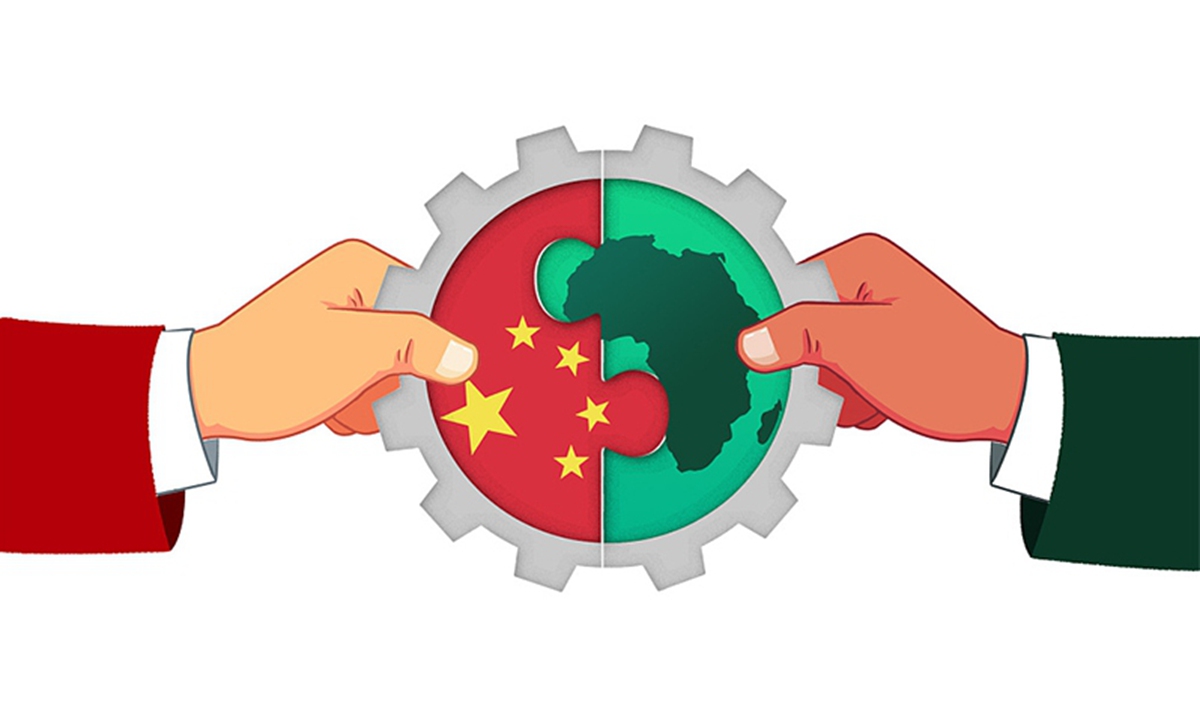
China Africa Photo: VCG
In Nairobi, officials and business groups from China and Kenya have been discussing how they could leverage Beijing's zero-tariff policy to open wider opportunities for Kenyan companies in the vast Chinese market, while African traders in China are already scouting for more goods to export there, as the new policy begins to clear a smoother path for China-Africa trade.
China has noted the earnest expectation and positive feedback from Africa regarding the zero-tariff treatment. This is an important measure of China taking the initiative to expand unilateral opening up, Chinese Foreign Ministry spokesperson Lin Jian said on Wednesday.
As protectionism and unilateralism are on the rise, and continents near the Middle East are hit by spillovers of the situation there, China shares opportunities and pursues common development with Africa through the zero-tariff policy, and contributes to global peace and development with greater stability in China-Africa ties, the spokesperson stressed.
China will continue to sign agreements on economic partnership for shared development with African countries and at the same time upgrade the "green lanes" for import of African agricultural and food products to China, so as to further improve China-Africa trade facilitation, Lin said.
According to the Customs Tariff Commission of the State Council on Tuesday, China will grant zero-tariff treatment, in the form of preferential tariff rates, to an additional 20 African countries that have established diplomatic ties with China and are not classified as the least developed countries, from May 1, 2026 to April 30, 2028. This came after China had granted zero-tariff treatment on 100 percent of tariff lines since December 1, 2024 for 33 least developed African countries with which it maintains diplomatic relations. That means the country will expand zero-tariff treatment to all African countries that have diplomatic relations with it starting Friday.
The move marks the full upgrade of the zero-tariff policy for Africa to its highest level, and comes at a historic moment as China and Africa mark the 70th anniversary of their diplomatic ties, reflecting the consistency of China's Africa policy, Du Xiaohui, director-general of the Foreign Ministry's Department of African Affairs said, calling the measure a "golden name card" of bilateral cooperation.
The new policy responds to the practical difficulty that these African countries face in completing negotiations in the short run, while negotiations between the two sides will continue, China's Ministry of Commerce (MOFCOM) said on Wednesday.
Institutional empowerment
Also on Wednesday, China's customs authority released a detailed interpretation of rules of origin for imports from eligible African countries under the zero-tariff policy, adding what experts described as "operational clarity" to the landmark market-opening measure and helping translate it into customs practice.
The clarification came after the Customs Tariff Commission set out the tariff policy on Tuesday and the General Administration of Customs (GAC) later issued corresponding origin management measures.
The GAC interpretation details how eligible imports can qualify for preferential treatment, covering origin determination, certificates of origin, direct shipment and customs declaration procedures, according to the customs authority's official statement.
For African exporters and traders, the customs clarification is more than a technical document, as it gives businesses a clearer path to tailor production, logistics and sales plans for the Chinese market, Song Wei, a professor at the School of International Relations and Diplomacy at Beijing Foreign Studies University, told the Global Times on Wednesday.
Sourakhata Tirera, a Senegalese businessman who has been engaged in China-Africa trade since 2003, told the Global Times that he is actively looking for higher-quality African products to export to China, hoping to leverage the new zero-tariff policy to expand business opportunities.
"The policy opens access to the world's largest consumer market and gives African businesses a chance to shift from importing to exporting," Tirera said, adding that it could also help drive industrial development and job creation if African governments support the private sector in seizing this major opportunity.
The Greater Bay Area Importers and Exporters Association, a chamber of commerce covering the southern Chinese region's 11 cities, has close trade links with Africa. Its president Lam Lung-on told the Global Times on Wednesday that "quality African consumer goods such as Namibian lobsters and Tanzanian mud crabs are entering the area's market at a faster pace."
Citing agriculture as an example, Lam said that the zero-tariff policy will remove the tariff disadvantage of processed goods compared with raw materials, encouraging local primary and deep processing in Africa, while also strengthening supply and production links in sectors such as machinery and electronics, textiles and minerals.
China has remained Africa's largest trading partner for 17 consecutive years. In the first quarter of 2026, China-Africa trade reached 646.56 billion yuan ($94.56 billion), up 23.7 percent year-on-year, official data showed.
Business groups in Africa have urged firms to seize the opportunity. In a statement published on its website on Monday, the Kenya National Chamber of Commerce and Industry (KNCCI) said that China's zero-tariff policy offers "unprecedented export growth" prospects, with its president Erick Rutto noting that opportunities for Kenyan products could become "virtually limitless" if businesses act decisively.
Responsibility of a major country
Song views the zero-tariff policy as a strategic step that could help move bilateral cooperation beyond individual projects toward full industrial-chain collaboration that will support Africa's economic autonomy, with implications that extend beyond bilateral ties.
African officials have voiced similar expectations. According to Xinhua, Abraham Korir Sing'Oei, principal secretary at Kenya's State Department for Foreign Affairs, described the zero-tariff agreement at a high-level symposium on Monday as a landmark framework for boosting mutually beneficial trade and investment, as well as a blueprint for other African countries.
Effective implementation of the policy would be important not only for Kenya and China, but also as a demonstration of the two sides' joint efforts to implement the outcomes of the 2024 Forum on China-Africa Cooperation and uphold WTO rules, the report cited Regina Akoth Ombam, principal secretary of Kenya's State Department for Trade, as saying.
In recent years, some Western media outlets have portrayed China's role in Africa in a negative light, warning of over-dependence on raw material exports, describing the relationship as "asymmetrical" and even framing African countries as "pawns" in broader geopolitical competition. However, such narratives to smear China-Africa cooperation have been increasingly dismissed as baseless as their mutually beneficial engagement advances, analysts said.
While the US tightens its market and imposes restrictions, China is opening its market and creating a new preferential trade framework for African nations, an analysis by RT said, pointing to pragmatic drivers behind China-Africa cooperation, from restructuring trade flows and standardizing market access rules to forging deeper economic ties between African partners and the Chinese market.
China's zero-tariff policy is drawing more development resources to the African continent, materially advancing regional integration and strengthening its capacity for self-driven development, while demonstrating China's commitment to share market dividends with the world and support the development of the Global South, Song noted.
China-Africa trade has expanded 27.5-fold over the past two decades, rising from 87.38 billion yuan in 2000 to 2.49 trillion yuan in 2025, according to customs data, underscoring the strong momentum and deepening integration of bilateral economic ties.
MOFCOM said in its Wednesday statement that China's decision to take the lead in cutting tariffs demonstrates its responsibility as a major country and advances the Global Governance Initiative and the Global Development Initiative, amid rising unilateralism and protectionism.
China-Africa economic and trade cooperation has repeatedly proven to be mutually beneficial and win-win, experts said. As Kenyan media Business Daily Africa put it, the message from China is "clear and consistent": "We are partners," "We respect your sovereignty," and that there are "no political conditions."
RELATED ARTICLES