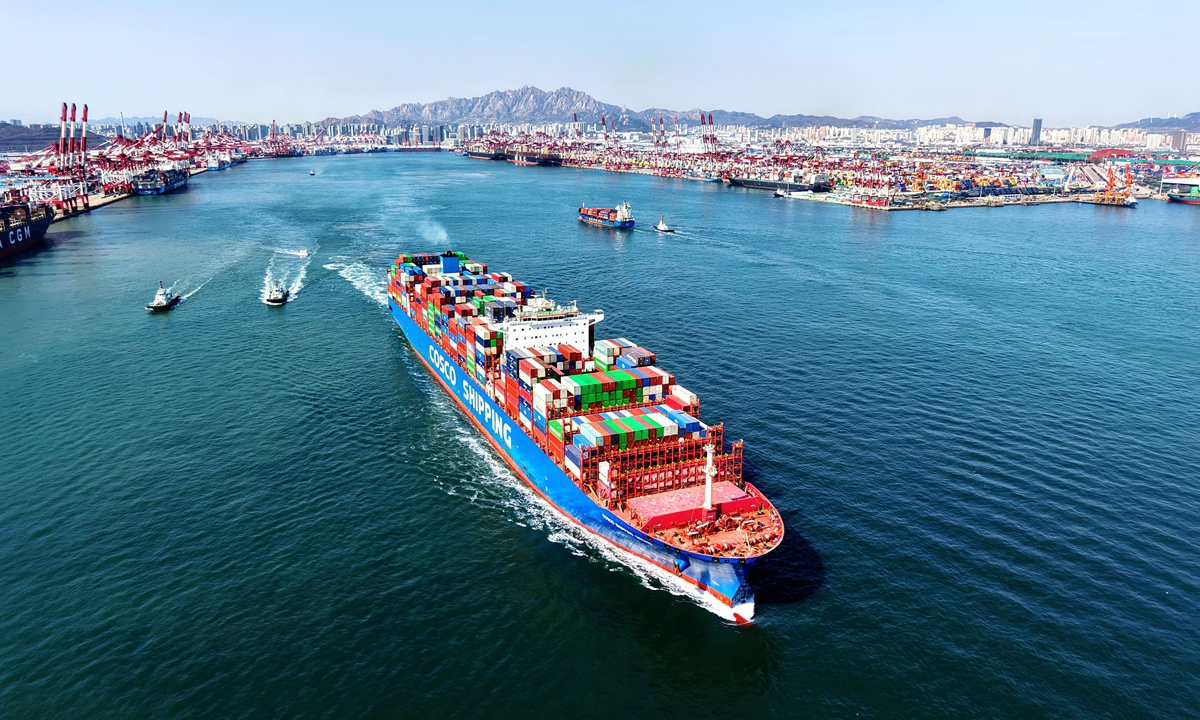
View of a container vessel near Qingdao port in East China's Shandong Province on April 7, 2026 Photo: VCG
Multiple major Chinese ports have recently launched direct shipping routes with African countries as China-Africa trade ties deepen, with zero-tariff measures for 53 African countries that have diplomatic relations with China expected to take effect on May 1.
The launch of more direct shipping routes will further boost bilateral trade, offering more opportunities for relevant countries, analysts said.
On Sunday, at the Qianwan Container Terminal of Qingdao Port, East China's Shandong Province, a vessel loaded with China-made goods, including auto parts, tires, and solar panels, completed loading its cargo and set sail for key West African ports such as Tema and Lagos. This marks the second container shipping route to Africa that Qingdao Port has opened this year, CCTV News reported.
The route deploys 13 vessels and operates on a weekly fixed-schedule service. As a key regular port of call in northern China, Qingdao Port provides direct connections to major commercial hubs in West Africa, significantly shortening the logistics time between Shandong and inland regions and West Africa, said the CCTV News report.
In the first quarter of 2026, total exports from Qingdao ports to Africa exceeded 43.56 billion yuan ($6.37 billion), up 26.3 percent year-on-year. Among them, exports of mechanical and electrical products grew by 37.4 percent and those of high-tech products increased by 25.7 percent.
Also in Shandong, Yantai Port has ramped up its role of connectivity with African countries. Since the beginning of this year, Yantai Port has launched three new routes to Algeria, Namibia, and other destinations, while increasing sailing frequencies to ease booking pressure for foreign trade enterprises, local media outlet Qilu Evening News reported.
According to Yantai Port, first-quarter cargo volume on its China-Africa breakbulk liner routes exceeded 2 million tons, up 31.9 percent year-on-year. For the first time, quarterly throughput surpassed the 2-million-ton mark, underscoring the strong momentum of the "golden two-way logistics corridor" between China and Africa.
Not long ago, Tianjin Port, a major port in North China, launched a new container liner service directly connecting it to South Africa, filling the gap in direct shipping routes between Tianjin and South African ports and adding a new logistics channel to China-Africa economic and trade cooperation, according to the official website of Tianjin Port Group on April 20.
The route mainly involves exports of steel, building materials, chemicals, automobiles, and other products to South Africa. It deploys 12 vessels with capacities ranging from 5,700 to 11,000 standard containers and operates on a weekly schedule. The voyage takes only 40 days, 10 days shorter than before, allowing inland cargo to benefit from a convenient direct shipping service to southern Africa, significantly reducing logistics costs and improving transport efficiency, said the port.
Meanwhile, high-quality mineral products from South Africa can be transported more quickly to the Beijing-Tianjin-Hebei region, providing a stable supply of raw materials for regional industrial production, according to the port.
The ramp-up in the launch of new container shipping routes comes as the full implementation of a zero-tariff policy for 53 African countries with which China has diplomatic relations is set to officially take effect on May 1.
In addition to the launch of the zero-tariff policy, China is continuing to promote the negotiation and signing of economic partnership agreements for shared development, and further expanding market access for African exports to China through measures such as upgrading "green channels," the People's Daily reported.
Starting from December 1, 2024, China has granted zero-tariff treatment for 100 percent of tariff lines to all least-developed countries with diplomatic relations, including 33 African countries.
China's zero-tariff measures for African countries with which it has diplomatic relations are being continuously upgraded, marking a new step in China's pursuit of high-standard opening-up, and making China the first major economy in the world to implement full-coverage zero tariffs for all African countries with diplomatic ties, Hu Qimu, a professor at the Maritime Silk Road Institute of Huaqiao University, told the Global Times on Sunday.
Zhou Mi, a senior research fellow at the Chinese Academy of International Trade and Economic Cooperation, told the Global Times on Sunday that this trend will not only help Chinese high-quality products such as machinery, electronics, and daily necessities reach Africa more efficiently, but also provide more convenient channels and platforms for African agricultural products and other locally produced high-quality goods to enter the Chinese market.
RELATED ARTICLES