ARTS / CULTURE & LEISURE
Traditional culture defines tech innovation at International Cultural Industries Fair
By Published: May 21, 2026 10:38 PM
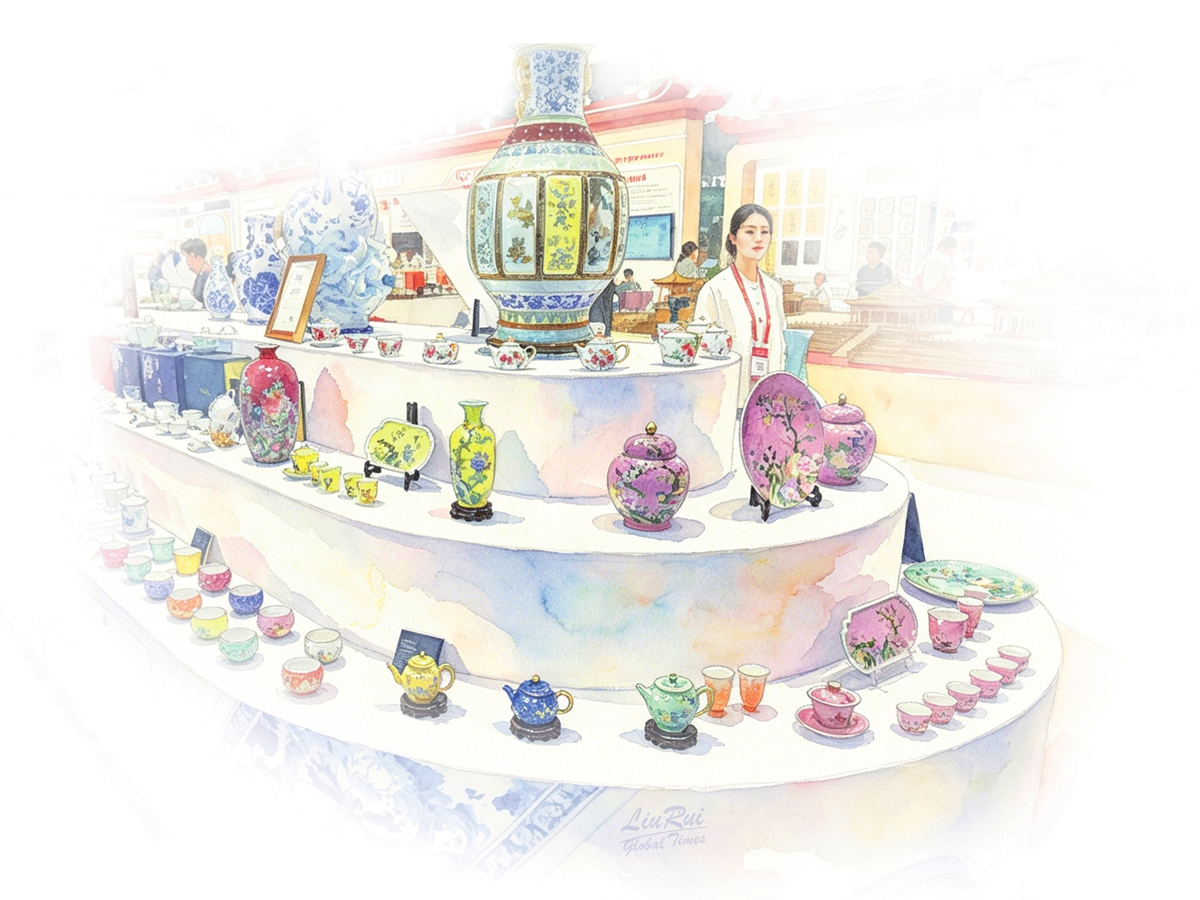
Illustration: Liu Rui/GT
The 22nd China (Shenzhen) International Cultural Industries Fair (ICIF) officially opened at the Shenzhen World Exhibition and Convention Center in Shenzhen, South China's Guangdong Province, on Thursday, turning 160,000 square meters of exhibition space into a dazzling display of more than 120,000 cultural items.Breaking the boundaries of traditional cultural exhibitions, this year's fair features cutting-edge sectors including artificial intelligence, digital performance, animation, and esports, leveraging advanced technology to reshape cultural communication modes and consumer experiences.
However, beneath the booming technological innovation, one can find that all frontier creative breakthroughs are rooted in traditional Chinese culture.
The museum cultural and creative zone stands as the most compelling proof. Over 30 top-tier Chinese museums, including the Palace Museum, the National Museum of China, Sanxingdui Museum, and Yinxu Museum, gathered at the fair to present their achievements in revitalizing cultural relics.
The special exhibition Ancient China in Cultural and Creative Works alone displayed more than 800 fine pieces from 22 key museums, weaving thousands of years of historical heritage into modern creative designs.
Running parallel to the fair, the 2026 Forum on Building up China's Cultural Strength opened with the theme "Inheriting Cultural Context and Advancing Cultural Innovation."
The simultaneous events raise a thought-provoking question: In an era when AI can generate images, text, and entire virtual worlds in the blink of an eye, where does traditional culture stand?
The guests who participated in the fair gave the answer: Traditional culture has turned into the most sought-after source of inspiration for technological innovation.
The Sanxingdui Museum's booth emerged as a major highlight, attracting endless crowds from both China and abroad throughout the exhibition.
Zhong Kejin, the head of Sanxingdui's cultural and creative division, told the Global Times with a mixture of pride and candor that her team had brought 300 top-selling items, carefully selected from nearly 2,000 products.
Plush toys inspired by mythological birds and pottery pigs, resin figurines of ancient bronze masks, and household items adorned with the civilization's unmistakable motifs - every piece radiated the enigmatic charm of the ancient Shu kingdom. The zone was, in her words, "jammed with people the entire time."
Zhong recalled that what surprised the team most was the overwhelming enthusiasm for cross-industry cooperation.
"Some were doing short dramas, some were in game development, and some were working on AR products," she said.
"We are still exploring physical cultural derivatives, while AI industries have already taken the initiative to connect with our IP," Zhong said.
She said that a globally competitive AI narrative needs a cultural soul, and Sanxingdui is offering one that is thousands of years in the making.
Just a few steps away, the Yinxu Museum booth told a parallel story.
Yinxu, the remains of the ancient capital of the Shang Dynasty (c.1600BC-1046BC) and the birthplace of the oracle bone script, carries a profound historical weight.
Zhao Yemeng, a cultural product designer of the Yinxu Museum, told the Global Times that the team had brought 40 to 50 exquisite items, narrowed down from nearly 400 products.
A shower cap shaped like the iconic Fu Hao owl-shaped zun, oracle bone refrigerator magnets, couplets printed with ancient characters, these clever adaptations of Shang culture were an immediate hit with visitors.
Fu Hao was the wife of King Wu Ding, who led the Shang Dynasty to its zenith. Her tomb was discovered in 1976 near Anyang, Central China's Henan Province, per the Xinhua News Agency.
Yet the team is not content simply selling souvenirs.
Xing Ruijuan, head of the museum's cultural and creative division, told the Global Times that they are actively building bridges toward the tech world.
She revealed that Yinxu is developing AI-enabled talking plush toys that can interact and converse with users, and AR-enhanced cultural products that transform static artifacts into dynamic, intelligent experiences.
Their ambitions go further. They are setting their sights on AI short dramas and digital entertainment, planning to tap classic IPs such as the warrior queen Fu Hao and King Wu Ding to craft compelling storylines for short dramas and digital entertainment.
The parallel exploration of Sanxingdui and Yinxu clarifies a trend that technology provides the form, but traditional culture supplies the soul.
Industry data further validates this logic. In 2025, China's cultural enterprises above designated size achieved operating income of 15 trillion yuan, an increase of 7.4 percent compared with the previous year.
In addition, the theme of the 2026 Forum on Building up China's Cultural Strength perfectly echoes the fair's core spirit.
Just like Zhong said, AI can rapidly generate images, short videos and 3D models, but the nation's profound traditional culture can endow technological works with unique Eastern aesthetics and historical depth.
The author is a reporter with the Global Times. life@globaltimes.com.cn
RELATED ARTICLES