ARTS / CULTURE & LEISURE
From books to batik: Guizhou artisan draws inspiration from reading to reinvent Dong ethnic craft
Guizhou artisan draws inspiration from reading to reinvent Dong ethnic craft
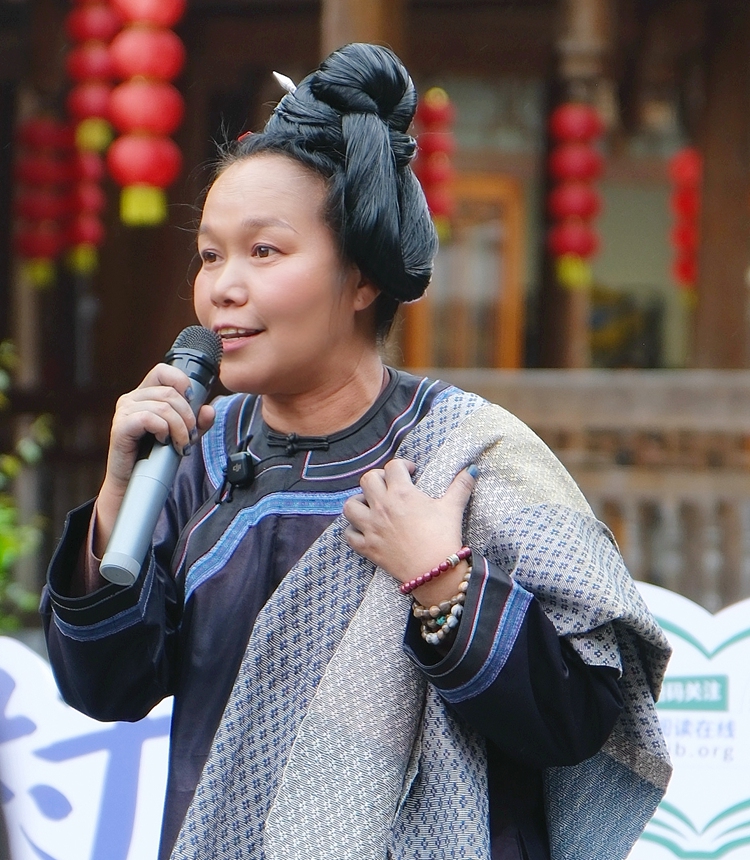
Lai Lei speaks at a reading promotion event in Zhaoxing Dong village, Southwest China's Guizhou Province, on April 27, 2026. Photo: Courtesy of Lai Lei
At a reading room in Tashi township of Rongjiang county, Southwest China's Guizhou Province, Lai Lei, a reading ambassador of the county, spoke to a group of local artisans about the different ways reading had shaped her life."Reading has changed my life. It gave me the confidence to see the wider world, and also allowed me to return to my hometown and do what I truly love," Lai told the Global Times.
Guizhou is home to 17 ethnic groups, with ethnic minority populations accounting for 36.11 percent of the province's total population.
The local ethnic communities preserve the age-old traditions such as indigo fabric dyeing, embroidery, and silver ornament making, which have become a distinctive industry that boosts rural revitalization and improves local people's well-being.
Rongjiang county is well known in China for its phenomenal grass-roots football tournament Village Super League (VSL), or Cunchao.
What makes the tournament unique is its deep integration with local heritage. During halftime, spectators enjoy performances of ethnic Dong songs, Miao drum dances and Bouyei folk songs. Winning teams receive handcrafted prizes such as cow-shaped batik dolls.
As designer of the cow-shaped dolls, Lai said the football tournament has strengthened local confidence by putting ethnic cultures at the center of Cunchao, the widely followed sporting event.
Starting with local batik and embroidery, she hopes to inspire more people to read, broaden their horizons, and innovate while also preserving their cultural heritage and enabling their handicrafts to reach more people.
Weaving into future
During the fifth National Conference on Reading held in East China's Jiangxi Province in April, Lai shared her story of returning to her hometown to preserve intangible cultural heritage and promote reading after having completed her education with financial support from fellow villagers.
"I didn't learn to speak Putonghua until I was 14. The reason I was able to attend college was that villagers pooled together small amounts of money, five yuan ($0.73) or 10 yuan at a time, to pay my tuition," she said. "It was reading that has allowed me to see the outside world, and Dong cloth, in turn, has allowed the world to see us."
In 2003, Dong cloth weaving skills, wax dyeing and embroidery were included in a list of national-level intangible cultural heritages.
Despite this, the traditional weaving craft faced the risk of phasing out in recent years. Lai then decided to quit her job in Shenzhen, South China's Guangdong Province and return to her hometown to preserve the fading tradition of Dong cloth weaving.
In 2015, Lai's Dong cloth products were invited to an exhibition in Paris and drew interest from buyers, but potential orders were later canceled because the fabric lacked internationally recognized certification.
Leading local women weavers, Lai turned to books and carried out repeated experiments, eventually developing the "24 Solar Terms indigo dyeing" technique and establishing a Chinese standard for traditional Dong cloth.
The technique is to create 24 different shades of "blue" corresponding to the 24 solar terms. The "blue" appears in various ways in different solar terms under different temperatures and climates.
Lai has always believed that reading is the foundation for preserving intangible cultural heritage.
"What matters is not how many books you have read, but how much knowledge and inspiration you have absorbed from them," she told the Global Times. "Now, as I travel to the villages across Rongjiang to promote reading, I hope to encourage people to broaden their thinking and enhance the value of their handicrafts, so that more people can see and appreciate our craftsmanship."
Mobile reading
To encourage more local students to put down their handphones and develop the habit of reading, Lai plans to create a mobile library so they can read anytime and anywhere.
"There are more than 20,000 students in the county. I want to tell the children that reading is not about escaping the mountains, but about illuminating them," she said.
"Reading doesn't have to take place in a fixed location. I want to put books on mobile tricycles so that whenever children see them, they can simply pick up a book and read. At the same time, they can bring books they have already read to exchange with others, allowing the books to circulate so everyone can share and benefit together," said Lai.
Lai said books on traditional dyeing, design and rural development inspired her to rethink how Dong cloth could adapt to modern development while preserving its cultural roots.
She said she wants to publish a book titled My Life in Weaving. The book will not only document the journey of Dong cloth from the remote mountains to the global stage, but also showcase the "woven life" created by over 30 women weavers in Rongjiang.
"Every person is a book," Lai said. "I'm compiling interview records of the weavers in the hope of presenting the weaving techniques they have expressed through the language of clothing. The book is planned for publication in August."
She also hopes to weave the ideas and stories of "craftsmanship intertwined with the love of reading" into the book.
"If you don't put what you read into practice, then all your reading is meaningless, and people will think reading is useless," Lai noted. "If you don't read, you have no opportunities at all. If you do read, at least you have a chance."
For Lai, reading is "a bridge that connects you with the outside world."
RELATED ARTICLES