APEC trade ministers gather to advance regional integration, multilateralism, with China injecting certainty
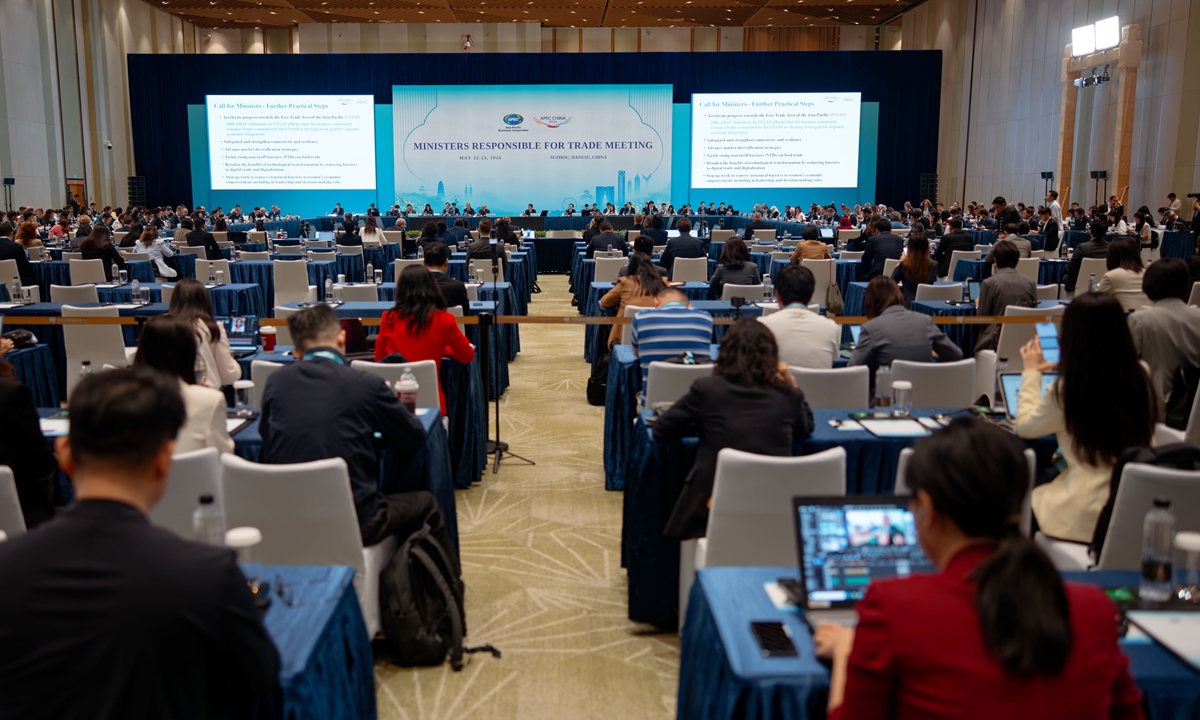
The APEC Ministers Responsible for Trade Meeting opens in Suzhou, East China's Jiangsu Province, May 22, 2026. Photo: IC
The Asia-Pacific Economic Cooperation (APEC) trade ministers' meeting opened in Suzhou, East China's Jiangsu Province on Friday, gathering approximately 700 representatives from 21 APEC economies and international organizations. As a key institutional meeting held regularly during each "APEC year," this two-day APEC Ministers Responsible for Trade Meeting focused on four key areas, including advancing regional economic integration, supporting the World Trade Organization, strengthening digital cooperation, and promoting green economy development.The agenda encompassed both high-level macroeconomic issues, such as global economic governance, and practical cooperation in emerging and frontier fields of shared interest to all parties, said China's Minister of Commerce Wang Wentao in an interview with the Xinhua News Agency, released on Friday.
As an important institutional meeting customarily held midway through the APEC host year, the trade ministers' meeting is tasked with contributing outcomes to the APEC Economic Leaders' Meeting - to be held in Shenzhen, South China's Guangdong Province in November 2026 - and serves as a barometer of economic and trade policy trends in the Asia-Pacific region and beyond, Wang Wentao said.
As a key component of the APEC series of meetings, the trade ministers' meeting plays a vital role in building regional economic and trade consensus, and coordinating cooperation policies. Promoting trade cooperation within the APEC framework is a key lever for advancing Asia-Pacific regional economic integration and safeguarding the multilateral trading system, Chinese experts said.
Call for multilateralism, cooperation
As one of the most dynamic economic regions in the world, the Asia-Pacific has benefited significantly from APEC's efforts to promote trade and investment liberalization and facilitation. Over the past three decades, APEC has helped reduce the average tariff in the region from 17 percent to around 5 percent since its establishment in 1989, laying a solid foundation for regional economic prosperity, according to statistics released by APEC.
Many APEC economies have been pursuing trade liberalization through various means. For example, the Regional Comprehensive Economic Partnership (RCEP), which connects 15 Asia-Pacific countries -- 12 of which are APEC members and is entering into its fourth year, represented a successful model of multilateral cooperation.
As the world's largest free trade area, RCEP has continued to be a driving force for its members. For example, Thai durians arriving at Shenzhen Port can reach the China market within two days of arrival, greatly improving trade efficiency.
According to Chinese customs, the majority of the imported durians at the Shenzhen port come from the APEC member economies.
There are many other examples of multilateral and bilateral cooperation under the APEC framework.
The Free Trade Area of the Asia-Pacific (FTAAP) is also one of the long-term visions for deepening economic integration in the Asia-Pacific region.
At a time when global trade is becoming increasingly fragmented and protectionism is on the rise, APEC cooperation has become a "stabilizing anchor" for hedging against risks and maintaining the stability of global supply chains, Hu Qimu, a professor at the Maritime Silk Road Institute of Huaqiao University, told the Global Times on Friday.
China's Commerce Minister highlighted that the APEC trade ministers' meeting is unfolding against a complex and challenging international backdrop, characterized by rising geopolitical tensions, growing unilateralism, and intensifying protectionism. These developments have severely disrupted the global economic and trade order and dampened growth prospects both in the Asia-Pacific region and worldwide.
"In light of this situation, all parties hold higher expectations for the meeting to forge broad consensus and achieve concrete, actionable outcomes," Wang Wentao said.
"The more turbulent and challenging the situation becomes, the more we must adhere to the principle of seeking common ground while shelving differences, work together to overcome difficulties, strive to build greater consensus, guide the Asia-Pacific economy through this period of hardship, and inject confidence into the global economy," Li Chenggang, China international trade representative with the Ministry of Commerce (MOFCOM) and vice minister of commerce, said in his address to the opening ceremony of the APEC trade ministers' meeting on Friday.
Against this backdrop, China hosting the APEC Ministers Responsible for Trade Meeting and promoting consensus among all parties on openness, innovation, and cooperation holds even greater practical significance. China's role is not only that of a participant in Asia-Pacific cooperation, but also an important stabilizer in safeguarding the multilateral trading system, promoting regional connectivity, and advancing green and digital transformation, said Hu.
China's contribution
The trade ministers' meeting is being held in parallel with the theme of the 2026 APEC "China Year" - "Building an Asia-Pacific Community to Prosper Together" - and the three priorities of "openness, innovation and cooperation." This year marks China's third time serving as host of APEC.
China has transformed itself from a "practitioner" of international rules to a "creator" and grown from a participant into a leader. At a time of profound changes in the global trade landscape, China is taking the initiative to shoulder responsibility, encouraging all parties to set aside differences, build consensus, point the way forward for Asia-Pacific cooperation, and contribute Chinese strength to global economic recovery, Hu said.
Over the 35 years since joining the APEC, China has always been a staunch supporter and major contributor to the organization, as well as an active advocate and leader in Asia-Pacific regional economic and trade cooperation. In 2025, China became the largest trading partner for 13 APEC economies. Its total trade volume with APEC economies reached $3.7 trillion, accounting for 57.8 percent of its total foreign trade. Of this, imports from APEC economies amounted to $1.5 trillion, according to statistics from the Ministry of Commerce.
Analysts also pointed out that China's host cities of APEC events themselves, such as Shenzhen and Suzhou, are vivid examples of China's reform and opening-up as well as industrial upgrade and innovation drive.
Since the launch of China's reform and opening-up, Shenzhen has been transformed from a small, remote fishing village into a globally influential innovation powerhouse. Its remarkable journey serves as a vivid embodiment of China's integration into the world economy.
Through APEC, Shenzhen will demonstrate China's tangible achievements in the digital economy, technological innovation, and green transformation, Wang Peng, an associate researcher at the Beijing Academy of Social Sciences, told the Global Times on Friday.
"China is leveraging its full-industry-chain advantages and technological innovation to support global digital development and economic growth. We precisely match our advanced capacity in digital infrastructure, green energy, and other fields with the industrial upgrading needs of APEC economies," said Wang Peng.
While Shenzhen serves as the "window" of China's reform and opening-up drive that began in the late 1970s, Suzhou Suzhou, the host city of the trade ministers' meeting, strives to build itself into an industrial upgrade and innovation hub. Suzhou has also become one of the Chinese cities with the largest number of platforms for opening to the outside world and the highest concentration of foreign capital. It is home to more than 19,000 foreign-invested enterprises, with cumulative utilized foreign investment exceeding $170 billion.
Suzhou Industrial Park has now been hailed as an important window through which to view China's reform and opening-up initiatives and serves as a successful example of international cooperation.
RELATED ARTICLES