APEC's 'China Year' ushers in 'Suzhou moment' as 32nd APEC Ministers Responsible for Trade Meeting approaches
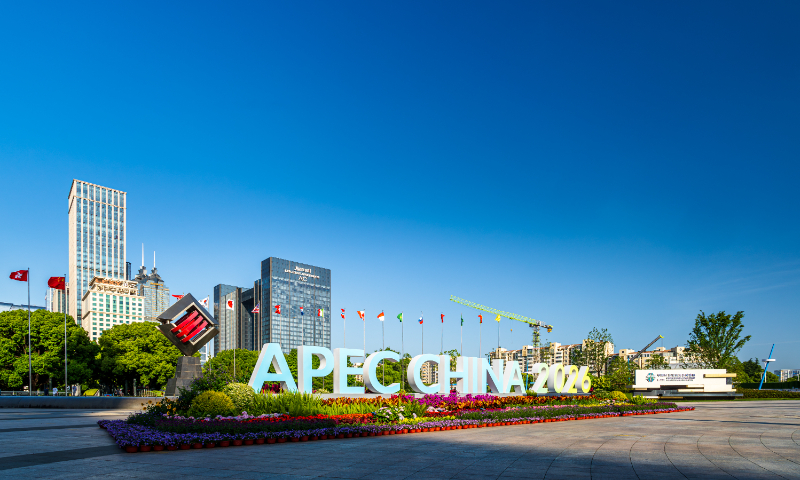
Photo taken on May 16, 2026 shows the APEC signs at the Suzhou Industrial Park, in Suzhou, East China's Jiangsu Province. Photo: VCG
In May, mist drifts across the vast waters of Taihu Lake, while the fragrance of blossoms lingers among the signature whitewashed houses and black-tiled roofs in Suzhou, East China's Jiangsu Province. Against the backdrop of the picturesque early-summer scenery of the Yangtze River Delta, known in Chinese as Jiangnan, Suzhou is once again stepping onto the global stage as it prepares to host the 32nd APEC Ministers Responsible for Trade Meeting.
Founded in 1989, the Asia-Pacific Economic Cooperation (APEC) is the highest-level, broadest and most influential economic cooperation mechanism in the Asia-Pacific region. On May 22 and 23, ministerial representatives from its 21 member economies will gather in Suzhou to discuss cooperation and chart the course for development in the Asia-Pacific region.
As China embarks the first year of its 15th Five-Year Plan (2026-30), Suzhou once again takes the stage in China's home-ground diplomacy. The meeting not only reflects trust in the city's openness and organizational capabilities, but also highlights its role in advancing the country's development agenda and projecting China's image to the world.
25 years on, Suzhou returns to the APEC spotlight
The year 2001 marked China's inaugural tenure as APEC host, and it was also the year Suzhou welcomed the 8th APEC Finance Ministers' Meeting.
Twenty-five years later, as China assumes the role of host for the third time, Suzhou is again stepping onto the stage of China's home-ground diplomacy by hosting the 32nd APEC Ministers Responsible for Trade Meeting.
"Suzhou is a renowned historical and cultural city as well as a major frontier of China's opening-up. It boasts a profound historical heritage while also radiating modern and international charm," He Yongqian, a spokesperson of the Ministry of Commerce (MOFCOM), said in January, describing a city where ancient elegance and contemporary vitality coexist.
With a history of more than 2,500 years, Suzhou's rich cultural heritage is reflected in Kunqu Opera, Pingtan storytelling and ballad singing, Suzhou embroidery, Kesi silk-weaving, its classical gardens of Jiangnan, and the Grand Canal - all bearing witness to the profound legacy of this Chinese city. Complementing its millennia-old cultural traditions is a modern Suzhou defined by openness, innovation and dynamic vitality in the new era.
Today, Suzhou is one of China's economic powerhouses. In 2025, its GDP reached $387.7 billion, ranking sixth among Chinese cities and approximately 20th globally. The scale of its foreign trade has long ranked among the top three or four nationwide.
The city is also one of China's most open, with one of the largest groups of foreign investors, hosting the largest number of opening-up platforms in the country. It is home to more than 19,000 foreign-invested enterprises, with cumulative utilized foreign investment exceeding $170 billion.
More notably, Suzhou is both a starting point and key node in many industrial chains in China and globally, with world-class industrial supporting capacity. It hosts about 160,000 industrial enterprises across sectors including electronic information, equipment manufacturing, new materials, new energy, biomedicine, and artificial intelligence, covering both emerging pillar sectors and industries of the future.
As a leading hub of China's open economy, Suzhou has long maintained deep and extensive economic and trade ties with APEC member economies. In 2025, its total foreign trade reached 2.81 trillion yuan ($410 billion), of which trade with APEC members accounted for 1.92 trillion yuan, nearly 70 percent.
Through concrete actions, the city has actively engaged in high-level international economic cooperation, connecting global industries and advancing regional economic integration and globalization. The city has contributed to an open, inclusive, and innovative world economy. All of these efforts are closely aligned with APEC's core principles.
Suzhou is home to government service teams well-versed in international rules, an enterprise ecosystem experienced in cross-border business, and world-class convention and exhibition facilities aligned with global standards. By hosting the APEC Ministers Responsible for Trade Meeting, Suzhou is not only serving as a "host city," but also setting a benchmark.
Convey confidence, expectations to the world
Different from 2001, when China first hosted the APEC Ministers Responsible for Trade Meeting with a focus on traditional issues such as trade and investment liberalization and facilitation, Asia-Pacific economic cooperation today has entered a more complex "deep-water zone."
Emerging areas such as digital economy, green and low-carbon development, and industrial and supply chain resilience have increasingly become key priorities for economic cooperation.
Unilateralism and protectionism are on the rise, and global industrial and supply chains are undergoing accelerated restructuring. China has consistently upheld high-standard opening-up and firmly safeguarded the multilateral trading system.
Against this backdrop, the convening of the APEC Ministers Responsible for Trade Meeting in Suzhou serves as an important window, through which China signals to the world that its door of opening-up will only become wider.
As an annual meeting, the APEC Ministers Responsible for Trade Meeting serves as a barometer for advancing regional economic integration and safeguarding the multilateral trading system. "Confidence" and "expectations" are the two key themes surrounding Suzhou's hosting of the 2026 meeting: confidence in and expectations for the APEC process, for Asia-Pacific cooperation, and for China's successful hosting of the event.
The international landscape is marked by rising turbulence and uncertainty, with sluggish economic growth and multiple complex challenges confronting the Asia-Pacific region. The world is turning its attention to Suzhou, looking for confidence from the city and hoping that the APEC Ministers Responsible for Trade Meeting will help build consensus and deliver positive outcomes, injecting new vitality and momentum into economic and trade growth in both the Asia-Pacific region and the wider world.
This high-profile Asia-Pacific economic and trade gathering will also leave a distinct mark on APEC's "China Year."
New opportunities in the 15th Five-Year Plan period
Hosting this major international event also represents a significant development opportunity entrusted to Suzhou by the nation.
Speaking at a press conference on the APEC Ministers Responsible for Trade Meeting held by the MOFCOM on May 9, Ji Jing, Suzhou's vice mayor, said that in the first year of the 15th Five-Year Plan period, the hosting of the APEC Ministers Responsible for Trade Meeting in Suzhou is a mission of honor entrusted by the country.
Suzhou aims to leave guests with three unforgettable impressions: a well-organized and memorable event, an elegant and refined experience, and a grand, inclusive city.
According to the briefing, about 700 representatives from 21 APEC economies and international organizations will gather in Jiangsu for the international event.
In addition, about 350 delegates from Fortune Global 500 companies, China's Top 500 firms, and leading industry players will attend the Asia-Pacific Business Partnership Dialogue and the 2026 Suzhou Global Investment Promotion Conference.
This meeting will serve to further open a window for exchanges and cooperation between Suzhou and APEC member economies, continuously expand the city's international network, and, while enhancing its level of openness, help Suzhou strengthen connectivity with domestic and international markets, said Qin Weixi, director of the Suzhou Municipal Commerce Bureau.
As the Asia-Pacific's highest-level economic cooperation mechanism, the APEC Ministers Responsible for Trade Meeting is expected to further deepen Suzhou's integration into regional industrial, supply, and innovation chains. It will not only expand the city's international cooperation in areas such as digital trade, the green economy, and biomedicine, but also - with the participation of Fortune Global 500 companies and industry leaders - help attract high-end foreign investment, headquarters projects, and R&D centers. This will further improve its industrial ecosystem and strengthen its position as a leading hub of the open economy.
The role of major events in promoting trade and industrial development has become a powerful engine driving Suzhou's accelerated opening-up.
RELATED ARTICLES