First complete ice core retrieved from summit of Mount Qomolangma as China-Nepal scientific expedition team secures key climate sample
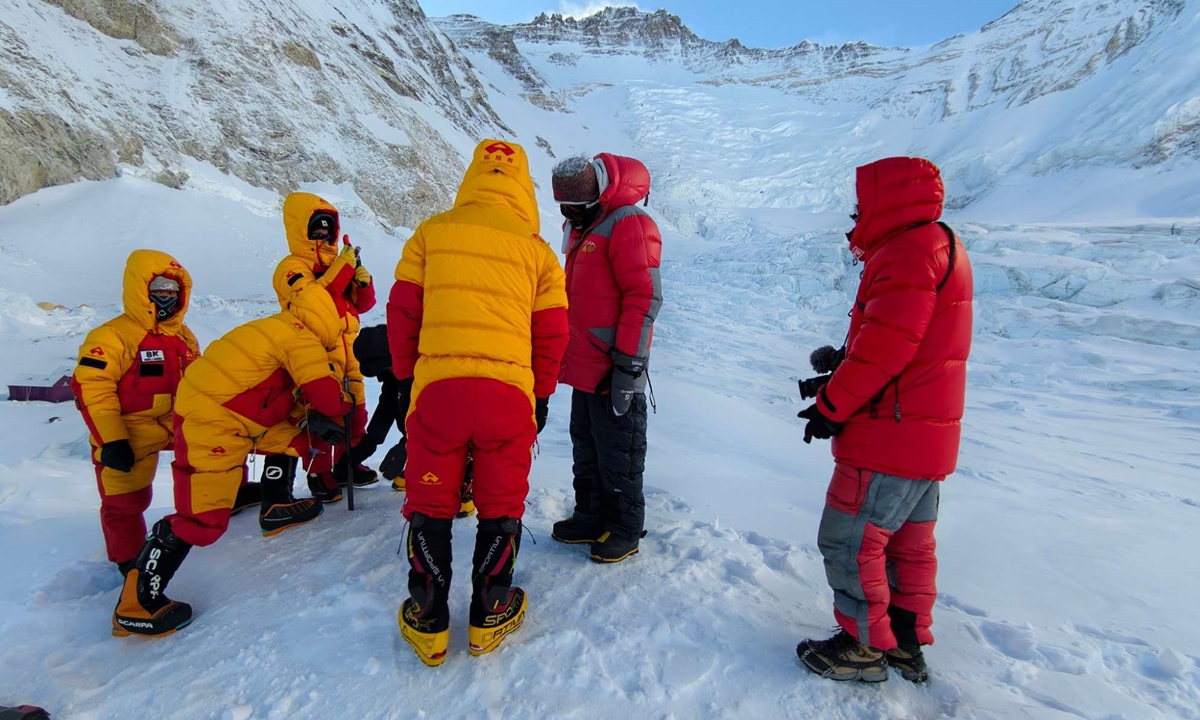
Members of the scientific expedition team conduct ice core drilling near the C2 camp at an altitude of 6,200 meters on Mount Qomolangma. Photo: Courtesy of Polar Hub
A China-Nepal joint scientific expedition named "Core of the Summit" successfully reached the summit of Mount Qomolangma from the Nepal side on Thursday and completed the first full-depth ice core drilling at the peak of the world's highest mountain and acquired the sample, chinanews.com reported on Friday.According to information shared with the Global Times by Polar Hub on Friday, members of the joint expedition reached the summit at around 7:30 am on Thursday and conducted scientific sampling work including ice core drilling at an altitude of 8,848.86 meters.
About two hours later, the summit scientific operation concluded, with the expedition completing the first-ever full-depth ice core extraction from the summit.
According to Polar Hub, the team continued to collect ice core and snow core samples across multiple altitude gradients on the way down. The samples will be transported to laboratories under low-temperature preservation conditions for research on climate and environmental changes in the world's highest region, cryosphere evolution, and atmospheric records at extreme altitudes.
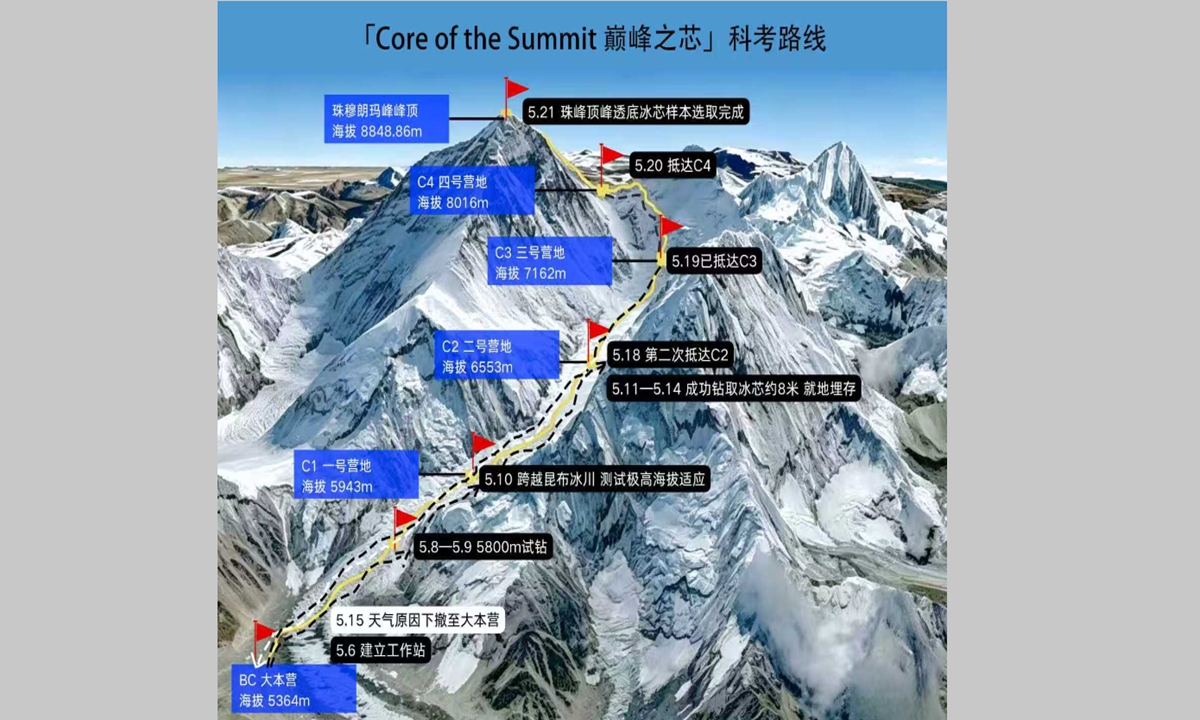
The climbing route of the "Core of the Summit" China-Nepal scientific expedition team on Mount Qomolangma Photo: Courtesy of Polar Hub
Wen Xu, leader of the expedition team, said that conducting ice core drilling at the summit of Mount Qomolangma requires not only completing an extreme mountain climb, but also carrying out continuous scientific operations within a narrow working window under conditions of severe oxygen deprivation and freezing temperatures.Xu Baiqing, chief scientist of the expedition and deputy director of the Institute of Tibetan Plateau Research with CAS, said the summit of Mount Qomolangma represents the highest geographical point on Earth and remains a major gap in human observation.
The summit ice core and multi-altitude samples obtained during the mission will provide key materials for revealing climate and environmental changes in the world's highest region and for understanding atmospheric circulation and material transport processes at extreme altitudes, according to Xu.
The collected samples are expected to arrive at the south base camp of Mount Qomolangma with the team in the coming days, before being transferred under professional low-temperature preservation conditions for subsequent laboratory analysis, according to chinanews.com.
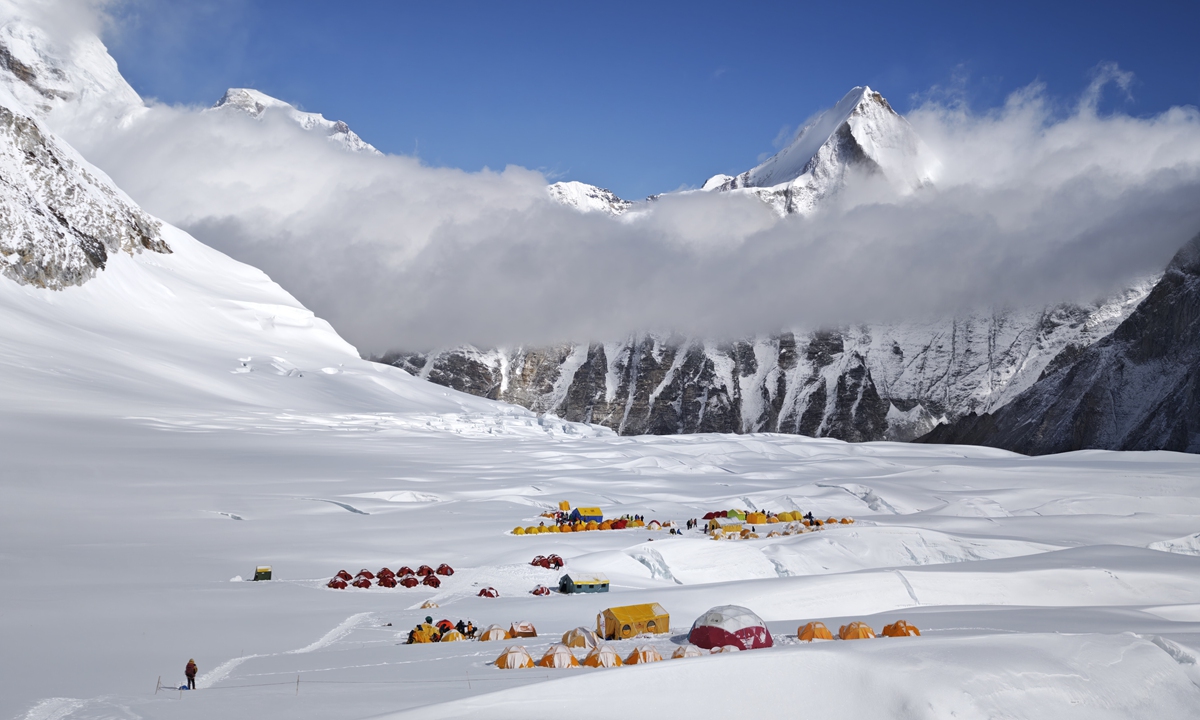
South base camp of Mount Qomolangma Photo: Courtesy of Polar Hub
Information shared from Polar Hub noted that the summit of Mount Qomolangma is an exceptionally unique observation zone for studying global cryosphere changes and high-altitude atmospheric environments. Obtaining a full-depth summit ice core marked a major breakthrough for the expedition, while continued sampling across different altitude gradients during the descent will help establish a complete chain of climate and environmental evidence for high-altitude regions.The collected samples are expected to help researchers better understand climate and environmental changes in ultra-high-altitude areas, the boundary of the Indian monsoon's influence, the transport pathways of pollutants into high-altitude regions, and differences in climate responses between the northern and southern slopes of Mount Qomolangma.
The mission also marked an important effort by Chinese scientific researchers to participate in global cryosphere research and high-altitude environmental observation, Polar Hub said.
RELATED ARTICLES