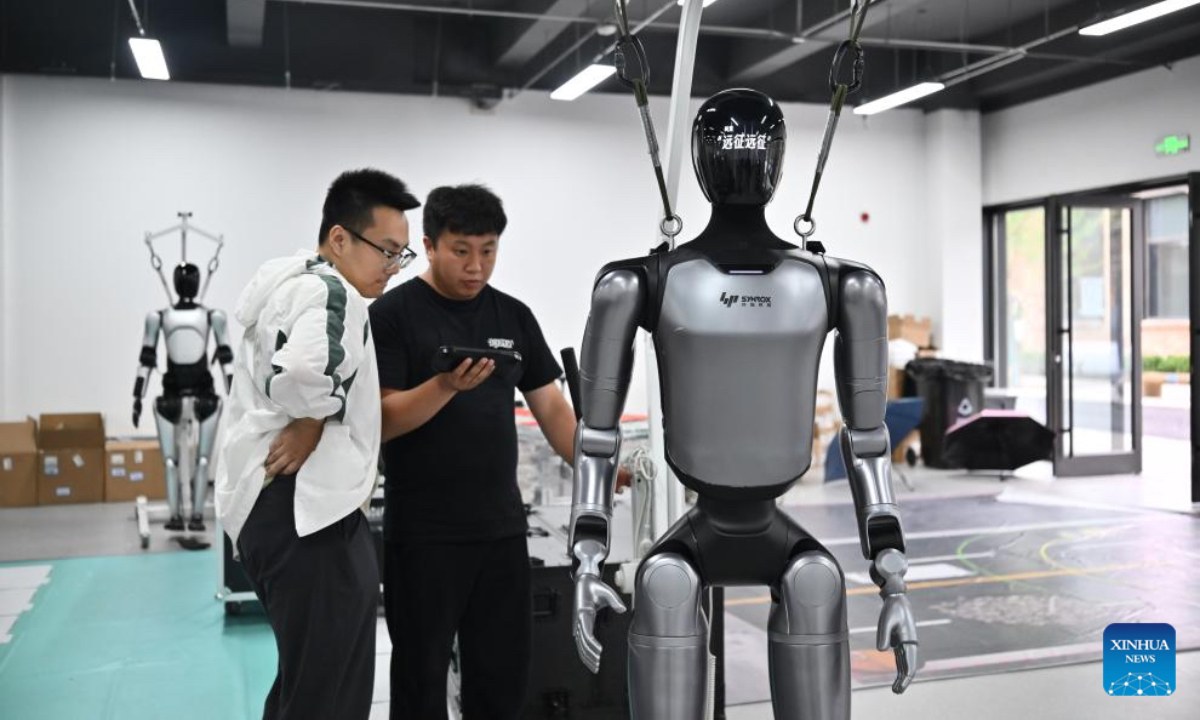
Engineers adjust a humanoid robot at tech firm SYNROX in 764 Aerospace, north China's Tianjin Municipality, May 20, 2026. (Xinhua/Sun Fanyue)
Every humanoid robot will be assigned an identity code, or "ID card," and will undergo full-chain management from production to scrapping, the Global Times learned on Friday from the technical committee of Humanoid Robots and Embodied Intelligence Standardization under the Ministry of Industry and Information Technology.
Setting up a management model centered on the ID card and endowing humanoid robots with social attributes will ensure that they remain under control across different fields, industries, and job positions, said Yu Xiuming, vice president of the China Electronics Standardization Institute. In addition, this will support the domestic industry's international competitiveness and enhance China's influence in the humanoid robot sector.
The Global Times learned that in the future, every humanoid robot must be assigned a unique, unalterable ID number that runs through its entire lifecycle - from factory exit to scrapping.
On Friday, the committee released a full lifecycle management service platform for humanoid robots, covering the entire chain from R&D, production and sales to usage, maintenance, scrapping and recycling.
The Global Times learned that the platform already covers more than 100 humanoid robot enterprises across China, and has completed full-lifecycle ID code assignment for over 200 product models and more than 28,000 robots.
Yu noted that the standards enable full-lifecycle traceability, cross-industry identification, and full-territory control of humanoid robots. "For the high-quality overseas expansion of humanoid robots, it is urgently necessary to establish a unified rules-based management standard system. This will provide technical support for international mutual recognition, cross-border distribution, and market access, while enhancing China's international influence and competitiveness in the humanoid robot industry," Yu said.
RELATED ARTICLES