Great opportunities lie in small commodities: three perspectives on a proactive government
Editor’s Note:
Chinese President Xi Jinping has urged efforts to further review the development experience of the city of Yiwu in East China's Zhejiang Province, and put it to good use. Yiwu's small commodities have broken into a vast market and developed into a major industry, forming the Yiwu development experience, he said, adding that this represents a successful model for developing county economies in line with local conditions, according to the Xinhua News Agency. The Securities Times launched a series titled “Close-up observations on Yiwu’s development experience,” exploring the vibrant “world supermarket.” Through on-the-ground perspectives and close-up observations, the series delves into the rich essence and enduring vitality of Yiwu’s development experience.
In District 2 of the Yiwu International Trade Market, the store of Zhejiang Xingbao Umbrella Co. is filled with thousands of colorful umbrellas — lightweight sun umbrellas, retro long-handle umbrellas, cartoon children’s umbrellas, and high-end custom umbrellas — presenting a dazzling array of products. Chairperson Zhang Jiying stands at the counter, skillfully introducing new products to several Middle Eastern merchants in Arabic and English. While 29 years ago, Zhang started with only a 98-centimeter-wide stall in the Yiwu market.
From “front store” to “back factory,” and from “selling umbrellas made by others” to “manufacturing umbrellas ourselves and selling them worldwide,” Zhang’s journey is a vivid microcosm of Yiwu’s model of “promoting industry through commerce and linking trade and industry.” It also serves as a snapshot of the continuous innovation in Yiwu’s development process. In 2025, Yiwu’s total import and export volume reached 836.49 billion yuan, with over 1.2 million market entities operating in the city.
Yiwu has become the “super hub” of global small commodity trade precisely because of three layers of innovation: industry-trade linkage has given the market a solid industrial foundation, digital transformation has injected technological power into trade, and institutional breakthroughs have created global channels for buying and selling.
Promoting ‘industry-trade linkage’
In 1989, Lü Xulian left his hometown and came to Yiwu, setting up a stall on a street-front shop outside the Yiwu International Trade Market. At that time, the market had not yet taken shape. “We people of that generation didn’t have a fixed industry. We sold whatever was profitable. From lighters and toys to leather shoes, we basically sold everything,” Lü recalled. Back then, more than 70 percent of the goods in Yiwu’s market came from other regions, such as Wenzhou leather shoes, Taizhou glasses, and Guangdong electronics.
By the 1990s, Yiwu’s small commodity market had already formed a pattern of “buying from across the country and selling to the whole country.” However, the drawbacks of not being a place of origin gradually became apparent. Approximately 70 percent of the goods in Yiwu’s market depended on external factories, leaving the city without sufficient control over sales. Against this backdrop, the Yiwu Municipal Party Committee and Government seized the opportunity and, starting in 1993, encouraged merchants to “attract business and shift to industry,” implementing the strategy of “promoting industry through commerce and linking trade with industry.”
Under the policy support of industry-trade linkage, Yiwu’s competitive industries such as garments, knitted socks, accessories, and toys have expanded beyond market stalls, forming a pattern of “small enterprises, large clusters; small commodities, large markets.” The “trade-industry linkage” model with “front store, back factory” has given the market a much stronger foundation.
Zhang realized early on that to grow her umbrella business, she needed her own factory. She began building her own production facilities and named the first factory “Xingbao.” From product design and raw material procurement to manufacturing and export sales, the entire supply chain is independently controlled. “We operate under a ‘front store, back factory’ model, with self-production and self-sales,” she said. “This gives us a price advantage and allows us to strictly control product quality. Every stitch on a Xingbao umbrella is extremely neat, with a standardized number of stitches per centimeter — we make umbrellas the same way high-end suits are made.”
It is precisely this “industry-trade linkage” model that has enabled Xingbao Umbrella to build a hard-to-replicate quality “moat” in the global umbrella market. Today, Xingbao umbrellas are sold to more than 170 countries and regions worldwide. The company registered brands. Zhang now operates more than 10 stores in Yiwu International Trade Market, with an annual production volume exceeding 5 million umbrellas.
Dong Haibing, chairperson of Zhejiang Yuanhong Glasses Co., also has deep firsthand experience of the impact the “industry-trade linkage” policy has brought to Yiwu merchants. A native of Duqiao town in Linhai, Taizhou — known as “China’s eyeglasses town” — Dong became part of the first group of merchants to settle in District 3 of Yiwu International Trade Market in 2005. Starting from scratch, he gradually expanded his business to Southeast Asia, South America, and Europe by leveraging the stable supply and competitive pricing from his hometown’s eyewear factories.
Dong said that the massive order volume from the Yiwu market has directly driven the capacity expansion and technological upgrading of the Duqiao eyewear industrial cluster. In turn, the Duqiao factories’ rapid response capability has become his core competitive advantage in the city’s market.
Upgrading ‘digital links to the world’
If the “industry-trade linkage” model solved the issue of “whether Yiwu has industry or not,” then in the past decade, the city has shifted its focus to technological and digital transformation, tackling the question of “whether the industry is good or not.” Today, Yiwu is undergoing a profound transformation from traditional trade to modern global commerce.
In October 2025, Yiwu’s sixth-generation Global Digital Trade Center officially opened. It is no longer just a trading market, but a new-type trade infrastructure integrating digital trade, intelligent logistics, and cross-border services.
As a merchant in the center, Fu Hua, chairperson of Red Sun Technology, moved from Yunnan to Zhejiang more than 10 years ago. His business journey is a typical example of traditional foreign trade practitioners transforming into intelligent technology enterprises.
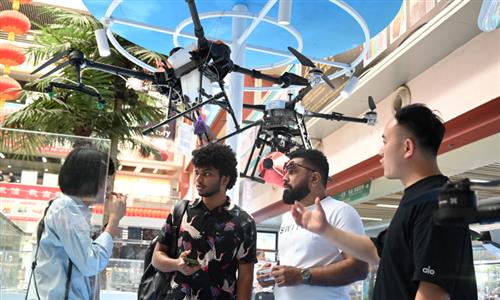
Fu has been working in Yiwu for over a decade. Previously, he sold office whiteboards in District 1 of the Yiwu International Trade Market. However, the whiteboard industry faced increasing limitations — prices were transparent and profits were thin. “Anyone can do it, and in the end, it becomes nothing but a price war.” The turning point came in 2025. With the opening of the sixth-generation Global Digital Trade Center, Fu decisively entered the field of technology products such as robots, drones, and LiDAR.
“In the past, selling whiteboards was like ‘Here are my products — you pick what you want,’” Fu said. “Now it’s ‘What do you need? I will solve your pain points.’” Less than six months after opening, Red Sun Technology has sold thousands of companion education robots, while sales of delivery robots and drones continue to grow. This shift from passive operations to proactive service represents the broader evolution of a new generation of Yiwu merchants.
In the sixth-generation Global Digital Trade Center, digital infrastructure is also being fully rolled out. Yiwu International Trade Market has innovatively developed the digital trade comprehensive service platform “Chinagoods,” along with multiple AI application scenarios, helping merchants and buyers improve trade and marketing efficiency. With the help of AI applications, the company has produced a large number of promotional posters and videos for robots and robotic dogs, achieving impressive sales results. Fu’s transformation from whiteboards to robots is a vivid footnote to the “creating something out of nothing” spirit of the sixth-generation Yiwu market.
Pioneering ‘consolidated shipping’
The innovative development of the Yiwu market is inseparable from the continuous improvement of its institutional environment. The government has consistently acted at critical moments, driving continuous innovation and breakthroughs in market models, trading methods and trade systems.
For example, the export of small commodities was once a global challenge: it involved numerous participants, highly diverse products, and frequent small-batch, multi-variety shipments that required “consolidated shipping.” Traditional general trade and processing trade models struggled to accommodate this. Yiwu’s solution was to push eight national ministries and commissions to create the market procurement trade model.
As a direct beneficiary of this institutional reform, a shop owner surnamed Wang, who runs an accessories business in District 1 of Yiwu International Trade Market, has a firsthand understanding of the changes brought by the policy. “Before the reform, consolidated shipping for export was a nightmare. A single container might contain over 50 types of accessories and toys. We had to declare each item separately, prepare individual contracts and invoices, and wait one to two days just for documentation. Then came another one to two days for customs clearance. Shipments were often rejected due to incomplete documents. We didn’t dare accept small orders at all.” Wang said candidly that under the traditional model, small orders involved high customs declaration costs and long processing cycles, forcing many merchants to give up on small overseas customers.
After the market procurement trade model was implemented, this predicament was completely resolved. The policy clearly states that a single declaration with a value of no more than $150,000 qualifies for simplified procedures. Up to hundreds of different goods can be consolidated into one declaration item, with paperless filing and automatic review and release. Clearance can be completed within one hour, and the entire customs process finished within 24 hours. “Now, consolidated shipping is ‘instant.’ Hundreds of different items can be handled with just one declaration form. We save on agency fees and time, and we can confidently accept small-batch orders,” Wang said.
This institutional innovation has enabled small, medium, and micro enterprises as well as ordinary merchants to participate in international trade with lower barriers. It has also facilitated the smooth and rapid entry of small-batch, high-variety goods into global markets. In 2025, Yiwu’s total exports reached 730.7 billion yuan, a year-on-year increase of 24.1 percent. Of this, exports under the market procurement model amounted to 599.17 billion yuan, accounting for 80.1 percent of the city’s total exports. Today, the market procurement trade model has been replicated and promoted in 39 regions across China and has been included twice in the State Council’s Government Work Report.
Over the past four decades, Yiwu’s innovation has never stopped. From industry-trade linkage that strengthened its industrial foundation, to the Digital Trade Center that opened a new digital chapter, and then to the market procurement trade model that broke down institutional barriers — every leap in the city’s development has not relied on a single “magic solution,” but on continuously iterating problem-solving approaches. Yiwu’s exploration offers a sustainable path for China’s county-level economies: “driven by the market as the engine and innovation as the driving force.”
This was compiled and translated by the Global Times based on an article originally published on the Securities Times on May 21, 2026.
Chinese President Xi Jinping has urged efforts to further review the development experience of the city of Yiwu in East China's Zhejiang Province, and put it to good use. Yiwu's small commodities have broken into a vast market and developed into a major industry, forming the Yiwu development experience, he said, adding that this represents a successful model for developing county economies in line with local conditions, according to the Xinhua News Agency. The Securities Times launched a series titled “Close-up observations on Yiwu’s development experience,” exploring the vibrant “world supermarket.” Through on-the-ground perspectives and close-up observations, the series delves into the rich essence and enduring vitality of Yiwu’s development experience.
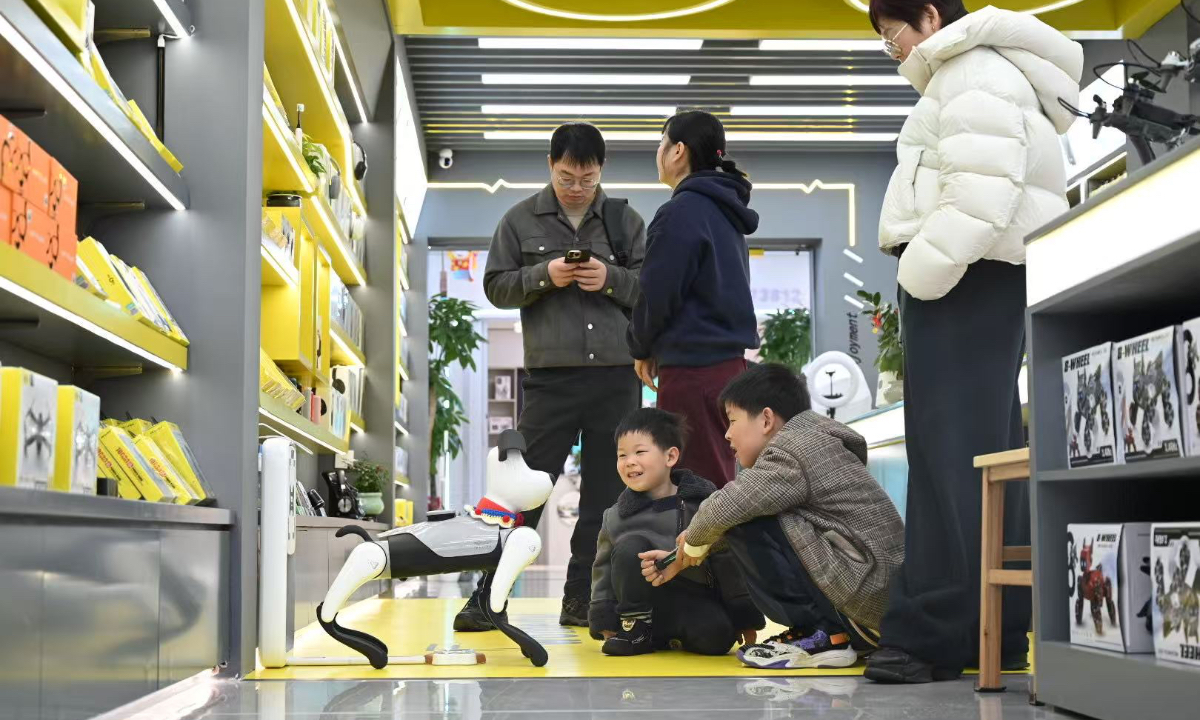
Consumers purchase digital toys at Yiwu International Trade Market Photo: Li Xiaoping/ Securities Times
In District 2 of the Yiwu International Trade Market, the store of Zhejiang Xingbao Umbrella Co. is filled with thousands of colorful umbrellas — lightweight sun umbrellas, retro long-handle umbrellas, cartoon children’s umbrellas, and high-end custom umbrellas — presenting a dazzling array of products. Chairperson Zhang Jiying stands at the counter, skillfully introducing new products to several Middle Eastern merchants in Arabic and English. While 29 years ago, Zhang started with only a 98-centimeter-wide stall in the Yiwu market.
From “front store” to “back factory,” and from “selling umbrellas made by others” to “manufacturing umbrellas ourselves and selling them worldwide,” Zhang’s journey is a vivid microcosm of Yiwu’s model of “promoting industry through commerce and linking trade and industry.” It also serves as a snapshot of the continuous innovation in Yiwu’s development process. In 2025, Yiwu’s total import and export volume reached 836.49 billion yuan, with over 1.2 million market entities operating in the city.
Yiwu has become the “super hub” of global small commodity trade precisely because of three layers of innovation: industry-trade linkage has given the market a solid industrial foundation, digital transformation has injected technological power into trade, and institutional breakthroughs have created global channels for buying and selling.
Promoting ‘industry-trade linkage’
In 1989, Lü Xulian left his hometown and came to Yiwu, setting up a stall on a street-front shop outside the Yiwu International Trade Market. At that time, the market had not yet taken shape. “We people of that generation didn’t have a fixed industry. We sold whatever was profitable. From lighters and toys to leather shoes, we basically sold everything,” Lü recalled. Back then, more than 70 percent of the goods in Yiwu’s market came from other regions, such as Wenzhou leather shoes, Taizhou glasses, and Guangdong electronics.
By the 1990s, Yiwu’s small commodity market had already formed a pattern of “buying from across the country and selling to the whole country.” However, the drawbacks of not being a place of origin gradually became apparent. Approximately 70 percent of the goods in Yiwu’s market depended on external factories, leaving the city without sufficient control over sales. Against this backdrop, the Yiwu Municipal Party Committee and Government seized the opportunity and, starting in 1993, encouraged merchants to “attract business and shift to industry,” implementing the strategy of “promoting industry through commerce and linking trade with industry.”
Under the policy support of industry-trade linkage, Yiwu’s competitive industries such as garments, knitted socks, accessories, and toys have expanded beyond market stalls, forming a pattern of “small enterprises, large clusters; small commodities, large markets.” The “trade-industry linkage” model with “front store, back factory” has given the market a much stronger foundation.
Zhang realized early on that to grow her umbrella business, she needed her own factory. She began building her own production facilities and named the first factory “Xingbao.” From product design and raw material procurement to manufacturing and export sales, the entire supply chain is independently controlled. “We operate under a ‘front store, back factory’ model, with self-production and self-sales,” she said. “This gives us a price advantage and allows us to strictly control product quality. Every stitch on a Xingbao umbrella is extremely neat, with a standardized number of stitches per centimeter — we make umbrellas the same way high-end suits are made.”
It is precisely this “industry-trade linkage” model that has enabled Xingbao Umbrella to build a hard-to-replicate quality “moat” in the global umbrella market. Today, Xingbao umbrellas are sold to more than 170 countries and regions worldwide. The company registered brands. Zhang now operates more than 10 stores in Yiwu International Trade Market, with an annual production volume exceeding 5 million umbrellas.
Dong Haibing, chairperson of Zhejiang Yuanhong Glasses Co., also has deep firsthand experience of the impact the “industry-trade linkage” policy has brought to Yiwu merchants. A native of Duqiao town in Linhai, Taizhou — known as “China’s eyeglasses town” — Dong became part of the first group of merchants to settle in District 3 of Yiwu International Trade Market in 2005. Starting from scratch, he gradually expanded his business to Southeast Asia, South America, and Europe by leveraging the stable supply and competitive pricing from his hometown’s eyewear factories.
Dong said that the massive order volume from the Yiwu market has directly driven the capacity expansion and technological upgrading of the Duqiao eyewear industrial cluster. In turn, the Duqiao factories’ rapid response capability has become his core competitive advantage in the city’s market.
Upgrading ‘digital links to the world’
If the “industry-trade linkage” model solved the issue of “whether Yiwu has industry or not,” then in the past decade, the city has shifted its focus to technological and digital transformation, tackling the question of “whether the industry is good or not.” Today, Yiwu is undergoing a profound transformation from traditional trade to modern global commerce.
In October 2025, Yiwu’s sixth-generation Global Digital Trade Center officially opened. It is no longer just a trading market, but a new-type trade infrastructure integrating digital trade, intelligent logistics, and cross-border services.
As a merchant in the center, Fu Hua, chairperson of Red Sun Technology, moved from Yunnan to Zhejiang more than 10 years ago. His business journey is a typical example of traditional foreign trade practitioners transforming into intelligent technology enterprises.
Fu has been working in Yiwu for over a decade. Previously, he sold office whiteboards in District 1 of the Yiwu International Trade Market. However, the whiteboard industry faced increasing limitations — prices were transparent and profits were thin. “Anyone can do it, and in the end, it becomes nothing but a price war.” The turning point came in 2025. With the opening of the sixth-generation Global Digital Trade Center, Fu decisively entered the field of technology products such as robots, drones, and LiDAR.
“In the past, selling whiteboards was like ‘Here are my products — you pick what you want,’” Fu said. “Now it’s ‘What do you need? I will solve your pain points.’” Less than six months after opening, Red Sun Technology has sold thousands of companion education robots, while sales of delivery robots and drones continue to grow. This shift from passive operations to proactive service represents the broader evolution of a new generation of Yiwu merchants.
In the sixth-generation Global Digital Trade Center, digital infrastructure is also being fully rolled out. Yiwu International Trade Market has innovatively developed the digital trade comprehensive service platform “Chinagoods,” along with multiple AI application scenarios, helping merchants and buyers improve trade and marketing efficiency. With the help of AI applications, the company has produced a large number of promotional posters and videos for robots and robotic dogs, achieving impressive sales results. Fu’s transformation from whiteboards to robots is a vivid footnote to the “creating something out of nothing” spirit of the sixth-generation Yiwu market.
Pioneering ‘consolidated shipping’
The innovative development of the Yiwu market is inseparable from the continuous improvement of its institutional environment. The government has consistently acted at critical moments, driving continuous innovation and breakthroughs in market models, trading methods and trade systems.
For example, the export of small commodities was once a global challenge: it involved numerous participants, highly diverse products, and frequent small-batch, multi-variety shipments that required “consolidated shipping.” Traditional general trade and processing trade models struggled to accommodate this. Yiwu’s solution was to push eight national ministries and commissions to create the market procurement trade model.
As a direct beneficiary of this institutional reform, a shop owner surnamed Wang, who runs an accessories business in District 1 of Yiwu International Trade Market, has a firsthand understanding of the changes brought by the policy. “Before the reform, consolidated shipping for export was a nightmare. A single container might contain over 50 types of accessories and toys. We had to declare each item separately, prepare individual contracts and invoices, and wait one to two days just for documentation. Then came another one to two days for customs clearance. Shipments were often rejected due to incomplete documents. We didn’t dare accept small orders at all.” Wang said candidly that under the traditional model, small orders involved high customs declaration costs and long processing cycles, forcing many merchants to give up on small overseas customers.
After the market procurement trade model was implemented, this predicament was completely resolved. The policy clearly states that a single declaration with a value of no more than $150,000 qualifies for simplified procedures. Up to hundreds of different goods can be consolidated into one declaration item, with paperless filing and automatic review and release. Clearance can be completed within one hour, and the entire customs process finished within 24 hours. “Now, consolidated shipping is ‘instant.’ Hundreds of different items can be handled with just one declaration form. We save on agency fees and time, and we can confidently accept small-batch orders,” Wang said.
This institutional innovation has enabled small, medium, and micro enterprises as well as ordinary merchants to participate in international trade with lower barriers. It has also facilitated the smooth and rapid entry of small-batch, high-variety goods into global markets. In 2025, Yiwu’s total exports reached 730.7 billion yuan, a year-on-year increase of 24.1 percent. Of this, exports under the market procurement model amounted to 599.17 billion yuan, accounting for 80.1 percent of the city’s total exports. Today, the market procurement trade model has been replicated and promoted in 39 regions across China and has been included twice in the State Council’s Government Work Report.
Over the past four decades, Yiwu’s innovation has never stopped. From industry-trade linkage that strengthened its industrial foundation, to the Digital Trade Center that opened a new digital chapter, and then to the market procurement trade model that broke down institutional barriers — every leap in the city’s development has not relied on a single “magic solution,” but on continuously iterating problem-solving approaches. Yiwu’s exploration offers a sustainable path for China’s county-level economies: “driven by the market as the engine and innovation as the driving force.”
This was compiled and translated by the Global Times based on an article originally published on the Securities Times on May 21, 2026.
RELATED ARTICLES