Editor's Note:
Chinese President Xi Jinping has urged efforts to further review the development experience of the city of Yiwu in East China's Zhejiang Province, and put it to good use. Yiwu's small commodities have broken into a vast market and developed into a major industry, forming the Yiwu development experience, he said, adding that this represents a successful model for developing county economies in line with local conditions, according to the Xinhua News Agency. The Securities Times launched a series titled "Close-up observations on Yiwu's development experience," exploring the vibrant "world supermarket." Through on-the-ground perspectives and close-up observations, the series delves into the rich essence and enduring vitality of Yiwu's development experience.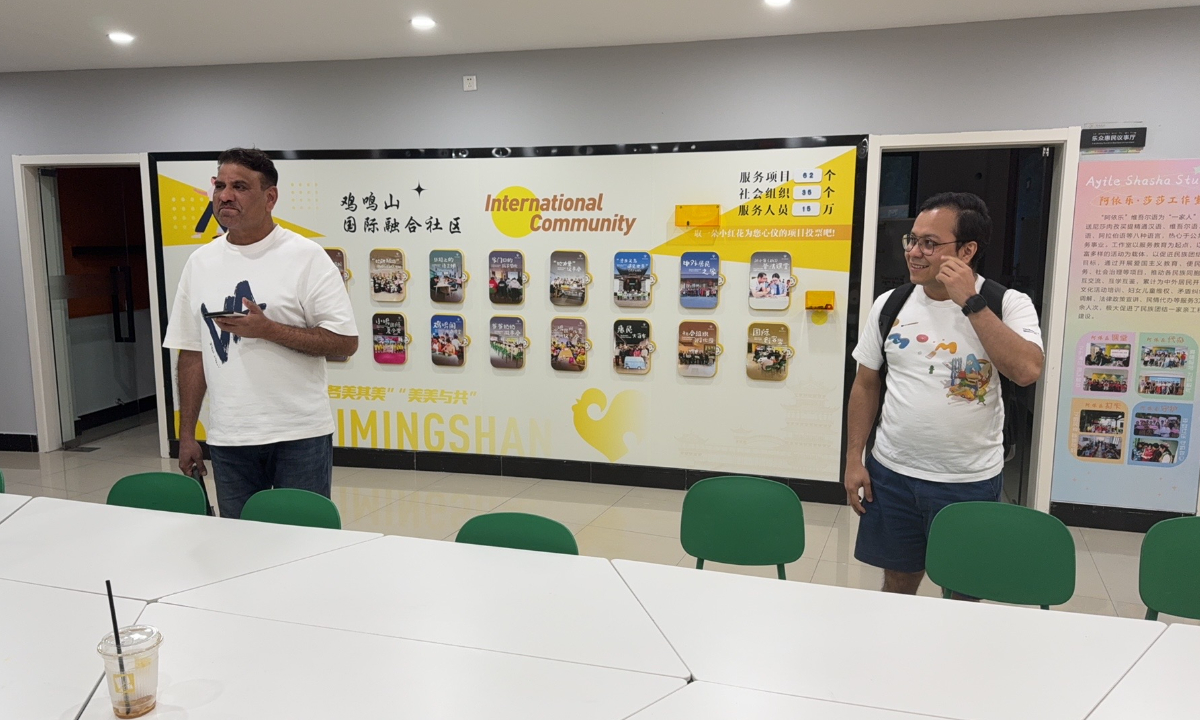
Two foreigners at Jimingshan Community Service Center in Yiwu, East China's Zhejiang Province Photo: Li Xiaoping/ Securities Times
"People around the world are learning Chinese, and the words of Confucius are becoming increasingly global..." Years after the release of the song Chinese Language by Taiwan pop girl group S.H.E, the scene described in the lyrics is now vividly playing out in Yiwu, East China's Zhejiang Province.
Known as "the world's supermarket," Yiwu is home to around 38,000 long-term foreign residents. These overseas merchants are key participants in Yiwu's markets, active across wholesale centers, residential communities, and surrounding villages. In several international communities where foreign traders are concentrated, local neighborhood committees have set up free Chinese-language classes to help foreign residents learn Putonghua.
As foreign residents become increasingly integrated into local life, communities have also formed mediation teams known as "international lao niang jiu," pioneering a nationwide mechanism that allows foreigners to help mediate disputes involving other foreigners under a model of joint governance and shared participation.
"Lao niang jiu," a well-known figure in Shanghai folklore, is often used to describe a respected elder or mediator known for fairness and skill in resolving disputes.
A community 'Confucius Institute'
Jimingshan Community in Yiwu is only about a 10-minute drive from the renowned Yiwu International Trade Market. Its prime location has made it one of the main gathering places for foreign residents in Yiwu.
The community's "Confucius Institute at your Doorstep" has become a popular platform for long-term foreign residents to learn Chinese and better understand China. Due to growing demand, classes were moved from a small third-floor meeting room to a larger classroom on the fourth floor with more than 100 seats, which are often filled to capacity. Over the past 12 years, the program has served more than 120,000 overseas merchants from 57 countries and regions.
There, Securities Times reporters met Aamir from Pakistan and Yesid Isidro from Colombia.
Aamir first came to Yiwu in 2018, marking his first visit to China. After eight years in the city, he said Yiwu had made a deep impression on him. "Life here is peaceful, the city is clean, and all basic daily needs can be met very conveniently," he said.
In Yiwu, Aamir established his own foreign trade company. He said Yiwu's appeal lies in its role as the world's largest wholesale hub for small commodities, backed by a vast manufacturing base and efficient supply-chain services. "Many stores are directly connected to factories behind them. That's what makes Yiwu especially attractive," he said.
Like Aamir, Yesid Isidro was also drawn to Yiwu by its reputation as the world's largest small commodities market. He arrived in 2022 and now works for a foreign trade company. Out of his love for Chinese culture, he also adopted a Chinese name — Tang Jun.
He said his business experience in Yiwu was "completely different from what many people imagine." "There are so many advantages here," he said. "In Yiwu, you can handle all foreign trade affairs directly with clients and suppliers while also checking product quality and prices at the same time. The logistics system is highly efficient, and container handling and customs procedures are very convenient. These are all extremely important for foreign trade business."
'Like a big family'
The area where Jimingshan Community now stands was originally a rural area. As Yiwu's markets expanded rapidly and the urban area continued to grow, Jimingshan Community was officially established in 2003.
The community is truly a "mini-United Nations community." It is home to around 30,000 permanent residents, including approximately 1,400 foreign nationals from 74 countries and regions.
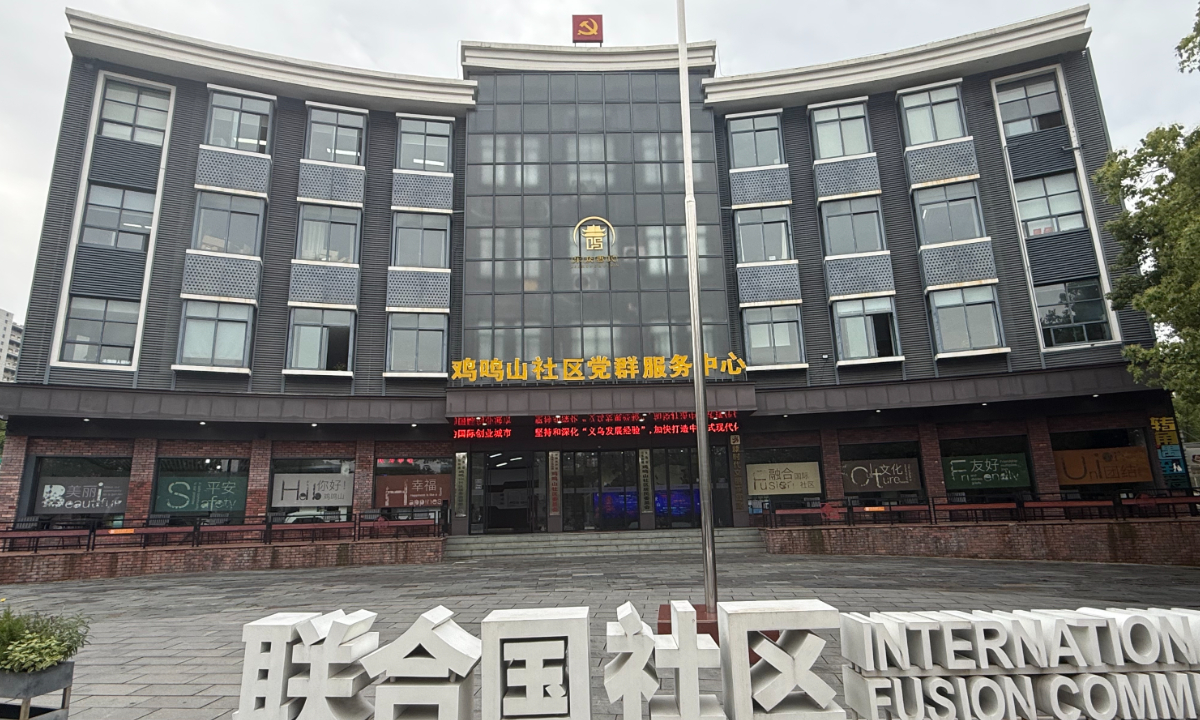
Jimingshan Community Party-Mass Service Center in Yiwu, East China's Zhejiang Province Photo: Li Xiaoping/ Securities Times
"Managing and serving such a large foreign population has brought considerable challenges to the community," Jing Jing, Party secretary of Jimingshan Community, told the Securities Times.
In 2006, Jimingshan Community launched a pilot program to help foreign residents integrate into the community. "Since then, we've conducted forums and home visits to better understand the needs of foreign businesspeople in both work and daily life," Jing said. "At the same time, the community has responded to their needs through platform-building and coordinated resource allocation." She said these services have made life and business more convenient for foreign residents while helping create a favorable business environment.
In 2014, the community established the country's first community-based service center for foreign residents, working with multiple departments to provide information on issues such as children's education and tax reforms. The community also launched regular Chinese-language courses and organized various cultural and sporting activities.
Reporters noticed a bulletin board on the first floor of the community's Party and public service center displaying a "monthly activity schedule." In May alone, besides 10 regular activities, a wide variety of additional evening events were held from Monday to Friday each week.
Speaking about the community activities, Yesid Isidro said: "Thanks to these activities, my Chinese has improved a lot. I've also made Chinese friends and gained a better understanding of the real China."
Aamir shared the same sentiment. "The atmosphere at the community events is very friendly. We're like one big family, and our social circles keep growing. That has also been very helpful for our work," he said.
An international mediation team
Jimingshan Community is also home to an active "international lao niang jiu" team, or international mediation team. The initiative pioneered a nationwide "foreigners mediating for foreigners" mechanism under a model centered on co-building, co-governance and shared participation.
The team in Jimingshan Community consists of 15 foreign mediators who participate in resolving disputes involving foreign residents, community consultations and cultural integration efforts. The studio is headed by Dheghani Gholam Hossein, an Iranian businessman based in Yiwu.
Explaining why the initiative was established, Jing said the foreign background of the "International lao niang jiu" members naturally helps overseas merchants feel more comfortable and understood. Their language skills and cultural familiarity also make them more effective in handling disputes involving foreign residents.
The team has helped resolve not only neighborhood disputes, but also commercial disputes involving foreign trade companies.
For example, in early 2024, cooperation between Ningbo Guanglong International Logistics Co and Iran's MTB company reached a deadlock due to differences in legal systems, language barriers and business practices. Ningbo Guanglong International Logistics Co later contacted Hossein, and the community's foreign-related mediation studio has also quickly launched mediation procedures. The two sides eventually reached a settlement in August 2024.
The "foreigners mediating for foreigners" approach, rooted in respect for cultural diversity, reflects the community's innovative grassroots governance model. Since its establishment in 2014, the "International lao niang jiu" studio has resolved more than 350 disputes.
All services provided by the "International lao niang jiu" team are free of charge. For Hossein, actively participating in foreign-related mediation is both a way to give back to society and an opportunity to build valuable business connections. Hossein has since married a Chinese lady and settled down in Yiwu. Hossein is now the chairman of a company in Yiwu and regards Yiwu as his "second hometown."
Communities like Jimingshan Community can be found throughout Yiwu. The city has become a major hub for foreign merchants in China, attracting more than 38,000 long-term foreign businesspeople, 110,000 overseas Chinese merchants and more than 10,000 foreign-invested business entities. Yiwu became the first county-level city in China with both more than 10,000 foreign-invested business entities and over 10,000 foreign nationals enrolled in social insurance programs. In 2025, Yiwu received more than 680,000 visits from foreign businesspeople.
Jing Jing, Party secretary of Jimingshan Community, said that whether it is providing daily-life services for foreign residents, organizing the "International lao niang jiu" team to mediate business disputes, or advancing the development of international community zones, all efforts are aimed at creating a better business environment for foreign merchants in Yiwu.
Looking ahead, the community's Party committee will continue identifying residents' needs, create more spaces and platforms for cultural integration between Chinese and foreign residents, and further explore diversified and collaborative models for international community governance by fostering more community partners.
This was compiled and translated by the Global Times based on an article originally published on the Securities Times on May 19, 2026.