APEC ministers' meeting achieves multiple results, consensuses; China's leading role injects more certainty into regional and global economy, Chinese expert says
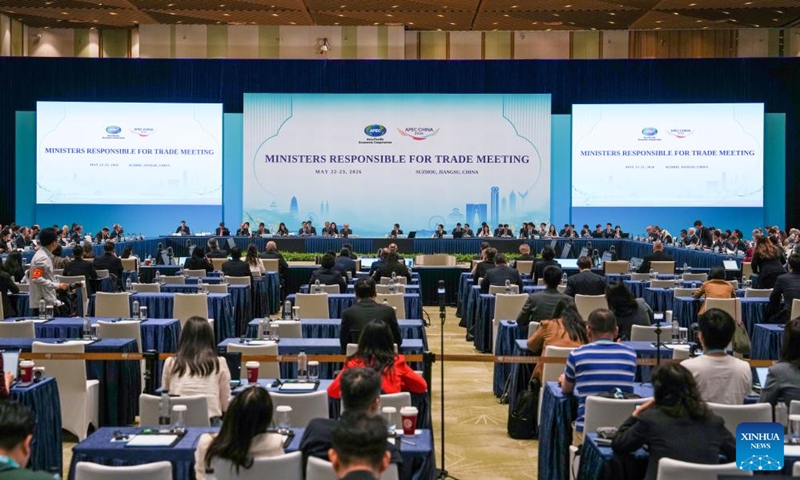
The APEC Ministers Responsible for Trade Meeting opens in Suzhou, east China's Jiangsu Province, May 22, 2026. Aligning with the theme of the APEC 2026 "China Year" -- "Building an Asia-Pacific Community to Prosper Together," the two-day meeting will discuss a range of priority issues, including regional economic integration, support for the World Trade Organization, digital cooperation, and the green economy. (Xinhua/Li Bo)
The 2026 APEC Ministers Responsible for Trade Meeting that concluded in Suzhou, East China's Jiangsu Province on Saturday, achieving results and consensuses in five aspects including reaffirmation of strong support for the long-term vision of the Free Trade Area of the Asia-Pacific, a joint message on advancing the WTO reform and drew up a blueprint for services sector development over the next decade, according to a press conference held by China's Ministry of Commerce (MOFCOM).
The 2026 APEC Ministers Responsible for Trade Meeting has actively sought the broadest common ground for all parties to participate in economic and trade cooperation, China's Commerce Minister Wang Wentao said at the conference.
Participants of the meeting, including representatives from 21 APEC economies, APEC observers, the WTO and the United Nations Conference on Trade and Development, held candid, in-depth and constructive discussions and achieved fruitful results, Wang said.
The two-day meeting ended with an issuance of the 2026 APEC Ministers Responsible for Trade Joint Statement and the approval of the APEC Roadmap for Innovative, Competitive and Resilient Services.
Elaborating on the outcomes, Wang said the meeting reaffirmed strong support for the long-term vision of the Free Trade Area of the Asia-Pacific, with parties committed to advancing regional economic integration. The meeting also sent a joint message on advancing the WTO reform and drew up a blueprint for services sector development over the next decade, Wang noted.
Other achievements included a new consensus on expanding digital trade cooperation, with substantive progress made on a framework document for regional digital trade cooperation, and actively exploring new measures for green trade development.
"The broad participation in the meeting, along with those achievements, sends a strong signal that despite a volatile and interconnected international landscape, Asia-Pacific economies are actively seeking the broadest common ground in economic and trade cooperation, upholding open regionalism and genuine multilateralism, and opposing 'decoupling' in industrial and supply chains," Song Wei, a professor at the School of International Relations and Diplomacy at Beijing Foreign Studies University, told the Global Times.
The joint statement and new roadmap inject much-needed stability and predictability into regional and global trade and investment, the expert said.
As a leader in regional cooperation, a defender of multilateralism, and a primary engine of the world economy, China's successful hosting of the meeting fully demonstrates the responsibility of a major country. "China will not only inject strong impetus into regional cooperation in the Asia-Pacific, but also provide greater certainty, stability, and positive energy for global economic growth and international cooperation," Song said.
In recent years, China's annual contribution to global economic growth has remained at around 30 percent, making it the largest driver of global economic growth. China steadfastly advances high-level opening-up, actively aligns with international high-standard economic and trade rules, and promotes trade and investment liberalization and facilitation, providing new impetus for global economic growth, Song said.
RELATED ARTICLES