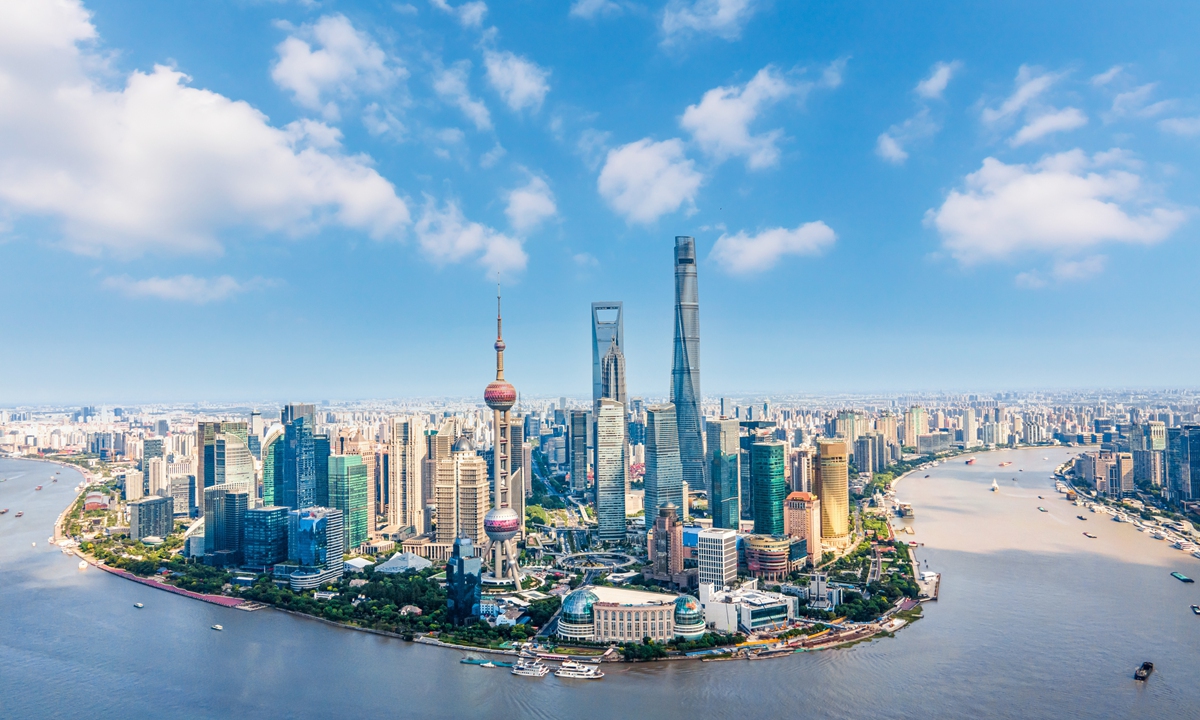
A view of the Lujiazui area in Shanghai Photo: VCG
Chinese companies are purchasing a growing number of overseas consumer brands, the Financial Times reported on Saturday. There were $2.4 billion of consumption goods deals seen in the first quarter of this year, almost all in Europe and North America. Last year's total of $6.8 billion investment was the highest since 2018, data from consultancy Rhodium Group showed.
High-profile transactions, from the purchase by China's biggest sportswear brand Anta Sports Products of a stake in Puma to ultra-fast-fashion retailer Shein's acquisition of US clothing brand Everlane, display a profound shift in China's consumption sector, moving from "product exports" to "brand globalization."
The global consumption market is undergoing profound transformations, with changing brand valuations and competition dynamics. By stepping up their overseas brand acquisitions, Chinese companies are not only seizing a strategic window of opportunity but also actively participating in the reshaping of the global consumption sector.
Behind this shift lies growing confidence accumulated over the past decades, rooted in the continuous improvement of China's supply chain competitiveness, operational efficiency, and financial strength, as well as the steady progress of China's evolution from a manufacturing giant to a consumption-led economic powerhouse.
Some Western media outlets have been quick to attribute Chinese companies' overseas investment wave to "intense domestic competition" spilling over into global market. This narrow view misses the deeper logic of China's high-tech upgrading.
When domestic businesses reach a certain stage of development, they naturally feel the need to expand abroad. The investments are active moves to leverage homegrown strengths for global competition, and at the same time, help the world combat inflation. Interpreting the investments as a mere spillover of China's domestic competition doesn't tell the whole truth.
After decades of development, China has built the world's largest and most complete industrial consumer-goods supply chain. Its business model, featuring digitalized operations, refined management and rapid iteration, have matured, enabling domestic firms to accumulate robust market expertise and build up financial capacity.
Boasting the most comprehensive manufacturing ecosystem and efficient logistics network, China leads the globe in emerging consumption models such as e-commerce and social-media marketing. Combining these domestic advantages with overseas brands' channel resources, design concepts and market recognition often generates remarkable synergy effect.
On the one hand, Chinese companies can gain smoother access to mainstream European and American consumer markets through acquired brands' established channels and local influence, reducing the uncertainties brought by trade policies.
On the other hand, international brands operating in China benefit from more efficient supply-chain support and digital marketing empowerment, unlocking greater potential in China's high-end consumer segment.
More importantly, this two-way empowerment is deepening the globalization of China's consumption industry. In overseas markets, the brand assets obtained through merger and acquisition deals would lower entry costs, and help establish local production and distribution systems.
At home, as the consumption structure continues to improve, and people's demand for premium products rises, bringing in high-quality international brands not only enriches market offerings but also enhances Chinese companies' capability in brand management, product design, and quality control.
This integrated domestic-international layout is creating a more balanced and sustainable development structure - one that no longer relies purely on exports, but instead deeply binds global resources with Chinese corporate operational efficiency.
Brand globalization is not simply a game of capital acquisition. Challenges include cultural integration, local operation, regulatory compliance, and maintaining stable management teams. Yet, undeniable progress has been made.
The path from contract manufacturing to brand integration, and from goods exports to capital-enabled expansion, is clearly visible. The rising wave of cross-border merge and acquisition proves that Chinese industrial confidence is being built. It is also a vivid microcosm of China's high-quality economic development.
RELATED ARTICLES