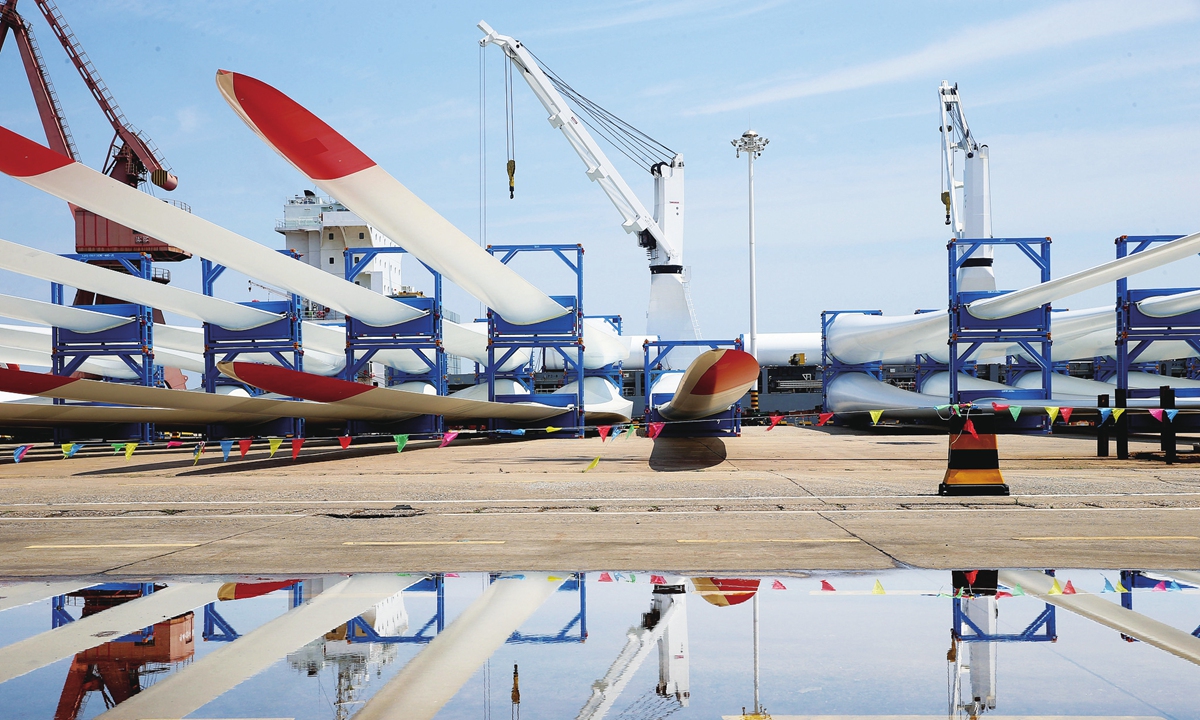
Wind power equipment bound for overseas markets is stored at the terminal of Dongfang Port Branch of Lianyungang Port in East China's Jiangsu Province on June 23, 2025. Photo: VCG
The first quarter of 2026 has turned out to be quite a busy season for Chinese new energy firms in overseas markets.
In January, CALB Group Co, a Chinese firm specializes in lithium batteries, said it had signed an investment deal with the Portuguese government to build a lithium battery production base in the country.
In February, Sungrow Power announced plans to invest approximately 230 million euros in its first European manufacturing plant, with an annual capacity of 20 GW of photovoltaics (PV) inverters and 12.5 GWh of energy storage systems.
In March, Hithium Energy Storage reportedly signed a letter of intent with the Spanish government to invest approximately 400 million euros in building a large-scale battery and energy storage system manufacturing facility.
Also in March, at the renewable exhibition Solar Solutions Amsterdam, LONGi Energy Storage Solutions signed energy storage system supply agreements with two core European partners with a combined volume of 600 MWh.
These moves offer a clear snapshot of a broader trend gaining momentum in 2026, as a growing number of Chinese companies in PV, energy storage, and new energy equipment report robust first-quarter results and surging overseas orders, according to industry data and media reports.
Behind this strong momentum lies the competitive edge that Chinese new-energy companies have built on the global stage after years of heavy investment and technological development. This advantage is amplified by the accelerating green energy transition in many parts of the world, driven in part by volatility in global energy markets stemming from geopolitical conflicts and other disruptions, businesses and industry experts noted.
Surging orders
This trend is also reflected in latest official data. According to data released by the General Administration of Customs on Tuesday, China's exports of green products such as lithium batteries and wind turbine generators and their parts increased by 50.4 percent and 45.2 percent year-on-year, respectively, in the first quarter of this year.
Amid surging overseas demand, Chinese new-energy firms are seen strong results in the first quarter.
Ningbo Deye Technology Co, a leading enterprise in inverter and energy storage battery supply, expects its first-quarter net profit to be between 1.1 billion yuan and 1.2 billion yuan, a year-on-year increase of 55.91 percent to 70.08 percent.
The company said in a note that, affected by geopolitical fluctuations, energy shortages and price volatility have intensified, the importance of energy security has been elevated and the demand for residential and commercial & industrial energy storage in regions such as Europe, the Middle East and Southeast Asia has increased significantly.
Earlier, JinkoSolar noted at an investor Q&A session that the recent Middle East conflict has disrupted shipping and pushed up international oil and gas prices, potentially delaying local projects in the short term. However, it has highlighted the fragility of traditional energy supply chains, strengthening global focus on energy security and underpinning long-term demand for clean energy like PV and energy storage.
Yu Zhenhua, executive vice director of the China Energy Storage Alliance (CNESA), told the Global Times that the growing need for the global green energy transition and China's industrial chain advantages are the core driving forces behind surging orders for Chinese new-energy products.
After years of accumulation, Chinese enterprises have occupied a dominant position in the global battery energy storage market, with full-chain advantages in battery cell manufacturing, system integration, engineering delivery, and other links, and are important participants and stable suppliers in the global energy transition, Yu said.
This dominant position has already been established. Data from CNESA shows that in 2025, new overseas orders secured by Chinese energy storage companies reached 366 GWh, a year-on-year increase of 144 percent, with a concentrated surge in the second half. By region, Australia, the US, Saudi Arabia and Chile ranked among the top four in order volume, with Australia leading by a wide margin, the data showed.
In terms of growth rate, emerging markets including the Middle East, South America and Southeast Asia have gained momentum, becoming new engines driving order growth. More than 70 Chinese energy storage companies expanded overseas, covering the entire industrial chain, with battery manufacturers remaining the main drivers. Demand from specialized scenarios such as data centers, mine microgrids, ports and islands has accelerated. Long-term service agreements have become standard, and joint overseas expansion models have grown noticeably, according to CNESA.
Brighter outlook
Liu Yong, secretary general of the Energy Storage Application Branch of China Industrial Association of Power Sources, told the Global Times that, affected by geopolitical competition, climate change, energy transition and other factors, the outlook for Chinese new energy products in the international market is even brighter.
Amid the accelerating global push for energy security and the green transition, Europe, the United States, the Middle East, Southeast Asia, Japan, South Korea, and Australia have emerged as the primary target markets for Chinese new-energy companies, followed closely by Africa and Central Asia, according to Liu.
Some international institutions, industry associations and experts also noted that geopolitical conflicts in the Middle East have further exposed the fragility of traditional energy supply chains and accelerated the global shift toward a stable, diversified and clean energy structure.
Fatih Birol, head of the International Energy Agency, said that energy transition was moving "very strongly" before the US-Israeli war against Iran began — but the fallout from the resulting energy shock means countries will likely direct even more investment toward clean energy sources, according to CNBC.
"The current global energy transition is accelerating, providing a vast external market space for Chinese energy storage companies," Yu said.
Looking ahead to 2026, many Chinese energy storage companies have plans to further expand into overseas markets. Some intend to build factories overseas to enhance local productivity; others are prepared to provide technology and cooperate with local manufacturers for mutual benefit, according to a report from the People's Daily overseas edition on Tuesday.
A concrete example is CALB's project in Portugal. Construction of what it described as a zero-carbon AI gigafactory started in late February, with delivery expected in 2027, according to the company's press release.
RELATED ARTICLES