Chinese government bond yields show notable resilience, while others see sell-off
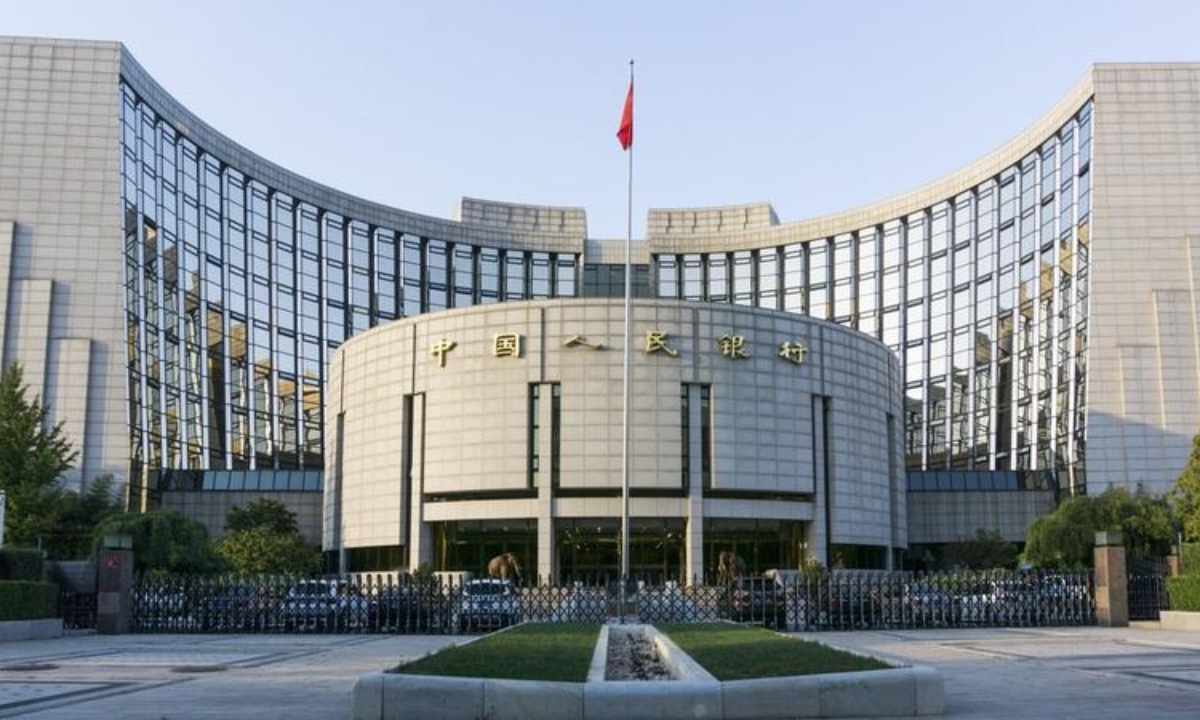
The headquarters of the People's Bank of China in Beijing Photo: IC
Chinese government bond yields have demonstrated notable resilience over the past month against the backdrop of rising geopolitical tensions, while the debts of major economies such as US and Europe have been in a sell-off during the same period, relevant data showed. Some media outlets and analysts said the trend further highlights the Chinese assets' characteristic as a "safe haven" for investors, at a time when the world is grappling with mounting uncertainties, steep energy price surges and rising global tensions.
According to a report by the Financial Times, yields on China's 10-year government bond have dipped marginally to 1.81 percent since the end of February. In contrast, yields on 10-year US Treasuries have surged by 0.38 percentage points to 4.34 percent, while yields on gilts have rocketed by 0.7 percentage points. In the capital market, bond yields and prices generally move inversely, meaning that when investors sell bonds heavily, bond prices fall, which in turn pushes yields higher.
With regards to the reasons behind this trend, the Financial Times report noted that the world's second-biggest economy "emerges as a haven" from soaring energy prices and rising global inflation.
The resilience of Chinese assets also comes as the prices of global major commodities fluctuated drastically over the past month. On Thursday, the spot gold price slumped around 3 percent as of 6:18 pm, spot silver was down by 5.5 percent, while Brent crude oil, the global oil benchmark, soared by 7.51 percent.
Wang Peng, an associate research fellow at the Beijing Academy of Social Sciences, told the Global Times on Thursday that investors are betting that the Chinese economy will be less vulnerable to the energy crisis compared with other economies. "China's complete industrial system and diversified energy structure, with its strengths in coal and renewable energy, have significantly cushioned the imported risks arising from volatility in international energy prices," Wang explained.
Multiple global research institutions have highlighted the Chinese government's efforts to diversify its energy import sources and its energy structure as an effective buffer amid the ongoing US-Israel-Iran conflict in the Middle East.
"China's CPI remained moderate for a long time. In contrast to Europe and the US, which have been under significant inflationary pressure, China's CPI moderate growth has led to more stable real interest rates and helped preserve the real yields on Chinese bonds," Wang said.
He also stressed that China has adhered to a monetary policy independent of the US Federal Reserve, which means that it has ample policy space that could provide liquidity support for Chinese government bonds. "Compared with the sharp volatility in overseas markets, the continuity and consistency of China's macroeconomic policies have reduced risk premiums, providing stronger price support for Chinese government bonds amid market fluctuations," he said.
Global Times
RELATED ARTICLES