Certain EU members’ reported trade measures targeting China show ‘twisted view’
Misguided approach of ‘making others take medicine for own illness’ to backfire: expert
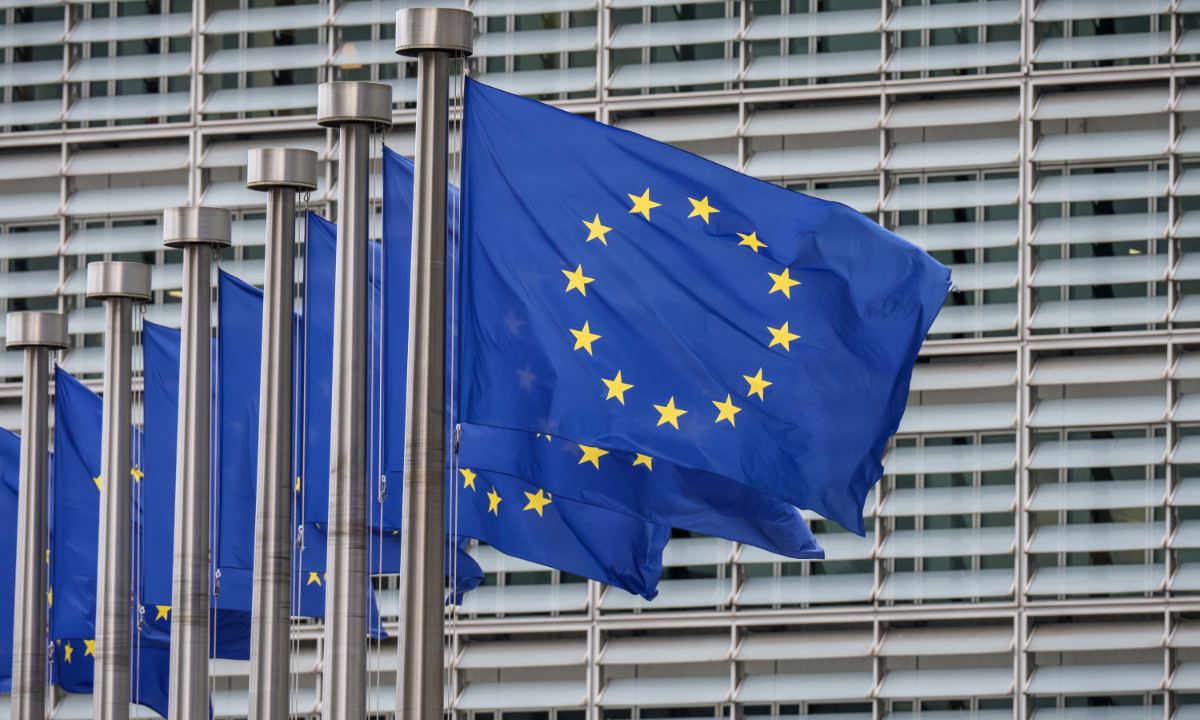
The European Union (EU) flags in front of EU headquarters in Brussels, Belgium. Photo: VCG
As the visit of German Economy Minister Katherina Reiche to China is around the corner, some EU members pressed for tougher trade measures to defend European industry due to the so-called "rise of unfair trade practices" amid exports from China, the Financial Times (FT) claimed in a report on Sunday. Such a move has exposed certain EU countries' twisted views on trade with China, as they simultaneously advocate toughness while playing victim, a Chinese expert said on Monday, warning it would damage bilateral trade.
The FT report said Spain, France, Italy and the Netherlands circulated a joint paper with Lithuania ahead of a key European Commission meeting on Friday on how to handle China. The paper claimed that some of the EU's main trading partners are "imposing new trade barriers or contributing to systemic and structural industrial overcapacity," without mentioning specific countries by name. However, the FT report noted that EU commissioners regularly accuse China of exporting overcapacity and claimed that trade defense measures are at the highest level in almost 20 years.
Accusing "certain main trading partners" of creating overcapacity or trade barriers is a classic victimhood narrative that evades the EU's own responsibility for declining industrial development, Jian Junbo, director of the Center for China-Europe Relations at Fudan University's Institute of International Studies, told the Global Times on Monday.
This is a misguided approach of "making others take the medicine for one's own illness," Jian said, warning that blaming external parties only conceals the fact that the EU's internal structural reforms have been lagging behind.
According to the FT report, the paper sought to blame "new trade barriers" or "structural and industrial overcapacity" of some of the EU's main trading partners for job losses in its manufacturing industry. However, there have been many reports showing the EU's own failures to support its industries. For example, a report by the European Trade Union Confederation in 2024 said the EU lost almost a million manufacturing jobs in just four years, and the cuts were "caused principally by a lack of tailored support for EU industry," according to a press release.
Jian said the EU's repeated accusations of China "exporting overcapacity" have become a fixed narrative. These accusations ignore the EU's own high-cost environment and declining export competitiveness, reducing complex market competition to a simplistic claim of "China's unfairness," he said, noting the distorted approach of playing a "victim" of trade barriers, while simultaneously advocating "tough" posture against China.
According to the FT report, the paper rolled out several protectionist measures, including proposing ways to make it quicker and easier to impose higher tariffs on imports as well as using more powerful safeguards tool that can be triggered quickly by a surge in imports and applies to every trading partner. France has long called for tougher measures, with President Emmanuel Macron on Friday suggesting a "section 301" tool modelled on the US version. Notably, Germany is having an internal debate on revising ties and has yet to sign the paper, per the FT report.
Noting significant internal division within the EU, Jian warned that forcibly pushing such radical trade measures risks causing internal deadlock, ultimately harming Europe's own economic growth rather than genuinely enhancing its competitiveness. The expert also said the EU's recent "small actions" against China have intensified, seriously damaging the positive atmosphere of China-EU cooperation.
He Yadong, a spokesperson from China's Ministry of Commerce, said on May 21 that if the EU fabricates a new trade tool targeting China under the pretext of "overcapacity," it is essentially an attempt to cover up its own industrial difficulties and suppress external competition.
This move will not only damage China-EU economic and trade relations, but also disrupt the stability of global production and supply chains, and it will ultimately backfire on the EU's own industrial development. The EU shall bear full responsibility for this, the spokesperson noted.
'Benefit and restraint'
Amid some EU members' proposed tough measures against China, German Economy and Energy Minister Katherina Reiche's first visit to China will begin from May 26 to 29, with an economic delegation of about 40 business representatives accompanying her, according to the German government.
During the visit, she will hold political talks in Beijing and Guangzhou, a major economic hub in southern China, attend a business event, and visit local enterprises.
Ahead of the potential visit of Reiche, the German Chamber of Commerce in China has released an additional previously unpublished result from its May 2026 flash survey. It showed that 51 percent of surveyed companies believe "creating a supporting framework for partnerships between German and Chinese companies" is the most important measure for the German government to support their business development in China, followed by "strategically using the knowledge created in German-Chinese partnerships," which accounts for 42 percent.
Regarding the visit, Oliver Oehms, Executive Director & Board Member of the German Chamber of Commerce in China, said that "we hope this visit will bring insights gained on the ground into political discussions in Berlin and further deepen bilateral exchanges," according to a statement from the chamber.
Within the EU, countries with weaker industrial linkages to China and stronger protectionist tendencies are more inclined to create friction in trade with China, while countries such as Germany, which have closer industrial and trade ties with China, tend to seek a more balanced economic relationship, Cui Hongjian, professor at the Academy of Regional and Global Governance at Beijing Foreign Studies University, told the Global Times on Monday.
"At present, China-EU economic and trade relations are increasingly complex and differentiated, rather than a single cooperative framework, and cannot be dominated by any single factor in the short term, remaining in a state of both cooperation and competition," said Cui.
Amid the current global turbulence, Cui said that consolidating and expanding the China-EU economic and trade cooperation base, and preventing cut-throat competition from eroding areas of cooperation, will help promote normal bilateral relations.
"At the same time, China should take precise responses and necessary countermeasures against EU protectionism, apply timely pressure and correction, and encourage the EU to clearly recognize the benefits of cooperation with China and the costs of confrontation, achieving a balance between mutual benefit and restraint," said Cui.
In April, in response to Brussels' intensified discriminatory maneuvers targeting Chinese enterprises, and some European think tanks churning out a series of "trade war" narratives against China, an insider told the Global Times that "If the EU chooses to move further down the path of protectionism, China will take firm countermeasures to safeguard national interests and the legitimate rights of its enterprises."
"China is neither unfamiliar with nor intimidated by trade wars. If the EU chooses to provoke a trade war, China will respond promptly and resolutely. However, any escalation - let alone a full-scale trade war - would harm both sides, disrupt global industrial and supply chains, and weigh on global growth," the insider noted.
The MOFCOM spokesperson said the Chinese side has consistently advocated that China and the EU should resolve differences through consultation. China will not initiate trouble, but if China's national interests and the legitimate rights and interests of its enterprises are harmed, it will not sit idly by, He said, urging the EU to face reality, return to the correct track of dialogue, and take actions that genuinely benefit the development of China-EU economic and trade relations.
"If the EU insists on pushing forward the so-called new tool and adopts discriminatory restrictive measures against Chinese enterprises or products, China will firmly take countermeasures," the spokesperson noted.
RELATED ARTICLES