Intl participants highlight China’s key role in global marine governance at Xiamen forum, advancing marine conservation and blue economy
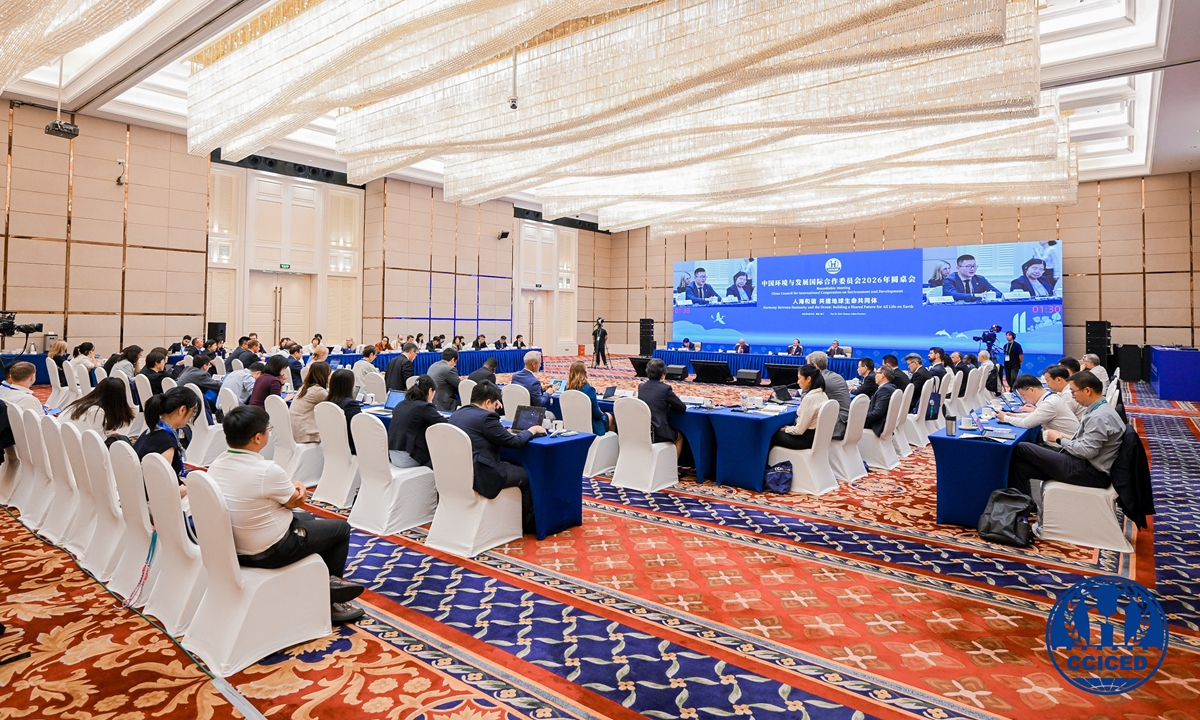
People attend the 2026 Roundtable of the China Council for International Cooperation on Environment and Development (CCICED) in Xiamen, East China's Fujian Province, on May 25, 2026. Photo: Courtesy of CCICED
The 2026 Roundtable of the China Council for International Cooperation on Environment and Development (CCICED) kicked off in Xiamen, East China's Fujian Province, on Monday, with a focus on global ocean governance, marine industrial transformation and other topics. International participants highlighted China's role in advancing marine conservation and the blue economy at the forum.
Under the theme "Harmony Between Humanity and the Ocean: Building a Shared Future for All Life on Earth," several participants emphasized the role China has played in global marine governance, especially China's solutions in tackling overfishing, advancing cooperation with African countries, and promoting blue carbon governance and mangrove-based marine ecological development.
Dai Minhan, Chinese team leader of the CCICED SPS on Ocean, noted that China's marine policy and the natural resources policy groups of CCICED have proposed a set of priority actions, including reaffirming China's support for global ocean conservation, strengthening compliance and full-chain traceability in distant-water fisheries, aligning fishery subsidy policies with international rules, and enhancing participation and influence in multilateral marine governance mechanisms in alignment with the Agreement on Biodiversity Beyond National Jurisdiction (BBNJ) under the UN Convention on the Law of the Sea.
When talking about China's vision for global ocean governance, Zhang Wei, deputy director of the Fujian Ocean Innovation Center, said that China has a major opportunity to build a native AI manufacturing platform, which stems from resource discovery and molecule design to process development, pilot production, quality control, and market validation.
"The goal should not only be to catch up with existing models, but to help define the next global model of regenerative blue economy development," Zhang told the Global Times.
Guillermo Ortuno Crespo, co-lead of the High Seas Specialist Group under the International Union for Conservation of Nature's World Commission on Protected Areas, noted that international fisheries governance is often constrained by lengthy negotiations in which "negotiations among parties sometimes stagnate and no decision is made."
"There are a few countries that are large enough and impactful enough in fisheries that they don't need to wait for this consensus and so can lead by example, and China is one," Crespo told the Global Times.
Crespo also linked overfishing to the implementation of the BBNJ agreement Officially entering into force on January 17, the BBNJ agreement is viewed as "a landmark framework" for global ocean governance and biodiversity conservation in areas beyond national jurisdiction, including the high seas and deep seabed regions.
On January 16, China submitted a formal note to the United Nations secretary-general applying to host the agreement's secretariat in Xiamen.
"It would send incredible message if a country like China proposed a new course that is more inclusive and more respectful of all countries concerning fisheries and where no one country benefits the most," Crespo said.
Discussions at the forum also highlighted China's experience in integrated bay management, coastal restoration, blue carbon development and green port construction. Participants pointed to Fujian, particularly Xiamen, as an example of China's "human-ocean harmony" approach.
One example is the Xiatanwei Mangrove Park, a major mangrove restoration project in Xiamen. Since 2005, the city has planted around 85 hectares of mangroves, which now serve as a natural buffer against typhoons and storm surges while improving the local ecosystem.
Su Jilan, a researcher at the Second Institute of Oceanography, Ministry of Natural Resources, stressed at the meeting that besides the mangrove restoration, the ecological significance of coastal wetlands and tidal flats, the foundation of China's nearshore marine ecosystem, also provide key ecosystem services including fish nursery habitats, water purification, carbon storage and storm protection.
China's approach in Tong'an Bay around 2015, which removed over 200 million cubic meters of silt from tidal flats, has since been adopted by some African countries as a model for marine ecological restoration and coastal governance, according to Xinhua News Agency.
"The case was highly impressive for African countries, as was the role of the China-Africa Marine Science and Blue Economy Cooperation Center in marine talent cultivation, ocean observation and scientific cooperation," Hellen Gichuhi, chair of the UNESCO-IOC Sub-Commission for Africa and Adjacent Island States, told the Global Times.
Gichuhi noted that many African coastal communities remain vulnerable to environmental and economic shocks, and that the transition to green marine industries "must create opportunities, not exclusions."
RELATED ARTICLES