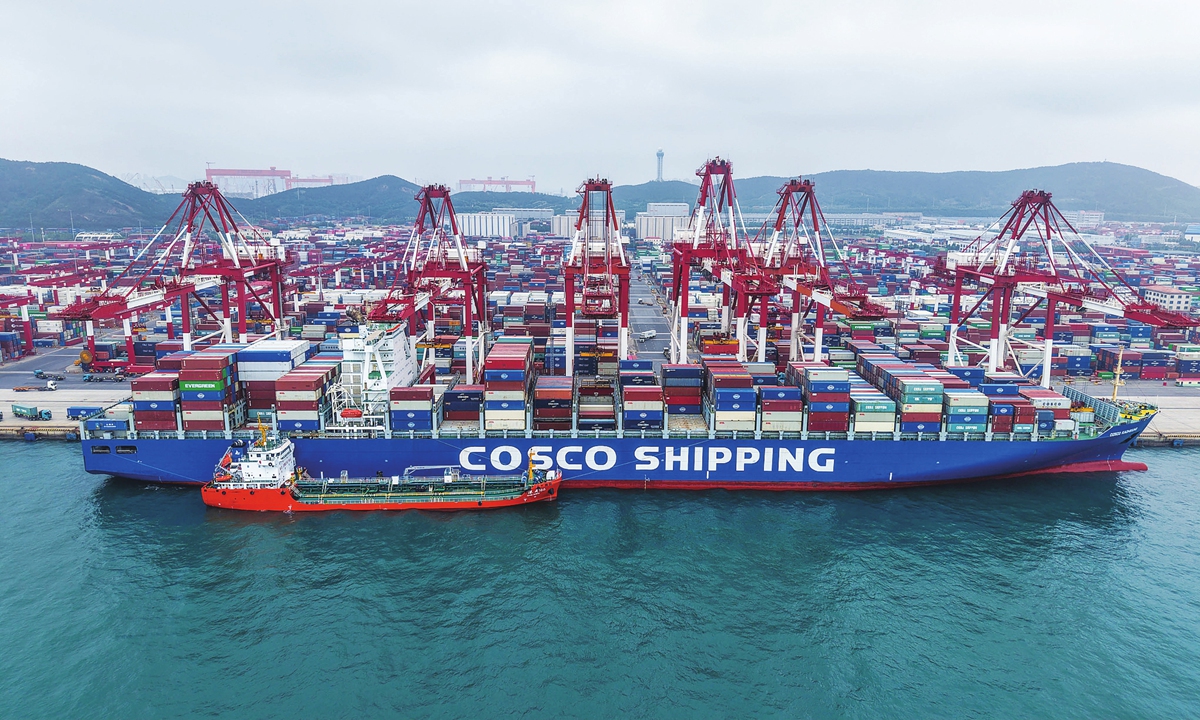
A container ship docks at the Qingdao Port, East China's Shandong Province, on May 25, 2026. Photo: VCG
As China enters its 15th Five-Year Plan period (2026-30) with a GDP growth target of 4.5-5 percent for 2026 while striving for better performance, we are witnessing not a slowdown, but a sophisticated transition. Having observed the Chinese economy for decades - first as an extraordinary engine of double-digit expansion following the reforms of the 1970s and 1980s, and now as a mature global leader - I view this shift as a move from a "growth stage" to a "productivity-centric stage."
In the past, the world grew accustomed to the sheer scale of China's development. Today, the focus is rightly on "quality growth." This means rebalancing the traditional export-oriented model. China continues to stand as the undeniable manufacturing superpower of the world, yet it is now equally a massive global consumer market. This balancing act involves moving toward a service economy and a consumption-driven model, which is a natural and healthy evolution for an economy of this size and complexity.
What impresses me most is the consistency and holism of China's long-term vision. One of the greatest advantages of the Chinese economy is its planning horizon. Unlike systems that often operate on short-term political cycles, China plans for five, 10, and even 15 years ahead. This allows the government and the private sector to align around specific goals such as economic restructuring and high-tech advancement with remarkable consistency and clarity.
Central to this new quality growth is the rapid development of artificial intelligence (AI). We are currently seeing a fascinating dynamic in the global tech landscape. China not only develops large language models, but also uses small language models in order to diffuse this technology to help to adapt for specific sectors including healthcare and education.
This approach simplifies life for users and creates a "first-mover advantage" in adapting AI for real economic productivity. It is not just about the technology itself, but about how it is integrated into the fabric of daily life and industry.

Kairat Kelimbetov Photo: Courtesy of Kairat Kelimbetov
This is where the opportunity for global cooperation becomes clear. When China shares this knowledge - with its neighbors, with Belt and Road Initiative (BRI) partner countries, and with Central Asia - it helps us build a joint platform for modernization. This technological integration is directly linked to smart cities, infrastructure development and the future of financial markets. We are talking about an entire ecosystem of data governance: how to score, store, and protect big data. Alongside the development of quantum computing, this represents a revolution unlike anything humanity has seen.China's contribution to the world economy remains indispensable. Accounting for a significant share of global GDP growth over the past decades, China is not only managing its domestic social and economic reforms to improve people's livelihoods, but also playing a constructive role in the multilateral system. As the global economy navigates the shift from broad globalization to regionalization, China's stable fundamentals and its commitment to building a cohesive community with its neighbors provide an anchor of confidence.
Kazakhstan and China are strengthening cooperation across multiple sectors. Kazakhstan has established an offshore yuan clearing center to facilitate bilateral trade. In terms of imports and exports, businesses prefer to operate in local currencies. Kazakhstan imports from China a lot, including high-tech industry products, and the country needs payments in Chinese currency. The Chinese yuan has become increasingly popular in our part of the world.
The two countries have also recently expanded cooperation in capital markets through sovereign wealth funds such as Samruk-Kazyna and Baiterek. Kazakhstan also issued Panda bonds in the Hong Kong Stock Exchange.
Looking ahead, I am convinced that China will continue to play a very significant role in the growth of the global economy over the next five years. By focusing on high-tech innovations that improve the quality of life and by pioneering the practical application of AI, China is contributing not only to its own development, but also to the development of many other countries. For Kazakhstan and our Central Asian partners, this journey of connectivity and shared technological progress is one we are proud to be a part of.
This article is compiled based on an interview with Kairat Kelimbetov, former deputy prime minister of Kazakhstan and former governor of the National Bank of Kazakhstan. bizopinion@globaltimes.com.cn
RELATED ARTICLES