People's Daily: Lunar soil fibers may become 'steel reinforcement' for future Moon base construction
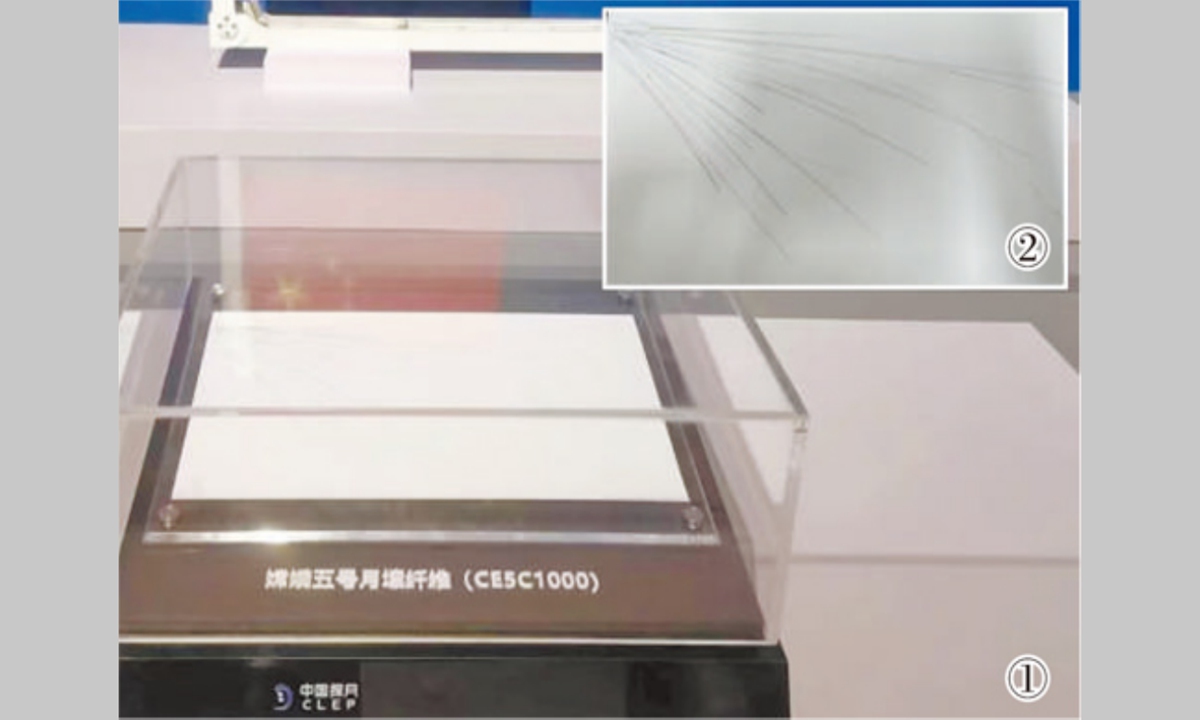
Figures 1 and 2 show a lunar soil fiber sample and a magnified view of the fiber's details displayed at the "20 Years of China's Lunar Exploration Program" exhibition. Photo: Courtesy of Donghua University
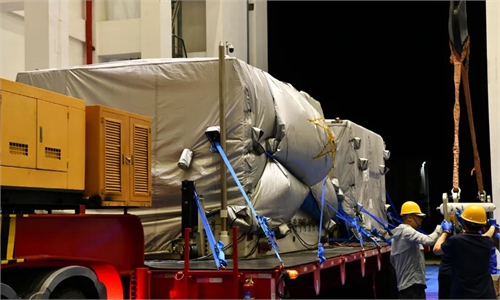
Could lunar soil be turned into fibers the way melted sugar is stretched into threads in candied sweet potatoes? Recently, experimental fiber samples made from lunar soil were sent aboard a Tianzhou cargo spacecraft to China's space station, where they will undergo exposure tests on an external platform under harsh conditions including high vacuum, intense radiation and extreme temperature fluctuations.The team behind the lunar soil fiber technology is led by academician Zhu Meifang from the College of Materials Science and Engineering at Donghua University. Cheng Yanhua, a researcher on the team, told reporters that the fibers produced from lunar soil are as thin as human hair. The principle itself is relatively straightforward: lunar soil is heated until molten, forming droplets that are then drawn into fibers.
The chemical composition and mineral content of lunar soil are similar to basalt and contain various trace elements. Fibers made from basalt are already widely used in high-end equipment manufacturing. Reproducing simulated lunar soil on Earth through scientific proportioning is not particularly difficult. The real challenge lies in recreating the Moon's environment on Earth. According to Cheng, producing fibers under such conditions is like trying to make sugar figurines in a vacuum, something that is difficult to achieve using conventional methods.
To simulate the Moon's high vacuum and microgravity conditions, Zhu's team began research into materials under extreme environments in 2016 and independently developed a lunar environment fiber spinning device. In 2020, after the Chang'e-5 mission returned with lunar soil samples to Earth, the team achieved a key breakthrough. Using just 0.5 grams of real lunar soil, researchers successfully produced continuous fibers about three meters long and as thin as a strand of hair.
In April 2025, the delicate yet resilient lunar soil fiber was displayed at the exhibition "20 Years of China's Lunar Exploration Program" at the National Museum of China. In September 2025, the technology, which possesses fully independent intellectual property rights, won a top award at the China International Industry Fair.
"Transport costs between Earth and the Moon are extremely high. Future lunar research station construction will have to rely on local resources," a team member said. "These lunar soil fibers could potentially be used to 'set up tents on the Moon' using local materials."
According to the team, the fibers could eventually be woven into flexible structural materials or used to reinforce lunar soil concrete, serving as the "steel reinforcement" for future lunar bases.
At present, lunar soil fiber production remains at the stage of basic experimental verification, and practical application is still some time away. The purpose of sending the fiber samples to the space station is to test whether they can withstand the harsh conditions of outer space in a real space environment. Every set of experimental data, researchers say, will provide valuable experience for future efforts to build human habitats on the lunar surface.
This was compiled and translated by the Global Times based on an article originally published in the People's Daily on May 26.
RELATED ARTICLES