Smart mobility boosts digital growth, real economy; exoskeleton sales up 785.5%: ministry
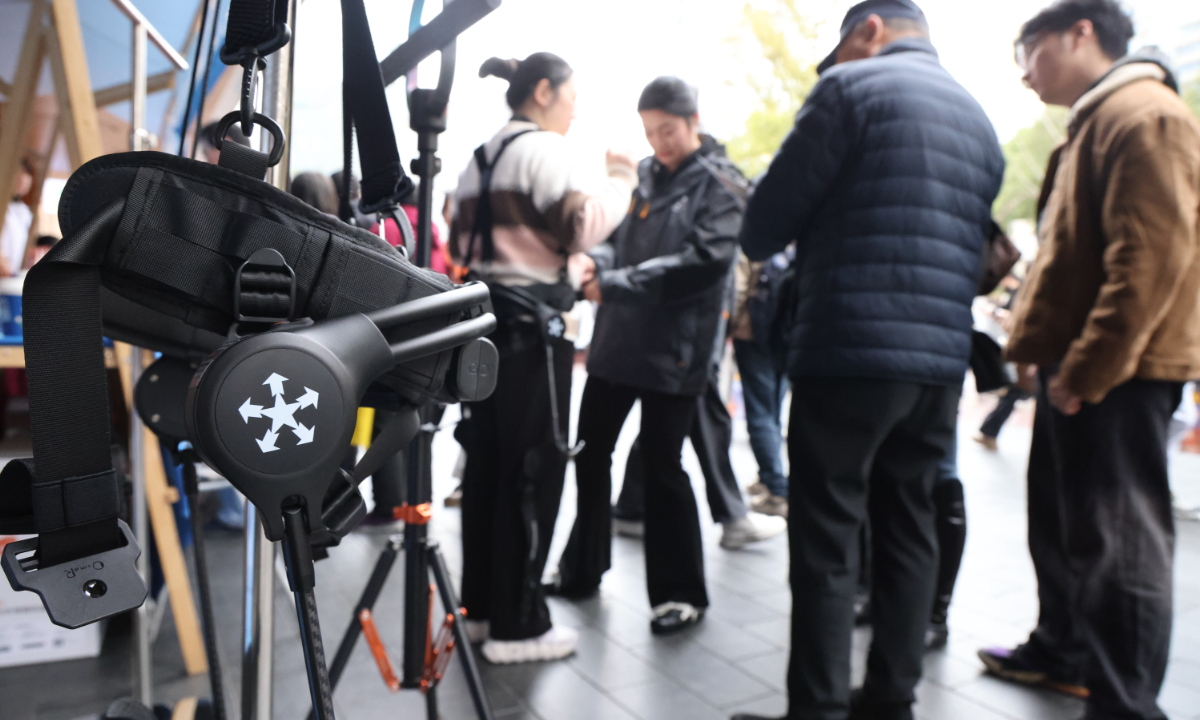
Citizens experience and observe an exoskeleton device in Shanghai on March 21, 2026. Photo: VCG
Official Chinese data released on Tuesday showed that the country's digital and intelligent delivered solid results in upgrading industries in the first four months of the year, with one of the most striking examples being a 785.5 percent surge in online retail sales of smart mobility exoskeletons.Emerging consumption scenarios such as intelligent mobility have continued to drive demand for digital products, according to data from China's Ministry of Commerce (MOFCOM).
E-commerce continued to play an empowering role from January to April, with digitalization technologies driving industrial upgrading, domestic consumption stimulation, and global market expansion creating broader opportunities for cooperation, helping strengthen the foundations of the real economy, the MOFCOM said.
Digital consumption also significantly boosted consumer demand for higher-quality products. Beyond smart mobility devices, consumer-level embodied artificial intelligence (AI) products have seen rapid growth in shipments.
In April, online retail sales of smart glasses and humanoid robots rose 175.2 percent and 20.6 percent, respectively, the ministry said. Meanwhile, e-commerce also delivered notable gains in promoting the digital and intelligent transformation of industries.
From January to April, online retail sales of agricultural products nationwide increased 12.2 percent, while e-commerce transaction volumes for key monitored sectors, including metal products and chemical products, rose 34.8 percent and 12.2 percent, respectively, according to the MOFCOM.
Digital and intelligent transformation is no longer a matter of choice for industries but an irreversible trend, serving as a key catalyst for new quality productive forces and driving a profound shift in productivity, a Chinese expert said.
China's digital and intelligent transformation has moved beyond the stage of simply reducing costs and improving efficiency, and is entering a new phase marked by the rapid rise of embodied AI and broader consumer adoption, said Wang Peng, an associate researcher at the Beijing Academy of Social Sciences. The surge in products such as exoskeletons and smart glasses suggests that AI is evolving from behind-the-screen algorithms into tangible, wearable, interactive and perceptive technologies, signaling that digital and intelligent transformation is building a full-chain ecosystem from foundational infrastructure to end-user applications, he said.
As economic development gained pace in recent years, China's AI market exceeded 1.2 trillion yuan in 2025, according to the People's Daily. As of the end of March this year, the country had built 4.958 million 5G base stations, while its total computing capacity ranked second globally, laying the groundwork for the country's digital and intelligent transformation.
Wang said that digital and intelligent transformation previously focused on improving production efficiency, but was now increasingly extending into consumer, services and everyday scenarios, reflecting closer integration between technological innovation and market demand. He noted that its support for the real economy lay in improving efficiency, optimizing resource allocation and creating new growth drivers, adding that beyond technological upgrading, it was also helping drive the real economy toward higher-quality and more efficient development.
RELATED ARTICLES