Alignment of China's 15th Five-Year Plan, Kyrgyzstan's National Development Programme a strategic necessity
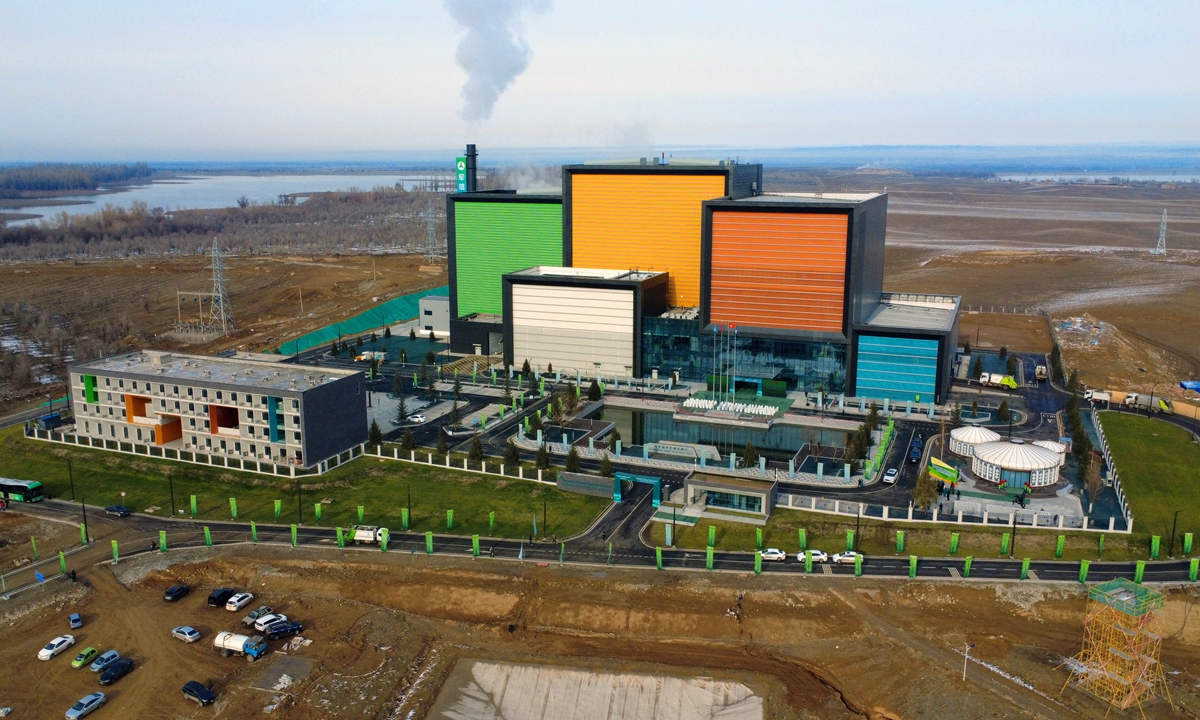
Photo shows a waste-to-energy incineration project in Bishkek, Kyrgyzstan on December 27, 2025. The project is backed by Chinese investment and built with Chinese technology. Photo: VCG
Editor's Note:
China has entered its 15th Five-Year Plan period (2026-30) with full momentum. At a recent China-Kyrgyzstan think tank dialogue, it was noted that the 15th Five-Year Plan could be aligned with the medium- and long-term development strategies of Central Asian countries. Global Times (GT) reporter Wang Wenwen talked to Sheradil Baktygulov (Baktygulov), director of the Institute of World Policy of Kyrgyzstan, about how Kyrgyzstan can align its national development program with China's 15th Five-Year Plan.

Sheradil Baktygulov Photo: Courtesy of Sheradil Baktygulov
GT: As China enters the 15th Five-Year Plan period, its economic priorities are shifting from rapid growth to quality and sustainability. How do you think this shift will affect China's economic engagement with Central Asian countries like Kyrgyzstan?
Baktygulov: This is a very reflective question. As China shifts toward quality-driven and sustainable growth under the 15th Five-Year Plan, its economic engagement with Central Asian countries, including Kyrgyzstan, will likely become more selective, green, and technology-oriented. The 15th Five-Year Plan of China, and the national development programs and strategies of the Central Asian countries share a common goal - to ensure peaceful development and prosperity for their societies and citizens. The ways of reaching this shared goal vary from country to country and depend on the scale and characteristics of each economy. We can see the complementarity of different economic cooperation projects and programs between China and the five Central Asian countries. Most importantly, China is willing to generously share its own expertise with the other countries around the world. China's high-quality and sustainable economy will sharpen its role for Central Asian countries as the locomotive of development, prosperity and progress.
GT: What aspects in China's 15th Five-Year Plan do you pay particular attention to? How does it reflect China's economic resilience and long-term planning?
Baktygulov: The 15th Five-Year Plan period represents a critical phase for China to basically achieve socialist modernization. Among its key aspects, particular attention should be paid to technological self-reliance and industrial upgrading, green and low-carbon transition, as well as coordinated regional development and common prosperity. These priorities demonstrate China's economic resilience by emphasizing supply chain security, domestic innovation in core technologies, and a proactive response to global climate challenges. The 15th Five-Year Plan has indicated new horizons not just for the development of China, but will also serve as a guide for broader human development.
Also, the 15th Five-Year Plan's long-term vision is evident in its consistent policy framework that transcends short-term fluctuations, balancing steady growth with structural reforms. This strategic approach not only mitigates external shocks but also fosters sustainable development, reinforcing China's capacity to maintain growth momentum amid global uncertainties.
GT: From your perspective, what would successful "strategic alignment" look like in practice between the 15th Five-Year Plan and Kyrgyzstan's National Development Programme until 2030? What concrete outcomes should both sides aim for by 2030?
Baktygulov: The alignment of China's 15th Five-Year Plan with Kyrgyzstan's National Development Programme until 2030 is not merely a diplomatic gesture, but a strategic necessity backed with a clear roadmap. Both sides are moving beyond theoretical cooperation toward practical implementation.
Successful "strategic alignment" in this context means moving from parallel development to integrated development. It involves synchronizing China's goals of technological self-sufficiency and "smart" modernization with Kyrgyzstan's goal of transforming from a landlocked country into a regional transport and logistics hub.
There are several concrete goals and measurable outcomes for 2030 across four critical sectors. The first sector is infrastructure & connectivity. The second is digital economy & innovation. The third is trade & investment and the fourth is human connectivity.
By 2030, if this alignment succeeds, Kyrgyzstan will be operating as a seamless digital and physical gateway between Central Asia and China, rather than just a transit corridor. For China, it would mean a stable, prosperous southern border and a successful model of "smart connectivity" exported to the world.
GT: Last week, the Cabinet of Ministers of Kyrgyzstan approved a large-scale state program - the Development of Renewable Energy Sources in the Kyrgyz Republic for 2026-2030: Distribution and Microgeneration. As China prioritizes green energy and low-carbon transition, how do you see China's 15th Five-Year Plan supporting Kyrgyzstan's program?
Baktygulov: The newly approved renewable energy program in Kyrgyzstan for 2026-30 aligns closely with several key priorities expected to feature prominently in China's 15th Five-Year Plan. Existing cooperation frameworks, ongoing projects, and policy directions from China indicate strong potential for support in three critical areas: large-scale investment, technology and equipment supply, and policy alignment.
One of the most concrete signals of support comes directly from Chinese state-owned enterprises. As reported in April this year, China Energy Engineering Group has expressed strong interest in investing up to $1 billion in Kyrgyzstan's renewable sector. This investment would focus on constructing solar and wind power plants with a combined capacity of 700 MW. This aligns with the Kyrgyz program's goal of attracting external capital and significantly expanding the country's share of clean energy.
Furthermore, the Chinese companies are not just looking at new solar and wind projects. They have also been actively engaged in modernizing Kyrgyzstan's existing energy infrastructure, which remains a stated priority for Kyrgyzstan. Meanwhile, China can provide the hardware and know-how necessary to make the Kyrgyz program a success. China is the world's leading producer of renewable energy technologies. This scale gives it a unique ability to provide cost-competitive equipment for both large-scale state projects and for the "microgeneration" segment that Kyrgyzstan aims to promote among citizens and small businesses.
GT: The China-Kyrgyzstan-Uzbekistan railway has been described as a historic opportunity for Kyrgyzstan to transform from a landlocked economy into a key transit hub in Eurasia. How does this flagship project fit into the broader vision of China's 15th Five-Year Plan for cross-border connectivity, and what new opportunities might emerge for Kyrgyzstan during this planning cycle beyond infrastructure?
Baktygulov: The railway is Kyrgyzstan's single most important infrastructure project since independence. For decades, being landlocked has been a severe economic constraint for Kyrgyzstan, limiting its access to global markets and making imports and exports expensive. The railway fundamentally changes this by creating a new, efficient, and direct transport corridor. It is not an isolated project but a core part of a larger vision for Eurasian connectivity.
The railway project includes building modern, broad- and standard-gauge track through difficult mountainous terrain. Also, it should be noted that this is not just a rail line. It will likely spur parallel road upgrades, communication lines, and power supply improvements in the underserved Jalal-Abad and Naryn provinces. Additionally, the railway reduces over-reliance on any single transit neighbor. Kyrgyzstan can position itself as a neutral, open corridor for China, Russia, the EU, Turkey, and Central Asian countries. This is not about competition, but about diversifying trade routes connecting China with global markets.
Beyond physical infrastructure, this planning cycle presents Kyrgyzstan with several strategic opportunities to diversify its economy and expand into emerging digital and green sectors. For example, while domestic renewable energy is a focus, a landmark opportunity lies in regional energy trade. Cooperation between China and Kyrgyzstan has gone beyond the traditional "resources for infrastructure" model and is moving toward industrial modernization, technological integration, and long-term restructuring.
RELATED ARTICLES