The Tau Scaling Law comes out: Chinese innovation is rewriting the post-Moore era
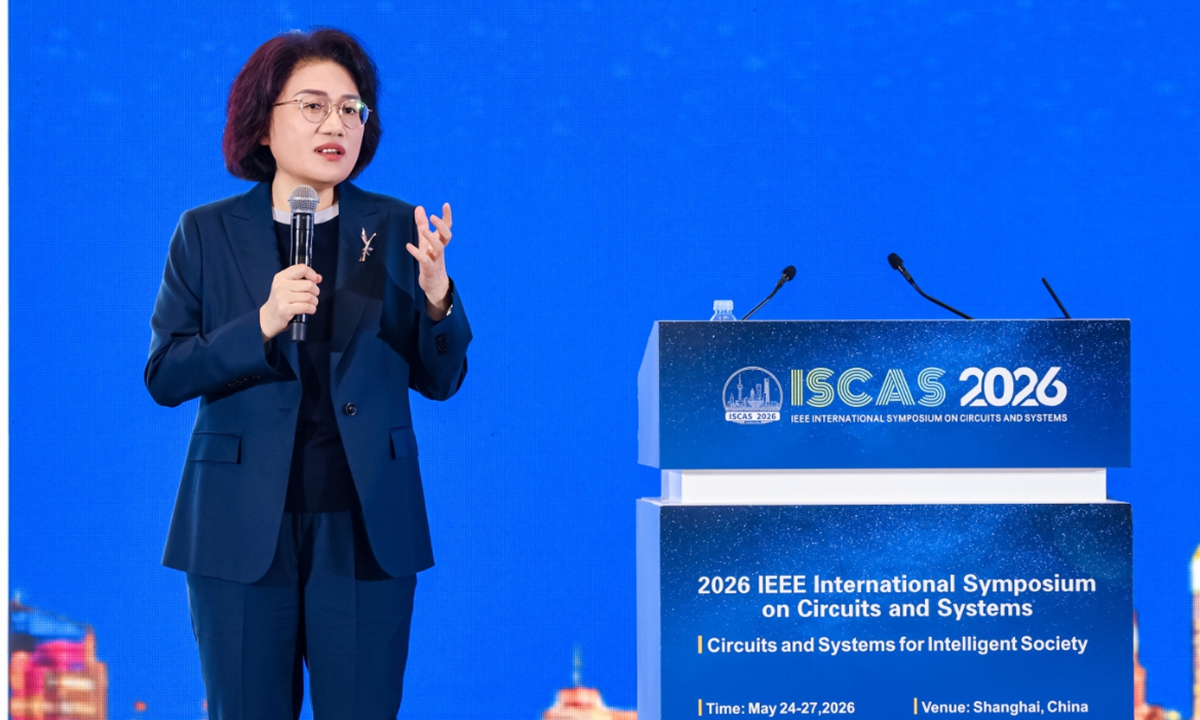
He Tingbo, a Huawei board member and president of the company's semiconductor business department, unveils the Tau (τ) Scaling Law, on March 25, 2026. Photo: People's Daily/Lin Yuan
On May 25, He Tingbo, a Huawei board member and president of the company's semiconductor business department, officially introduced a new evolutionary path for semiconductors - the Tau Scaling Law. It addresses a key question in the post-Moore era: as Moore's Law gradually approaches its limits, what can continue to drive improvements in chip performance?
For over 60 years, the global semiconductor industry has largely developed alongside Moore's Law. Its core logic is to continually shrink transistor sizes, packing more transistors into a unit area, thereby increasing computing power and lowering costs. This path has laid the foundation for the prosperity of the modern information industry. However, as chip manufacturing processes enter sub-7 nm nodes, transistor sizes are approaching atomic scales, and problems such as leakage, heat generation and rising manufacturing costs are becoming increasingly prominent. Relying solely on geometric miniaturization of transistors to advance chips is gradually reaching physical and economic limits.
Against this backdrop, Huawei innovatively proposed the Tau Scaling Law, attempting to replace geometric miniaturization with time scaling. In short, instead of just striving to make transistors smaller, it aims to systematically reduce the time constant τ by continuously compressing signal propagation delays and shortening data transmission times. This enables overall performance leaps without significantly shrinking transistor sizes.
What this reflects is an innovative shift in thinking. In the past, the semiconductor industry's competition was caught in a rat race around Moore's Law. Now, Huawei has stepped out of the conventional mindset and charted a new course. It is believed that future chip development will gradually move away from focusing solely on incremental transistor size reductions toward holistic system optimization.
The Tau Scaling Law is more than just a technical breakthrough; it symbolizes China's path of independent innovation in the face of external pressures. After the US sanctions on Huawei in 2019, He Tingbo, in an internal letter, made a striking remark: "There will be no more building spare tires for 10 years and then replacing tires; the buffer zone has disappeared. Every new product that comes out must be aligned with the 'technological independence' plan." Looking back today, these words carry even greater significance.
It lays bare a plain truth: The Chinese people don't fear threats or intimidation. The more suppression they face, the greater impetus it gives to independent innovation; the tighter the blockades, the stronger systemic resilience they build.
Huawei's recent introduction of the Tau Scaling Law represents a new path forged through sheer determination in the face of immense external pressure. What it embodies is not merely a corporate technological pursuit, but a distinctly Chinese logic of innovation and formidable resilience - seeking vitality amid crises and forging capabilities under pressure.
Where does such resilience stem from? Fundamentally, it lies in China's long-accumulated industrial foundation, engineering capabilities and organizational strengths, as well as the spiritual essence distilled from over 5,000 years of Chinese civilization: Refusing to give in, refusing to be intimidated, relying on oneself, and enduring hardship. Cultural confidence is never an empty phrase; ultimately, it must be reflected in real-world creativity and developmental achievements.
Huawei has grown within the Guangdong-Hong Kong-Macao Greater Bay Area, and the proposal of the Tau Scaling Law serves as the most vivid real-world testament to the region's creativity. Whether in terms of economic strength, industrial chain support, or the vitality of scientific and technological innovation, the Greater Bay Area continues to demonstrate that China's development is not a series of isolated, piecemeal breakthroughs, but rather a systemic leap driven by regional synergy, institutional innovation and industrial upgrading.
Huawei's ability to pioneer new paths and advance cutting‑edge technologies in such an environment further demonstrates that China's innovation is never a solo endeavor, but a concentrated manifestation of the systemic strength of a major nation.
The significance of the Tau Scaling Law may not lie in whether it immediately replaces Moore's Law, but in the clear signal it sends: in the post-Moore era, the rules don't need to be defined solely by the West, and the path forward doesn't need to follow only the old routes.
China's technology sector is proving that true breakthroughs involve not merely catching up or keeping pace, but daring to change lanes, blaze new trails and establish new rules.
Greater suppression fuels greater growth; tighter blockades spur greater innovation. This may well be the most profound insight the Tau Scaling Law offers to the Chinese mainland's technological development. The Taiwan region, which prides itself on its semiconductor industry, ought to grasp the underlying logic and boundless potential of this shift, and earnestly contemplate its own future and destiny.
RELATED ARTICLES